
Online Database of Chemicals from Around the World
| Tianjin Zhongxin Chem-tech Co., Ltd. | China | |||
|---|---|---|---|---|
 | www.tjzxchem.com | |||
 | +86 (22) 6688-0623 | |||
 | +86 (22) 8988-0739 ex 8030 | |||
 | sales@tjzxchem.com | |||
| Chemical manufacturer since 2007 | ||||
| chemBlink Premium supplier since 2009 | ||||
| Classification | Organic raw materials >> Amino compound >> Acyclic monoamines, polyamines and their derivatives and salts |
|---|---|
| Name | Pentamethyldiethylenetriamine |
| Synonyms | 1,1,4,7,7-Pentamethyldiethylenetriamine-; N-[2-(Dimethylamino)ethyl]-N,N',N'-trimethyl-1,2-ethanediamine; Bis(2-dimethylaminoethyl)methylamine; N,N,N',N',N''-Pentamethyldiethylenetriamine; PMDTA |
| Molecular Structure | 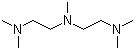 |
| Molecular Formula | C9H23N3 |
| Molecular Weight | 173.30 |
| CAS Registry Number | 3030-47-5 |
| EC Number | 221-201-1 |
| SMILES | CN(C)CCN(C)CCN(C)C |
| Density | 0.83 g/mL |
|---|---|
| Melting point | -20 °C |
| Index of Refraction | 1.442 |
| Boiling point | 198 °C |
| Refractive index | 1.442 |
| Flash point | 77 °C |
| Hazard Symbols |    GHS05;GHS06;GHS07 Danger Details GHS05;GHS06;GHS07 Danger Details | ||||||||||||||||||||||||||||||||||||||||||||||||
|---|---|---|---|---|---|---|---|---|---|---|---|---|---|---|---|---|---|---|---|---|---|---|---|---|---|---|---|---|---|---|---|---|---|---|---|---|---|---|---|---|---|---|---|---|---|---|---|---|---|
| Risk Statements | H302-H311-H314-H318-H331-H412 Details | ||||||||||||||||||||||||||||||||||||||||||||||||
| Safety Statements | P260-P261-P262-P264-P264+P265-P270-P271-P273-P280-P301+P317-P301+P330+P331-P302+P352-P302+P361+P354-P304+P340-P305+P354+P338-P316-P317-P321-P330-P361+P364-P363-P403+P233-P405-P501 Details | ||||||||||||||||||||||||||||||||||||||||||||||||
| Hazard Classification | |||||||||||||||||||||||||||||||||||||||||||||||||
| |||||||||||||||||||||||||||||||||||||||||||||||||
| Transport Information | UN 2734 | ||||||||||||||||||||||||||||||||||||||||||||||||
| SDS | Available | ||||||||||||||||||||||||||||||||||||||||||||||||
 chemBlink Chemical Story
|
Pentamethyldiethylenetriamine, commonly referred to as PMDETA, is an organic compound that has gained prominence in the fields of polymer chemistry and catalysis. This aliphatic amine features a structure characterized by a triethylene backbone with five methyl groups attached to the nitrogen atoms. The unique structure of PMDETA imparts significant reactivity and versatility, making it a valuable component in various chemical processes. The discovery of pentamethyldiethylenetriamine dates back to research focused on developing efficient amine-based catalysts for various reactions. Its synthesis involves the reaction of diethylenetriamine with formaldehyde in the presence of methylating agents. The resulting compound exhibits properties that enhance its performance in numerous applications, particularly in the production of polymers and as a curing agent in epoxy resins. One of the primary applications of PMDETA is in the synthesis of polymeric materials. As a catalyst, it accelerates the curing process of epoxy resins, improving the mechanical properties of the final product. PMDETA facilitates the cross-linking of epoxy and hardener components, resulting in a thermosetting polymer that exhibits high strength, durability, and chemical resistance. This application is critical in industries such as automotive, aerospace, and construction, where materials must withstand harsh conditions. In addition to its role in epoxy resins, pentamethyldiethylenetriamine is employed in the synthesis of polyurethanes. It acts as a catalyst in the reaction between isocyanates and polyols, promoting the formation of polyurethane networks. The use of PMDETA in this context allows for enhanced control over the curing process, leading to the development of materials with tailored properties. This versatility makes it a popular choice in the manufacturing of flexible foams, adhesives, and coatings. Furthermore, PMDETA is recognized for its application in the synthesis of dendritic polymers and nanomaterials. Its branched structure allows for the creation of complex architectures that can enhance the properties of materials, such as increased surface area and improved reactivity. Researchers have explored the use of PMDETA in the development of functionalized nanoparticles and drug delivery systems, showcasing its potential in advanced materials science and biomedical applications. Despite its numerous advantages, the use of pentamethyldiethylenetriamine is accompanied by certain safety considerations. As with many amines, PMDETA can be irritating to the skin and respiratory system, necessitating careful handling during production and application. Manufacturers and researchers are encouraged to adhere to safety protocols to mitigate potential risks associated with exposure. Ongoing research into pentamethyldiethylenetriamine focuses on optimizing its use in various applications while exploring its potential in emerging technologies. Investigations into new formulations and hybrid materials aim to expand the range of applications for PMDETA, particularly in fields such as energy storage, environmental remediation, and biomedicine. The ability to tailor the properties of PMDETA-based materials positions them as valuable components in future advancements in polymer chemistry and materials science. The discovery and application of pentamethyldiethylenetriamine highlight the significance of amine compounds in modern chemistry. Its roles in the production of polymers, nanomaterials, and advanced coatings underscore the impact of PMDETA in driving innovation across multiple industries while emphasizing the importance of safety and environmental considerations. References 2024. Poly(4-vinylbenzyl-g-β-butyrolactone) graft copolymer synthesis and characterization using ring-opening polymerization, free-radical polymerization, and “click” chemistry techniques. Journal of Chemical Sciences, 136(3). DOI: 10.1007/s12039-024-02296-0 2024. One-step synthesis of poly(methyl methacrylate-b-ε-caprolactone) block copolymer by simultaneous ATRP and ROP. Journal of Chemical Sciences, 136(3). DOI: 10.1007/s12039-024-02309-y 2023. Synthesis and characterization of poly(epichlorohydrin-g-4-vinylbenzyl-g-methyl methacrylate) graft copolymer by combination of ROP, RAFT, and ATRP Technics. Journal of Polymer Research, 30(6). DOI: 10.1007/s10965-023-03598-6 |
| Market Analysis Reports |