
Online Database of Chemicals from Around the World
| Beijing Eagle Sky Pharmatech Co., Ltd. | China | |||
|---|---|---|---|---|
 | www.eagleskypharmatech.com | |||
 | +86 (10) 5979-9429 8875-5821 | |||
 | +86 (10) 5804-3698 | |||
 | sophia_818@126.com contact@eagleskypharmatech.com | |||
 | QQ Chat | |||
| Chemical manufacturer since 2009 | ||||
| chemBlink Premium supplier since 2010 | ||||
| Classification | Biochemical >> Inhibitor >> Endocrinology & hormones >> Estrogen/progestogen receptor regulator |
|---|---|
| Name | Slu-PP-332 |
| Synonyms | 4-hydroxy-N-[(E)-naphthalen-2-ylmethylideneamino]benzamide |
| Molecular Structure | 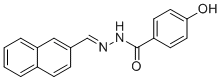 |
| Molecular Formula | C18H14N2O2 |
| Molecular Weight | 290.32 |
| CAS Registry Number | 303760-60-3 |
| SMILES | C1=CC=C2C=C(C=CC2=C1)/C=N/NC(=O)C3=CC=C(C=C3)O |
| Density | 1.2±0.1 g/cm3 Calc.* |
|---|---|
| Index of refraction | 1.63 (Calc.)* |
| * | Calculated using Advanced Chemistry Development (ACD/Labs) Software. |
| Hazard Symbols |  GHS07 Warning Details GHS07 Warning Details |
|---|---|
| Risk Statements | H315-H319 Details |
| Safety Statements | P264-P280-P302+P352-P337+P313-P305+P351+P338-P362+P364-P332+P313 Details |
| SDS | Available |
 chemBlink Chemical Story
|
SLU-PP-332, also known chemically as (E)-4-hydroxy-N′-(naphthalen-2-ylmethylene)benzohydrazide, is a synthetic small molecule that functions as a pan-agonist for estrogen-related receptors ERRα, ERRβ, and ERRγ. With a molecular weight of approximately 290 g/mol, SLU-PP-332 has emerged as a research tool to pharmacologically mimic metabolic effects associated with aerobic exercise. This compound was developed to selectively activate ERR receptors, nuclear regulators that control mitochondrial biogenesis, fatty acid oxidation, and energy homeostasis. SLU-PP-332 binds the ligand-binding domain of ERRα with high potency—EC₅₀ near 100 nM—while retaining activity across all three receptor isoforms. Its E-hydrazone configuration is essential for optimal receptor engagement. Preclinical studies in mice demonstrate that SLU-PP-332 administration recapitulates many exercise-induced adaptations: enhanced energy expenditure, elevated fatty acid oxidation, reduced fat accumulation, and improved endurance—all in the absence of diet or activity changes. In diet-induced obese or genetically obese models, the compound reduced adiposity by approximately 12–20% over a treatment course without suppressing food intake. SLU-PP-332 enhances skeletal muscle oxidative capacity through increased mitochondrial content and a higher proportion of oxidative muscle fibers, resulting in improved stamina and fatigue resistance. Trials in murine heart failure models show improvements in cardiac function, reduced fibrosis, and enhanced survival, suggesting a role in mitigating metabolic cardiomyopathy. In aging kidney models, SLU-PP-332 improves mitochondrial function and dampens inflammation markers such as IL-6 and TNF-α. Mechanistically, SLU-PP-332 stabilizes the ERR receptor in its active form, promoting transcriptional coactivator engagement—most notably PGC-1α. This activation upregulates genes central to mitochondrial transcription factor A (TFAM), components of oxidative phosphorylation, and enzymes such as CPT1 and MCAD involved in fatty acid oxidation. The compound thus reprograms metabolic pathways toward a more oxidative, energy-consuming profile, functioning as an “exercise mimetic” at the molecular level. SLU-PP-332 is synthesized through condensation of 4-hydroxybenzohydrazide with 2-naphthaldehyde, yielding a crystalline hydrazone compound, typically purified to >98% by HPLC. It is supplied as a white-to-off-white solid for research use and is soluble in DMSO or ethanol for in vitro and in vivo studies. Short-term preclinical safety data indicate that SLU-PP-332 is generally well tolerated at effective doses in rodents, with no severe adverse events reported. However, comprehensive toxicology studies, pharmacokinetics, off-target profiling, and long-term safety data remain pending. To date, SLU-PP-332 is not approved for human use and remains strictly a research reagent. In summary, SLU-PP-332 is a potent synthetic agonist of all estrogen-related receptor isoforms that mimics aerobic exercise effects in metabolic tissues. By activating ERR-PGC-1α gene programs, it increases oxidative metabolism, enhances endurance, reduces adiposity, and protects against metabolic dysfunction. Its utility in models of obesity, heart failure, and aging positions it as a promising candidate for future therapeutic exploration in metabolic and mitochondrial disease contexts. References Yang C, Billon C, Burris TP (2023) Synthetic ERRα/β/γ agonist induces an ERRα-dependent acute aerobic exercise response and enhances exercise capacity. ACS Chemical Biology 18(4):756–761 DOI: 10.1021/acschembio.2c00720 Billon C et al. (2024) A synthetic ERR agonist alleviates metabolic syndrome. The Journal of Pharmacology and Experimental Therapeutics 388(2):232–240 DOI: 10.1124/jpet.123.001733 Wang XX et al. (2023) Estrogen-related receptor agonism reverses mitochondrial dysfunction and inflammation in the aging kidney. The American Journal of Pathology 193(12):1969–1987 DOI: 10.1016/j.ajpath.2023.07.008 |
| Market Analysis Reports |