
Online Database of Chemicals from Around the World
| Wuhan Kemi-works Chemical Co., Ltd. | China | |||
|---|---|---|---|---|
 | www.kemiworks.net | |||
 | +86 (27) 8573-6489 | |||
 | +86 (27) 8573-6485 | |||
 | info@kemiworks.net sales@kemiworks.com | |||
| Chemical manufacturer | ||||
| chemBlink Premium supplier since 2011 | ||||
| Classification | Chemical reagent >> Organic reagent >> Siloxane |
|---|---|
| Name | 3-(2-Aminoethylamino)propyl-dimethoxymethylsilane |
| Synonyms | N-[3-(Dimethoxymethylsilyl)propyl]ethylenediamine |
| Molecular Structure | 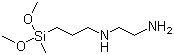 |
| Molecular Formula | C8H22N2O2Si |
| Molecular Weight | 206.36 |
| CAS Registry Number | 3069-29-2 |
| EC Number | 221-336-6 |
| SMILES | CO[Si](C)(CCCNCCN)OC |
| Density | 0.968 g/mL |
|---|---|
| Refractive index | 1.450 |
| Boiling point | 265 °C |
| Flash point | 90 °C |
| Hazard Symbols |   GHS05;GHS07 Danger Details GHS05;GHS07 Danger Details | ||||||||||||||||||||||||||||||||||||||||||||||||||||
|---|---|---|---|---|---|---|---|---|---|---|---|---|---|---|---|---|---|---|---|---|---|---|---|---|---|---|---|---|---|---|---|---|---|---|---|---|---|---|---|---|---|---|---|---|---|---|---|---|---|---|---|---|---|
| Risk Statements | H302-H314-H315-H317-H318 Details | ||||||||||||||||||||||||||||||||||||||||||||||||||||
| Safety Statements | P260-P261-P264-P264+P265-P270-P272-P280-P301+P317-P301+P330+P331-P302+P352-P302+P361+P354-P304+P340-P305+P354+P338-P316-P317-P321-P330-P332+P317-P333+P317-P362+P364-P363-P405-P501 Details | ||||||||||||||||||||||||||||||||||||||||||||||||||||
| Hazard Classification | |||||||||||||||||||||||||||||||||||||||||||||||||||||
| |||||||||||||||||||||||||||||||||||||||||||||||||||||
| SDS | Available | ||||||||||||||||||||||||||||||||||||||||||||||||||||
 chemBlink Chemical Story
|
3-(2-Aminoethylamino)propyl-dimethoxymethylsilane, also known as amino silane, is an organosilicon compound characterized by the presence of amine groups and methoxymethyl substituents attached to a propyl silane backbone. This compound has garnered significant attention in various fields, including materials science, adhesives, and surface modification due to its unique chemical properties. The discovery of 3-(2-aminoethylamino)propyl-dimethoxymethylsilane can be traced back to advancements in organosilicon chemistry during the latter half of the 20th century when researchers sought to develop silanes with enhanced reactivity and functional capabilities. The synthesis of 3-(2-aminoethylamino)propyl-dimethoxymethylsilane typically involves the reaction of 3-chloropropyl-dimethoxymethylsilane with ethylenediamine. This process results in the introduction of amino groups to the silane structure, enhancing its potential for forming strong chemical bonds with various substrates. The resultant compound exhibits excellent compatibility with organic materials, making it particularly useful in applications requiring adhesion and surface modification. One of the primary applications of 3-(2-aminoethylamino)propyl-dimethoxymethylsilane is in the formulation of adhesives and sealants. Its ability to bond with both organic and inorganic materials allows it to be used as a coupling agent, improving the adhesion properties of epoxy resins and polyurethane formulations. This characteristic is particularly valuable in industries such as automotive and construction, where strong, durable bonds are essential for structural integrity. In addition to its role in adhesives, 3-(2-aminoethylamino)propyl-dimethoxymethylsilane is widely used in the field of surface modification. When applied to substrates such as glass, metals, and ceramics, it can enhance surface properties by creating a silane coating that improves hydrophobicity and corrosion resistance. This functionality is crucial in the manufacturing of electronic devices, where moisture and chemical resistance are vital for performance and longevity. Another significant application of this silane compound is in the development of advanced composite materials. By incorporating 3-(2-aminoethylamino)propyl-dimethoxymethylsilane into polymer matrices, manufacturers can enhance the interfacial bonding between the matrix and reinforcing fibers. This improvement leads to increased mechanical strength and durability of the composites, making them suitable for demanding applications in aerospace, automotive, and construction industries. Furthermore, 3-(2-aminoethylamino)propyl-dimethoxymethylsilane has shown potential in the field of biomedical applications. Its biocompatibility and ability to form stable bonds with biological tissues make it an attractive candidate for use in medical devices and tissue engineering. Research has demonstrated that silane-modified surfaces can promote cell adhesion and growth, providing a favorable environment for tissue regeneration and repair. Despite its numerous advantages, the use of 3-(2-aminoethylamino)propyl-dimethoxymethylsilane requires careful handling and consideration of safety regulations. As with many organosilicon compounds, it is essential to adhere to established guidelines to minimize potential health risks associated with exposure. Regulatory agencies assess the safety of chemical substances to ensure that they are utilized responsibly within industrial and research settings. In summary, 3-(2-aminoethylamino)propyl-dimethoxymethylsilane is a multifunctional organosilicon compound with diverse applications in adhesives, surface modification, composite materials, and biomedical fields. Its unique chemical properties enable strong bonding with various substrates, enhancing the performance of materials in demanding environments. As research continues to uncover new applications for this versatile compound, its significance in industrial and biomedical settings is expected to grow. References 2021. Aerogels for Pollution Mitigation. Springer Handbook of Aerogels. DOI: 10.1007/978-3-030-27322-4_55 2022. Comparison of characteristics of the cellulose nanocrystal aerogels aminosilane-functionalized through gas-phase reaction. Journal of Porous Materials, 29(2). DOI: 10.1007/s10934-022-01209-1 2011. Amine-Based Nanofibrillated Cellulose As Adsorbent for CO2 Capture from Air. Environmental Science & Technology, 45(20). DOI: 10.1021/es202223p |
| Market Analysis Reports |