
Online Database of Chemicals from Around the World
| Shijiazhuang Dowell Chemical Co., Ltd. | China | |||
|---|---|---|---|---|
 | www.dowechem.com | |||
 | +86 (311) 8980-5679 +86 13463963265 | |||
 | +86 (311) 8526-2695 | |||
 | sell@dowechem.com | |||
 | QQ Chat | |||
| Chemical manufacturer since 2006 | ||||
| chemBlink Standard supplier since 2007 | ||||
| Novasyn Organics Pvt. Ltd. | India | |||
|---|---|---|---|---|
| www.novasynorganics.com | |||
| +91 (406) 620-2233 633-9111 | |||
| +91 (402) 781-1997 | |||
| info@novasynorganics.com | |||
| Chemical manufacturer | ||||
| chemBlink Standard supplier since 2010 | ||||
| BOC Sciences | USA | |||
|---|---|---|---|---|
| www.bocsci.com | |||
| +1 (631) 485-4226 | |||
| +1 (631) 614-7828 | |||
| info@bocsci.com | |||
| Chemical manufacturer | ||||
| chemBlink Standard supplier since 2010 | ||||
| Hangzhou Leap Chem Co., Ltd. | China | |||
|---|---|---|---|---|
| www.leapchem.com | |||
| +86 (571) 8771-1850 | |||
| market19@leapchem.com | |||
| QQ Chat | |||
| Chemical manufacturer since 2006 | ||||
| chemBlink Standard supplier since 2015 | ||||
| Amadis Chemical Co., Ltd. | China | |||
|---|---|---|---|---|
| www.amadischem.com | |||
| +86 (571) 8992-5085 | |||
| +86 (571) 8992-5065 | |||
| sales@amadischem.com | |||
| Chemical manufacturer since 2010 | ||||
| chemBlink Standard supplier since 2015 | ||||
| Shijiazhuang C-element Biotech Co., Ltd. | China | |||
|---|---|---|---|---|
| www.c-elementbiotech.com | |||
| +86 18033710157 | |||
| Lisa@C-elementBiotech.com | |||
| QQ Chat | |||
 | WeChat: 18033710157 | |||
| Chemical manufacturer since 2025 | ||||
| chemBlink Standard supplier since 2025 | ||||
| Atlantic Research Chemicals Ltd. | UK | |||
|---|---|---|---|---|
| www.atlantic-chemicals.com | |||
| +44 (8707) 746-454 | |||
| +44 (8707) 746-455 | |||
| info@atlantic-chemicals.com | |||
| Chemical manufacturer | ||||
| BoroPharm Inc. | USA | |||
|---|---|---|---|---|
| www.boropharm.com | |||
| +1 (888) 366-1496 | |||
| +1 (248) 348-5760 | |||
| sales@boropharm.com | |||
| Chemical manufacturer | ||||
| Classification | Pharmaceutical intermediate >> Heterocyclic compound intermediate >> Pyridine compound >> Pyridine derivative |
|---|---|
| Name | Methyl 5-hydroxynicotinate |
| Molecular Structure | 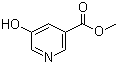 |
| Molecular Formula | C7H7NO3 |
| Molecular Weight | 153.13 |
| CAS Registry Number | 30766-22-4 |
| EC Number | 624-612-8 |
| SMILES | COC(=O)C1=CC(=CN=C1)O |
| Density | ensity1.3±0.1 g/cm3, Calc.* |
|---|---|
| Melting point | 190 °C (Expl.) |
| Index of Refraction | 1.552, Calc.* |
| Boiling Point | 374.2±22.0 °C (760 mmHg), Calc.* |
| Flash Point | 180.1±22.3 °C, Calc.* |
| * | Calculated using Advanced Chemistry Development (ACD/Labs) Software. |
| Hazard Symbols |   GHS05;GHS07 Danger Details GHS05;GHS07 Danger Details | ||||||||||||||||||||||||
|---|---|---|---|---|---|---|---|---|---|---|---|---|---|---|---|---|---|---|---|---|---|---|---|---|---|
| Risk Statements | H315-H318-H335 Details | ||||||||||||||||||||||||
| Safety Statements | P261-P264-P264+P265-P271-P273-P280-P302+P352-P304+P340-P305+P354+P338-P317-P319-P321-P332+P317-P362+P364-P391-P403+P233-P405-P501 Details | ||||||||||||||||||||||||
| Hazard Classification | |||||||||||||||||||||||||
| |||||||||||||||||||||||||
| SDS | Available | ||||||||||||||||||||||||
 chemBlink Chemical Story
|
Methyl 5-hydroxynicotinate is a chemical compound derived from nicotinic acid, a member of the vitamin B3 group. It is an ester formed by the reaction of methanol with 5-hydroxynicotinic acid, a substituted derivative of nicotinic acid. The molecular formula of methyl 5-hydroxynicotinate is C7H7NO3, and it has a structure consisting of a pyridine ring with a hydroxyl group at the 5-position and a methyl ester group at the carboxyl position. The compound is commonly studied for its biological and chemical properties, which are of interest in a variety of scientific fields. The synthesis of methyl 5-hydroxynicotinate typically involves esterification, where 5-hydroxynicotinic acid reacts with methanol in the presence of an acid catalyst. This process is well-established and is used to produce the ester efficiently. The esterification reaction yields a compound that retains the core nicotinic acid structure, but with a methyl group attached to the carboxyl group. Methyl 5-hydroxynicotinate has a number of applications in medicinal chemistry and pharmaceutical research. As a derivative of nicotinic acid, it shares some of the biological activities of its parent compound. Nicotinic acid and its derivatives, including methyl 5-hydroxynicotinate, are involved in the biosynthesis of NAD+ (nicotinamide adenine dinucleotide), a crucial molecule in cellular energy metabolism and redox reactions. NAD+ plays a vital role in a variety of biological processes, including DNA repair, gene expression regulation, and cell signaling. Methyl 5-hydroxynicotinate, therefore, has potential applications in fields such as biochemistry, pharmacology, and aging research. In the field of medicinal chemistry, methyl 5-hydroxynicotinate has been studied for its role in modulating the activity of enzymes involved in the NAD+ biosynthesis pathway. Some research has suggested that such compounds could be beneficial in improving mitochondrial function, which may be relevant in the context of age-related diseases and neurodegenerative disorders, such as Alzheimer’s disease. Additionally, methyl 5-hydroxynicotinate has been explored for its potential anti-inflammatory properties due to its structural similarity to other nicotinate derivatives, which are known to exhibit such effects. Beyond its biological applications, methyl 5-hydroxynicotinate is also used as an intermediate in the synthesis of other chemicals and pharmaceuticals. Its functional ester group makes it a versatile building block in the creation of more complex molecules. This has led to its use in organic synthesis for the production of various nicotinic acid derivatives and other bioactive compounds. These derivatives may have applications in drug discovery and development, particularly for diseases related to metabolism and inflammation. In materials science, derivatives of nicotinic acid, including methyl 5-hydroxynicotinate, have been investigated for their potential use in the synthesis of organic semiconductors. The structure of the compound, with its aromatic pyridine ring, may influence the electronic properties of materials, making it a candidate for use in organic electronic devices such as organic light-emitting diodes (OLEDs) and organic photovoltaic cells. Methyl 5-hydroxynicotinate is also used in laboratory research, particularly in the synthesis of nicotinic acid derivatives and in studying the metabolic pathways involving NAD+ and its precursors. It is commercially available from chemical suppliers and is typically used in research settings, where it serves as a reagent in various synthetic and analytical applications. While methyl 5-hydroxynicotinate has several well-documented applications, it is important to note that its potential biological effects and uses are still being actively researched. The compound’s known properties make it a valuable tool in biochemistry and pharmacology, with ongoing studies aimed at exploring its full range of biological and medicinal activities. Overall, methyl 5-hydroxynicotinate plays a significant role in the study of nicotinic acid derivatives, contributing to the development of new therapeutic strategies and materials. References 2020. Synthetic Approaches to Non-Tropane, Bridged, Azapolycyclic Ring Systems Containing Seven-Membered Carbocycles. Synthesis, 52(24). DOI: 10.1055/s-0040-1707385 2018. Fun with (4+3)-Cycloadditions. Synlett, 30(1). DOI: 10.1055/s-0037-1610327 |
| Market Analysis Reports |