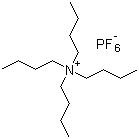
Tetrabutylammonium hexafluorophosphate (NBu₄PF₆) is a quaternary ammonium salt with the molecular formula [(C₄H₉)₄N]PF₆. This compound is known for its versatility in a variety of chemical applications, particularly in electrochemistry and organic synthesis. The exact date of the discovery of tetrabutylammonium hexafluorophosphate is not well documented, but it rose to prominence in the mid-20th century with the rise of the field of electrochemistry. The development and use of quaternary ammonium salts, including NBu₄PF₆, continued to grow as scientists sought stable, nonvolatile electrolytes for a variety of applications.
Tetrabutylammonium hexafluorophosphate is synthesized via a simple ion exchange reaction. The synthesis involves the reaction of tetrabutylammonium bromide (NBu₄Br) with a hexafluorophosphate source such as potassium hexafluorophosphate (KPF₆) to produce NBu₄PF₆, which can be purified by recrystallization or other methods to obtain a high purity product.
The primary application of tetrabutylammonium hexafluorophosphate is electrochemistry. It is used as an electrolyte in non-aqueous solutions due to its excellent solubility in organic solvents and its ability to conduct electricity without unwanted side reactions. This makes it ideal for cyclic voltammetry, electrochemical synthesis, and other electroanalytical techniques.
In organic synthesis, NBu₄PF₆ is used as a phase transfer catalyst and a reagent to promote various reactions. Its stability and solubility in organic media increase reaction rates and selectivity, making it valuable in processes such as nucleophilic substitution and oxidation. It also plays a role in stabilizing reaction intermediates and transition states.
Tetrabutylammonium hexafluorophosphate is a key ingredient in the formation of ionic liquids. These salts are liquid at relatively low temperatures and have unique properties such as low volatility, high thermal stability, and excellent solvency. NBu₄PF₆-based ionic liquids are used in green chemistry and can be used as environmentally friendly solvents and catalysts.
In materials science, NBu₄PF₆ is used in the synthesis and processing of advanced materials. It is involved in the preparation of conductive polymers, nanocomposites, and other functional materials where control of the ionic environment is critical. Its role in improving the properties and performance of these materials plays a key role for applications in electronics, sensors, and energy storage devices.
NBu₄PF₆ is widely used as a supporting electrolyte in various analytical techniques. Its presence in electrolyte solutions helps maintain ionic strength and stability, which is essential for accurate and reproducible measurements in techniques such as high performance liquid chromatography (HPLC) and capillary electrophoresis (CE).
References
2010. Benzoyl radicals from (hetero)aromatic aldehydes. Decatungstate photocatalyzed synthesis of substituted aromatic ketones. Organic & Biomolecular Chemistry, 8(20).
DOI: 10.1039/c0ob00066c
2013. Electrochemically assisted fabrication of size-exclusion films of organically modified silica and application to the voltammetry of phospholipids. Journal of Solid State Electrochemistry, 17(7).
DOI: 10.1007/s10008-013-2077-4
2020. Dissolution and deacetylation of chitin in ionic liquid tetrabutylammonium hydroxide and its cascade reaction in enzyme treatment for chitin recycling. Carbohydrate Polymers, 230.
DOI: 10.1016/j.carbpol.2019.115605
|




 GHS07 Warning Details
 chemBlink Chemical Story