
Online Database of Chemicals from Around the World
| Shanghai Scunder Industrial Co., Ltd. | China | |||
|---|---|---|---|---|
 | www.scunder.cn | |||
 | +86 (21) 5108-3588 | |||
 | +86 (21) 5812-2702 | |||
 | sales@scunder.cn scunder@126.com | |||
 | QQ Chat | |||
| Chemical manufacturer since 2005 | ||||
| chemBlink Standard supplier since 2007 | ||||
| Simagchem Corporation | China | |||
|---|---|---|---|---|
| www.simagchem.com | |||
| +86 13806087780 | |||
| +86 (592) 268-0237 | |||
| sale@simagchem.com | |||
| Chemical manufacturer since 2002 | ||||
| chemBlink Standard supplier since 2008 | ||||
| Shinya Chem Co., Ltd. | China | |||
|---|---|---|---|---|
| www.shinya-chem.cn | |||
| +86 (316) 222-6055 | |||
| +86 (316) 222-3178 | |||
| shinya@shinya-chem.cn limanltw@hotmail.com | |||
| Chemical manufacturer | ||||
| chemBlink Standard supplier since 2008 | ||||
| BOC Sciences | USA | |||
|---|---|---|---|---|
| www.bocsci.com | |||
| +1 (631) 485-4226 | |||
| +1 (631) 614-7828 | |||
| info@bocsci.com | |||
| Chemical manufacturer | ||||
| chemBlink Standard supplier since 2010 | ||||
| Langfang GreatAp Chemicals Co., Ltd. | China | |||
|---|---|---|---|---|
| www.grechembld.com | |||
| +86 (316) 209-8955 +86 18630626679 | |||
| +86 (316) 209-8956 | |||
| sales@grechembld.com | |||
| QQ Chat | |||
| Chemical manufacturer since 2001 | ||||
| chemBlink Standard supplier since 2012 | ||||
| Hangzhou Leap Chem Co., Ltd. | China | |||
|---|---|---|---|---|
| www.leapchem.com | |||
| +86 (571) 8771-1850 | |||
| market19@leapchem.com | |||
| QQ Chat | |||
| Chemical manufacturer since 2006 | ||||
| chemBlink Standard supplier since 2015 | ||||
| RIA International LLC | USA | |||
|---|---|---|---|---|
| www.riausa.net | |||
| +1 (973) 581-1282 | |||
| +1 (973) 581-1283 | |||
| marketing@riausa.net ria@riausa.net | |||
| Chemical distributor since 1986 | ||||
| chemBlink Standard supplier since 2016 | ||||
| Xipeng Technology(luoyang) Co., Ltd. | China | |||
|---|---|---|---|---|
| www.lyxipeng.com | |||
| +86 (379) 6599-2018 | |||
| cindycaily@126.com | |||
| Chemical manufacturer since 2019 | ||||
| chemBlink Standard supplier since 2021 | ||||
| Saian Chemical (shanghai) Co., Ltd. | China | |||
|---|---|---|---|---|
| www.saianchem.com | |||
| +86 18633110822 | |||
| teresa.liu@saianchem.com | |||
| QQ Chat | |||
 | WeChat: 18633110822 | |||
| Chemical distributor since 2018 | ||||
| chemBlink Standard supplier since 2025 | ||||
| MAX (Rudong) Chemicals Co., Ltd. | China | |||
|---|---|---|---|---|
| www.maxchemicals.com | |||
| +86 (513) 8481-4078 | |||
| +86 (513) 8481-6218 | |||
| maxunitech@maxunitech.com | |||
| Chemical manufacturer since 2000 | ||||
| Classification | Catalysts and additives >> Polymer |
|---|---|
| Name | Polixetonium chloride |
| Synonyms | Poly[oxyethylene(dimethyliminio)ethylene(dimethylimino)ethylene dichloride]; Polyquaternium 42 |
| Molecular Structure | 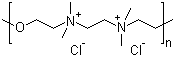 |
| Molecular Formula | (C10H24Cl2N2O)n |
| CAS Registry Number | 31512-74-0 |
| EC Number | 608-627-7 |
| SMILES | CCC[N+](C)(C)CC[N+](C)(C)CCO.[Cl-].[Cl-] |
| Hazard Symbols |  GHS07 Warning Details GHS07 Warning Details | ||||||||||||||||||||||||||||||||
|---|---|---|---|---|---|---|---|---|---|---|---|---|---|---|---|---|---|---|---|---|---|---|---|---|---|---|---|---|---|---|---|---|---|
| Risk Statements | H302-H315-H319-H335 Details | ||||||||||||||||||||||||||||||||
| Safety Statements | P280-P305+P351+P338 Details | ||||||||||||||||||||||||||||||||
| Hazard Classification | |||||||||||||||||||||||||||||||||
| |||||||||||||||||||||||||||||||||
| SDS | Available | ||||||||||||||||||||||||||||||||
 chemBlink Chemical Story
|
Polixetonium chloride is a polymeric quaternary ammonium compound developed for use primarily as an antiseptic and antimicrobial agent. Its discovery is associated with research into synthetic polymer-based disinfectants that expanded rapidly in the mid to late 20th century. Scientists sought to create materials that combined the stability and versatility of synthetic polymers with the potent antimicrobial properties characteristic of quaternary ammonium salts. Polixetonium chloride was one such development, designed to exhibit high cationic activity, strong binding to microbial membranes, and low toxicity to human tissues when appropriately formulated. The structure of polixetonium chloride includes a polymer backbone bearing multiple quaternary ammonium groups, giving the molecule a strong positive charge density. This property allows it to interact efficiently with the negatively charged surfaces of bacterial and fungal cells, leading to membrane disruption, leakage of cellular contents, and subsequent cell death. The antimicrobial action is largely non-specific, enabling activity against a broad range of Gram-positive and Gram-negative bacteria, as well as some fungi and viruses. Polixetonium chloride has found application mainly in the field of oral healthcare. It is a key ingredient in several types of mouthwashes, oral sprays, and dental gels, where it helps to control bacterial populations in the oral cavity, reduce plaque formation, and prevent gingivitis. It has also been incorporated into formulations intended for the treatment of oral mucosal infections and for preoperative oral antisepsis. The compound’s cationic nature enables strong adherence to oral mucosal surfaces and dental materials, prolonging its antimicrobial effects even after the removal of excess product. Beyond oral healthcare, polixetonium chloride has been studied and employed in skin antiseptics and wound-care formulations. Its polymeric form offers advantages over monomeric quaternary ammonium compounds, including reduced potential for systemic absorption and longer-lasting surface activity. It has been incorporated into creams and gels used for disinfection of superficial wounds, burns, and ulcers. The physicochemical properties of polixetonium chloride, such as its solubility in water and certain alcohols, thermal stability, and resistance to degradation, make it a suitable candidate for incorporation into a variety of aqueous and semi-solid formulations. In solution, it generally appears as a clear, colorless to pale yellow liquid, with the polymer content and molecular weight being key parameters influencing its antimicrobial efficacy and formulation behavior. Toxicological evaluations have shown that polixetonium chloride has low dermal and mucosal toxicity when used at recommended concentrations. However, like other quaternary ammonium compounds, it can cause irritation or allergic reactions in sensitive individuals, particularly with prolonged or repeated exposure. Therefore, its concentrations in consumer products are carefully controlled to balance efficacy and safety. Regulatory approvals for polixetonium chloride vary by country and intended use. In some regions, it is approved for use in over-the-counter oral hygiene products, whereas in others, its applications may be more limited to prescription-based formulations or hospital-grade antiseptics. Clinical studies have demonstrated its effectiveness in reducing oral microbial load and preventing postoperative infections following dental procedures. Research continues into optimizing formulations containing polixetonium chloride to enhance its delivery, prolong its activity, and minimize any potential side effects. Combinations with other antimicrobial agents or excipients are explored to create synergistic effects and improve patient compliance. The development of polixetonium chloride reflects a broader trend in pharmaceutical and material science research focusing on multifunctional polymers that provide targeted biological activity while maintaining favorable biocompatibility profiles. Its successful application in oral and dermal care underscores the importance of polymeric quaternary ammonium compounds in modern antimicrobial strategies. References 1998. Production of Respirable Vesicles Containing Live Legionella pneumophila Cells by Two Acanthamoeba spp. Applied and Environmental Microbiology, 64(1). DOI: 10.1128/aem.64.1.279-286.1998 2015. Biocides and Disinfectants: Challenges in Their Use and Regulation. Journal of Hospital Infection, 90(1). DOI: 10.1016/j.jhin.2015.01.009 2020. Antimicrobial Activity of Quaternary Ammonium Compounds. Microbial Drug Resistance, 26(3). DOI: 10.1089/mdr.2019.0298 |
| Market Analysis Reports |