
Online Database of Chemicals from Around the World
| Shanghai Zhongye Pharmaceutial & Chemical Co., Ltd. | China | |||
|---|---|---|---|---|
 | www.tzzy.com | |||
 | +86 (21) 6203-8888 62033-753 6204-1853 | |||
 | +86 (21) 6203-7888 | |||
 | info@tzzy.com | |||
| Chemical manufacturer since 2001 | ||||
| chemBlink Standard supplier since 2006 | ||||
| Jiangxi Yuyang Chemical Co., Ltd. | China | |||
|---|---|---|---|---|
| www.yuyangchem.com | |||
| +86 (792) 683-1839 | |||
| +86 (792) 683-2935 | |||
| gxp.999888@163.com | |||
| Chemical manufacturer | ||||
| chemBlink Standard supplier since 2007 | ||||
| Simagchem Corporation | China | |||
|---|---|---|---|---|
| www.simagchem.com | |||
| +86 13806087780 | |||
| +86 (592) 268-0237 | |||
| sale@simagchem.com | |||
| Chemical manufacturer since 2002 | ||||
| chemBlink Standard supplier since 2008 | ||||
| Hefei TNJ Chemical Industry Co., Ltd. | China | |||
|---|---|---|---|---|
| www.tnjchem.com | |||
| +86 (551) 6541-8684 | |||
| +86 (551) 6541-8697 | |||
| sales@tnjchem.com | |||
| Chemical manufacturer since 2001 | ||||
| chemBlink Standard supplier since 2010 | ||||
| BOC Sciences | USA | |||
|---|---|---|---|---|
| www.bocsci.com | |||
| +1 (631) 485-4226 | |||
| +1 (631) 614-7828 | |||
| info@bocsci.com | |||
| Chemical manufacturer | ||||
| chemBlink Standard supplier since 2010 | ||||
| Zhejiang Ideal Biotech Co., Ltd. | China | |||
|---|---|---|---|---|
| www.idealbiotech.com | |||
| +86 (570) 433-6358 +86 13967002930 | |||
| +86 (570) 433-6633 | |||
| sales@idealbiotech.com | |||
| Chemical manufacturer since 2007 | ||||
| chemBlink Standard supplier since 2014 | ||||
| Dongfan Chem (Shanghai) Co., Ltd. | China | |||
|---|---|---|---|---|
| www.dfanchem.com | |||
| +86 (21) 3450-0607 +86 13391355195 | |||
| +86 (21) 3332-1290 | |||
| sales@dfanchem.com | |||
 | QQ Chat | |||
| Chemical manufacturer since 2007 | ||||
| chemBlink Standard supplier since 2014 | ||||
| Shanghai Yingrui Biopharm Co., Ltd. | China | |||
|---|---|---|---|---|
| www.shyrchem.com | |||
| +86 (21) 3358-5366 3466-6753 +86 13311639313 | |||
| +86 (21) 3497-9012 | |||
| sales02@shyrchem.com | |||
| QQ Chat | |||
 | Skype Chat | |||
| Chemical manufacturer since 2009 | ||||
| chemBlink Standard supplier since 2017 | ||||
| Qingdao Wanyuan Mountain Biontech Co., Ltd. | China | |||
|---|---|---|---|---|
| www.bionutrichem.com | |||
| +86 15092119928 | |||
| cuiningning@bionutrichem.com | |||
| QQ Chat | |||
| Chemical distributor since 2018 | ||||
| chemBlink Standard supplier since 2022 | ||||
| Guangzhou Amsper Biotechnology Ltd. | China | |||
|---|---|---|---|---|
| www.amsper.com | |||
| +8618565278009 | |||
| gifty@amsper.com | |||
| QQ Chat | |||
| Skype Chat | |||
 | WeChat: +8618565278009 | |||
 | WhatsApp:+8618565278009 | |||
| Chemical distributor since 2018 | ||||
| chemBlink Standard supplier since 2025 | ||||
| Zley Holdings (Suzhou) Co., Ltd. | China | |||
|---|---|---|---|---|
| www.zleygroup.com | |||
| +86 (0512) 8777-5990 +86 18626205929 | |||
| +86 (0512) 8777-5990 | |||
| huangzhenzhou@zleygroup.com | |||
| WhatsApp:+852-9061-4262 | |||
| Chemical manufacturer since 2019 | ||||
| chemBlink Standard supplier since 2026 | ||||
| Chiron AS | Norway | |||
|---|---|---|---|---|
| www.chiron.no | |||
| +47 (73) 874-490 | |||
| +47 (73) 874-499 | |||
| chiron@chiron.no | |||
| Chemical manufacturer | ||||
| Frontier Scientific Services, Inc. | USA | |||
|---|---|---|---|---|
| www.frontierssi.com | |||
| +1 (302) 266-6891 (888) 577-2734 | |||
| +1 (302) 266-8296 | |||
| customerservice@frontierssi.com | |||
| Chemical manufacturer | ||||
| Classification | Organic raw materials >> Alcohols, phenols, phenolic compounds and derivatives |
|---|---|
| Name | o-Cymen-5-ol |
| Synonyms | 4-Isopropyl-m-cresol |
| Molecular Structure | 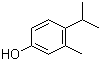 |
| Molecular Formula | C10H14O |
| Molecular Weight | 150.22 |
| CAS Registry Number | 3228-02-2 |
| EC Number | 221-761-7 |
| SMILES | CC1=C(C=CC(=C1)O)C(C)C |
| Density | 1.0±0.1 g/cm3 Calc.* |
|---|---|
| Melting point | 111 - 114 °C (Expl.) |
| Boiling point | 233.8±9.0 °C 760 mmHg (Calc.)* |
| Flash point | 104.1±7.2 °C (Calc.)* |
| Index of refraction | 1.523 (Calc.)* |
| * | Calculated using Advanced Chemistry Development (ACD/Labs) Software. |
| Hazard Symbols |   GHS05;GHS07 Danger Details GHS05;GHS07 Danger Details | ||||||||||||||||||||||||||||||||
|---|---|---|---|---|---|---|---|---|---|---|---|---|---|---|---|---|---|---|---|---|---|---|---|---|---|---|---|---|---|---|---|---|---|
| Risk Statements | H315-H318-H319-H335 Details | ||||||||||||||||||||||||||||||||
| Safety Statements | P261-P264-P264+P265-P271-P280-P302+P352-P304+P340-P305+P351+P338-P305+P354+P338-P317-P319-P321-P332+P317-P337+P317-P362+P364-P403+P233-P405-P501 Details | ||||||||||||||||||||||||||||||||
| Hazard Classification | |||||||||||||||||||||||||||||||||
| |||||||||||||||||||||||||||||||||
| SDS | Available | ||||||||||||||||||||||||||||||||
 chemBlink Chemical Story
|
o-Cymen-5-ol is a naturally occurring aromatic alcohol that belongs to the class of monoterpenoid phenols. It is derived from essential oils of plants such as thyme (Thymus spp.) and cymbopogon species, and its chemical structure features a hydroxyl group attached to a substituted aromatic ring with an isopropyl and methyl group in the ortho position. The compound was first identified through the chemical analysis of plant essential oils, a field that gained significant momentum in the late nineteenth and early twentieth centuries as analytical techniques such as distillation, crystallization, and later chromatographic methods were developed. These analyses revealed the presence of numerous bioactive constituents, including o-Cymen-5-ol, which was distinguished by its unique aromatic profile and hydroxyl functionality. The biological and chemical properties of o-Cymen-5-ol have been widely studied due to its antimicrobial and antioxidant activities. The phenolic hydroxyl group contributes to its reactivity against microbial cell membranes and enzymes, making it effective against a broad spectrum of bacteria and fungi. Its activity is closely linked to its lipophilic aromatic ring, which allows it to penetrate lipid membranes, disrupting cellular integrity. Early studies focused on essential oil fractions and demonstrated that o-Cymen-5-ol was a significant contributor to the antimicrobial potency of oils used in traditional herbal medicine. This foundational knowledge prompted further isolation and purification efforts to study the compound individually. Applications of o-Cymen-5-ol span both industrial and consumer products. In the food industry, it is used as a natural preservative and flavoring agent due to its antimicrobial and aromatic properties. Its ability to inhibit bacterial growth extends the shelf life of perishable goods while providing a characteristic flavor. In personal care and cosmetic products, o-Cymen-5-ol is incorporated into formulations such as shampoos, soaps, and topical creams, where it acts as a preservative and provides additional antimicrobial protection. Its incorporation in these products benefits from its dual function as a preservative and a fragrance component, enhancing product stability and sensory appeal. In pharmaceutical research, o-Cymen-5-ol has been evaluated for its potential in topical antiseptics, disinfectants, and dermatological formulations. Its efficacy against common pathogenic bacteria and fungi has been demonstrated in vitro, and it is often considered as a safer alternative to synthetic antimicrobial agents. Additionally, its antioxidant properties have been explored in studies related to oxidative stress mitigation and the stabilization of formulations susceptible to lipid oxidation. The synthesis of o-Cymen-5-ol can be achieved both by extraction from natural sources and by chemical synthesis, allowing for consistent purity and supply for industrial use. Chemical synthesis typically involves the selective hydroxylation of the aromatic ring of o-cymene or related precursors, providing a scalable route for commercial production. This synthetic approach has complemented natural extraction, ensuring the availability of o-Cymen-5-ol for research, food preservation, and cosmetic applications. Overall, the discovery and development of o-Cymen-5-ol illustrate the connection between natural product chemistry and practical applications. From its initial identification in plant essential oils to its current use in food, cosmetic, and pharmaceutical products, o-Cymen-5-ol serves as an example of how naturally derived phenolic compounds can provide functional benefits in multiple industries. References 2024. Evaluation of a new mouthwash formulated with Chlorhexidine and Cymenol after a scaling and root planing treatment in grade I and II periodontal patients. Medicina Oral, Patología Oral y Cirugía Bucal, 29(6). DOI: 10.4317/medoral.26818 2022. Substantivity of mouth-rinse formulations containing cetylpyridinium chloride and O-cymen-5-ol: a randomized-crossover trial. BMC Oral Health, 22(1). DOI: 10.1186/s12903-022-02688-z 2011. A randomised clinical trial to assess maintenance of gingival health by a novel dentifrice containing 0.1%w/w o-cymen-5-ol and 0.6%w/w zinc chloride. International Dental Journal, 61(Suppl 3). DOI: 10.1111/j.1875-595x.2011.00044.x |
| Market Analysis Reports |