
Online Database of Chemicals from Around the World
| Natural Micron Pharm Tech Co., Ltd. | China | |||
|---|---|---|---|---|
 | nmpharmtech.com | |||
 | +86 (0538) 535-2278 | |||
 | info@nmpharmtech.com | |||
| Chemical manufacturer since 2012 | ||||
| chemBlink Standard supplier since 2025 | ||||
| Classification | Biochemical >> Nucleoside drugs >> Nucleoside intermediate |
|---|---|
| Name | N4-Hydroxycytidine |
| Synonyms | 1-[(2R,3R,4S,5R)-3,4-dihydroxy-5-(hydroxymethyl)oxolan-2-yl]-4-(hydroxyamino)pyrimidin-2-one |
| Molecular Structure | 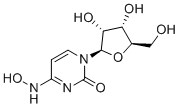 |
| Molecular Formula | C9H13N3O6 |
| Molecular Weight | 259.22 |
| Protein Sequence | N |
| CAS Registry Number | 3258-02-4 |
| EC Number | 868-922-3 |
| SMILES | C1=CN(C(=O)N=C1NO)[C@H]2[C@@H]([C@@H]([C@H](O2)CO)O)O |
| Density | 1.9±0.1 g/cm3 Calc.* |
|---|---|
| Boiling point | 576.1±60.0 °C 760 mmHg (Calc.)* |
| Flash point | 302.2±32.9 °C (Calc.)* |
| Index of refraction | 1.753 (Calc.)* |
| * | Calculated using Advanced Chemistry Development (ACD/Labs) Software. |
| Hazard Symbols |  GHS07 Warning Details GHS07 Warning Details | ||||||||||||||||||||
|---|---|---|---|---|---|---|---|---|---|---|---|---|---|---|---|---|---|---|---|---|---|
| Risk Statements | H302-H315-H319-H335 Details | ||||||||||||||||||||
| Safety Statements | P261-P264-P264+P265-P270-P271-P280-P301+P317-P302+P352-P304+P340-P305+P351+P338-P319-P321-P330-P332+P317-P337+P317-P362+P364-P403+P233-P405-P501 Details | ||||||||||||||||||||
| Hazard Classification | |||||||||||||||||||||
| |||||||||||||||||||||
| SDS | Available | ||||||||||||||||||||
 chemBlink Chemical Story
|
N4-Hydroxycytidine is a nucleoside analog derived from cytidine, in which a hydroxyl group is substituted at the N4 position of the cytosine base. This chemical modification alters the hydrogen-bonding pattern of the base while maintaining its ability to be incorporated into RNA by polymerases. N4-Hydroxycytidine is of particular interest for its antiviral properties, as incorporation into viral RNA can induce mutations during replication, leading to error catastrophe in RNA viruses. The discovery of N4-Hydroxycytidine stems from research into nucleoside analogs designed to interfere with viral replication. Scientists investigated cytidine derivatives that could be recognized by viral polymerases yet introduce errors into the RNA genome. N4-Hydroxycytidine was identified as a potent mutagenic agent for RNA viruses, displaying broad-spectrum antiviral activity while maintaining limited cytotoxicity toward host cells. Its development exemplifies a rational approach to antiviral drug design, using chemical modification to exploit differences between viral and host polymerases. Chemically, N4-Hydroxycytidine consists of a ribose sugar linked to a cytosine base bearing a hydroxyl group at the exocyclic N4 amine. The ribose is in the β-D configuration, as in natural nucleosides, allowing recognition by polymerases and incorporation into nucleic acids. The N4 hydroxyl substitution modifies base pairing properties, which results in increased error rates during RNA synthesis. This structural feature is crucial for its mechanism of action as a viral mutagen. Applications of N4-Hydroxycytidine are primarily in antiviral research and drug development. It has been studied extensively as the active metabolite of the prodrug molnupiravir, which is used to treat infections caused by RNA viruses, including coronaviruses. In cells, N4-Hydroxycytidine is phosphorylated to its triphosphate form and incorporated into viral RNA, promoting mutagenesis and inhibiting viral replication. Its ability to induce lethal mutagenesis is particularly valuable against rapidly mutating RNA viruses, providing a mechanism that reduces the likelihood of resistance development. In addition to therapeutic applications, N4-Hydroxycytidine is employed in biochemical and molecular biology research. It serves as a tool to study RNA polymerase fidelity, viral replication dynamics, and the molecular mechanisms of nucleoside analog-induced mutagenesis. Its incorporation into RNA can be analyzed using sequencing techniques to quantify mutation rates and assess the effects on viral genomes. Structurally, the compound is stable under standard laboratory conditions, although care is taken to prevent hydrolysis or degradation under extreme pH or temperature. Its chemical properties allow formulation into prodrugs and delivery systems suitable for in vivo studies and clinical applications. The development of N4-Hydroxycytidine and its derivatives highlights the intersection of chemical modification, enzymology, and antiviral pharmacology. Overall, N4-Hydroxycytidine is a chemically modified nucleoside that functions as a potent mutagen for RNA viruses. Its incorporation into RNA and the resulting induction of replication errors underpin its broad-spectrum antiviral activity. The compound exemplifies how targeted chemical modifications of nucleosides can be leveraged for therapeutic and research purposes, providing valuable tools for studying viral replication and developing effective antiviral strategies. References 2025. On degree-dependent topological study of line graph of some antiviral COVID-19 drugs. The European Physical Journal E. DOI: 10.1140/epje/s10189-025-00503-5 2025. In Vitro Synergistic Antiviral Effects of β‐D‐N4‐hydroxycytidine and Teriflunomide in Combination against a Broad Range of RNA Viruses. Journal of Medical Virology. DOI: 10.1002/jmv.70488 |
| Market Analysis Reports |