
Online Database of Chemicals from Around the World
| Sino Chemtech (Shanghai) Co., Ltd. | China | |||
|---|---|---|---|---|
 | www.shsinochem.com | |||
 | +86 (21) 5479-5335 +86 13917677577 | |||
 | +86 (21) 5479-5339 | |||
 | sales@shsinochem.com | |||
 | QQ Chat | |||
 | Skype Chat | |||
| Chemical manufacturer since 2007 | ||||
| chemBlink Standard supplier since 2007 | ||||
| Simagchem Corporation | China | |||
|---|---|---|---|---|
| www.simagchem.com | |||
| +86 13806087780 | |||
| +86 (592) 268-0237 | |||
| sale@simagchem.com | |||
| Chemical manufacturer since 2002 | ||||
| chemBlink Standard supplier since 2008 | ||||
| Psyche Chemicals Co., Limited | China | |||
|---|---|---|---|---|
| www.psychem.com | |||
| +86 (21) 3218-0356 | |||
| +86 (21) 3218-0836 | |||
| cherry@psychem.com | |||
| Chemical manufacturer | ||||
| chemBlink Standard supplier since 2008 | ||||
| Weihai Hanfu Biochemical Medicine Co., Ltd. | China | |||
|---|---|---|---|---|
| www.hanfubio.net | |||
| +86 (21) 3255-2395 | |||
| +86 (21) 3255-2397 | |||
| trade1@hanfubio.net | |||
| Chemical manufacturer | ||||
| chemBlink Standard supplier since 2010 | ||||
| Hefei TNJ Chemical Industry Co., Ltd. | China | |||
|---|---|---|---|---|
| www.tnjchem.com | |||
| +86 (551) 6541-8684 | |||
| +86 (551) 6541-8697 | |||
| sales@tnjchem.com | |||
| Chemical manufacturer since 2001 | ||||
| chemBlink Standard supplier since 2010 | ||||
| Shanghai Zhongsi Industry Co., Ltd. | China | |||
|---|---|---|---|---|
| www.shzhongsi.com | |||
| +86 (21) 5180-6036 | |||
| +86 (21) 5180-6035 | |||
| polymer2000@126.com | |||
| Chemical distributor | ||||
| chemBlink Standard supplier since 2011 | ||||
| Zhangjiagang Clent Chemical Co., Ltd. | China | |||
|---|---|---|---|---|
| www.clentchem.com | |||
| +86 (512) 5881-3106 +86 13962460297 | |||
| +86 (512) 5881-2106 | |||
| sales@clentchem.com | |||
| QQ Chat | |||
| Chemical manufacturer | ||||
| chemBlink Standard supplier since 2012 | ||||
| Wuxi Honor Shine Chemical Co., Ltd. | China | |||
|---|---|---|---|---|
| www.honorshinechem.com | |||
| +86 (510) 8359-3736 | |||
| +86 (510) 8357-4932 | |||
| sales@honorshinechem.com | |||
| Chemical distributor since 2013 | ||||
| chemBlink Standard supplier since 2014 | ||||
| Ecosfarm(Guangzhou) Bio-technologies Co., Ltd. | China | |||
|---|---|---|---|---|
| www.ecosfarm.com | |||
| +86 (20) 8398-2853 | |||
| +86 (20) 8398-2837 | |||
| millyhuang@ecosfarm.com | |||
| Chemical manufacturer since 2003 | ||||
| chemBlink Standard supplier since 2015 | ||||
| Kylin Chemicals Co., Ltd. | China | |||
|---|---|---|---|---|
| www.kylinchemicals.com | |||
| +86 (519) 6878-1297 +86 15995066920 | |||
| +86 (519) 8158-3863 | |||
| info@kylinchemicals.com | |||
| QQ Chat | |||
| Chemical distributor since 2015 | ||||
| chemBlink Standard supplier since 2015 | ||||
| Hangzhou Leap Chem Co., Ltd. | China | |||
|---|---|---|---|---|
| www.leapchem.com | |||
| +86 (571) 8771-1850 | |||
| market19@leapchem.com | |||
| QQ Chat | |||
| Chemical manufacturer since 2006 | ||||
| chemBlink Standard supplier since 2015 | ||||
| Alchemie Shanghai Co., Ltd. | China | |||
|---|---|---|---|---|
| www.alcshanghai.com | |||
| +86 (021) 5072-0087 | |||
| assistant2@alchemie-shanghai.com | |||
| Chemical distributor since 2018 | ||||
| chemBlink Standard supplier since 2025 | ||||
| Hangzhou Dayoo Co., Ltd. | China | |||
|---|---|---|---|---|
| www.dayoochem.com | |||
| +86 (571) 8583-3303 | |||
| +86 (571) 8586-5553 | |||
| dayoochem@163.com | |||
| Chemical manufacturer | ||||
| AccuStandard Inc. | USA | |||
|---|---|---|---|---|
| www.accustandard.com | |||
| +1 (203) 786-5290 | |||
| +1 (203) 786-5287 | |||
| orders@accustandard.com | |||
| Chemical manufacturer since 1986 | ||||
| Jiangsu Kuaida Agrochemical Co., Ltd. | China | |||
|---|---|---|---|---|
| www.kuaida-agrochem.com | |||
| +86 (513) 8441-5648 8441-5599 8441-5638 | |||
| +86 (513) 8454-2863 / 8454-8320 | |||
| sales@kuaida.cn | |||
| Chemical manufacturer | ||||
| Changzhou Eastchem International Co., Ltd. | China | |||
|---|---|---|---|---|
| www.eastchem.net | |||
| +86 (519) 8519-0355 8519-0377 | |||
| +86 (519) 8519-0399 | |||
| info@eastchem.net | |||
| Chemical manufacturer since 2005 | ||||
| Jingma Chemicals Ltd. | China | |||
|---|---|---|---|---|
| www.jmcchem.com | |||
| +86 (571) 8724-8111 | |||
| +86 (571) 8724-8222 | |||
| jmcchem@jmcchem.com | |||
| Chemical manufacturer since 1995 | ||||
| Tide Group Co., Ltd. | China | |||
|---|---|---|---|---|
| www.tide-china.com | |||
| +86 (571) 8527-0003 8993-7766 8993-7788 | |||
| +86 (571) 8527-0005 / 8993-7770 | |||
| info@tide-china.com | |||
| Chemical distributor since 2003 | ||||
| Whyte Chemicals | UK | |||
|---|---|---|---|---|
| www.whytechemicals.co.uk | |||
| +44 (20) 8346-5946 | |||
| +44 (20) 8349-4589 | |||
| sales@whytechemicals.co.uk | |||
| Chemical distributor | ||||
| Shandong Weifang Rainbow Chemical Co., Ltd. | China | |||
|---|---|---|---|---|
| www.rainbowchem.com | |||
| +86 (531) 8887-5221 8887-5230 8887-5227 | |||
| +86 (531) 8887-5224 / 8887-5232 | |||
| rainbowchem@rainbowchem.com | |||
| Chemical manufacturer since 2005 | ||||
| Bailing Agrochemical Group | China | |||
|---|---|---|---|---|
| www.bailingcn.com | |||
| +86 (510) 8682-4607 | |||
| +86 (510) 8682-3825 | |||
| info@bailingcn.com | |||
| Chemical manufacturer since 1989 | ||||
| Crescent Chemical Co. Inc. | USA | |||
|---|---|---|---|---|
| www.crescentchemical.com | |||
| +1 (631) 348-0333 | |||
| +1 (631) 348-0913 | |||
| crescent@creschem.com | |||
| Chemical distributor | ||||
| Classification | Chemical pesticide >> Herbicide >> Other herbicides |
|---|---|
| Name | Diuron |
| Synonyms | 3-(3,4-Dichlorophenyl)-1,1-dimethylurea; Fomesafen; 1,1-Dimethyl-3-(3,4-Dichlorophenyl)urea; 1-(3,4-Dichlorophenyl)-3,3-dimethylurea; N'-(3,4-Dichlorophenyl)-N,N-Dimethylurea; Aguron; Diater; Direx 4L; Direx 80W; Diurex; Cekiuron; Crisuron; Dailon; DCMU; DMU; Drexel diuron 4L; Dynex; Karmex; Karmex 80W; Karmex DL; Unidron; Vonduron |
| Molecular Structure | 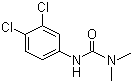 |
| Molecular Formula | C9H10Cl2N2O |
| Molecular Weight | 233.09 |
| CAS Registry Number | 330-54-1 (56449-18-4) |
| EC Number | 206-354-4 |
| SMILES | CN(C)C(=O)NC1=CC(=C(C=C1)Cl)Cl |
| Melting point | 158-159 °C |
|---|---|
| Water solubility | Slightly soluble. 0.0042 g/100 mL |
| Hazard Symbols |   GHS08;GHS09 Danger Details GHS08;GHS09 Danger Details | ||||||||||||||||||||||||
|---|---|---|---|---|---|---|---|---|---|---|---|---|---|---|---|---|---|---|---|---|---|---|---|---|---|
| Risk Statements | H350-H373:-H400:-H410: Details | ||||||||||||||||||||||||
| Safety Statements | P203-P260-P273-P280-P318-P319-P391-P405-P501 Details | ||||||||||||||||||||||||
| Hazard Classification | |||||||||||||||||||||||||
| |||||||||||||||||||||||||
| Transport Information | UN 2767 | ||||||||||||||||||||||||
| SDS | Available | ||||||||||||||||||||||||
 chemBlink Chemical Story
|
Diuron is a widely used herbicide belonging to the phenylurea class of compounds. It was developed in the mid-20th century as part of a growing effort to create selective and non-selective herbicides for both agricultural and industrial weed management. Since its introduction, diuron has become a staple in herbicidal formulations due to its broad-spectrum activity and long residual effect, especially in settings where extended weed suppression is necessary. The mode of action of diuron involves the inhibition of photosynthesis in susceptible plants. Specifically, it targets photosystem II by binding to the D1 protein in the chloroplast thylakoid membrane, disrupting electron transport during the light-dependent reactions. This results in the cessation of ATP and NADPH production, leading to a loss of energy and metabolic activity within plant cells. Affected plants show chlorosis and necrosis, eventually dying due to energy starvation and oxidative stress. Chemically, diuron is 3-(3,4-dichlorophenyl)-1,1-dimethylurea. Its structure includes a substituted phenyl ring and a dimethylurea group, which are critical for its herbicidal function and environmental behavior. It is typically formulated as a wettable powder or suspension concentrate and is applied to soil or vegetation to control annual and perennial broadleaf and grassy weeds. The herbicide is absorbed primarily through plant roots but can also exhibit foliar activity under certain conditions. Diuron is valued for its versatility and is used across a variety of non-crop and crop situations. It finds extensive use in orchards, vineyards, sugarcane, and cotton, where it helps maintain weed-free rows and reduces competition for nutrients and water. In non-agricultural contexts, it is applied in rights-of-way, industrial sites, and along railways and pipelines to control vegetation growth that could pose operational or safety hazards. Despite its effectiveness, diuron has been the subject of regulatory scrutiny due to its environmental persistence and potential to leach into groundwater. It has moderate to high mobility in soil, particularly in sandy or low-organic-matter substrates, and can contaminate aquatic systems if misused. This environmental profile has led to usage restrictions in certain regions and ongoing efforts to monitor its presence in surface and groundwater. In aquatic ecosystems, diuron is toxic to algae and aquatic plants, which are highly sensitive to photosynthesis inhibitors. Resistance to diuron has been documented in some weed species, particularly in areas of repeated and exclusive use. Resistance management strategies, including the rotation of herbicides with different modes of action and the integration of non-chemical weed control practices, are recommended to mitigate this issue. Diuron's effectiveness is preserved when used as part of a broader, diversified weed management plan. In conclusion, diuron remains an important herbicide in modern agriculture and vegetation management. Its mode of action, long-lasting control, and cost-effectiveness make it a valuable tool, especially in situations where persistent weed control is essential. However, its environmental impact and potential for resistance development necessitate careful stewardship and adherence to best management practices. References 1979. Loss of sensitivity to diuron after trypsin digestion of chloroplast photosystem II particles. FEBS Letters, 103(1). DOI: 10.1016/0014-5793(79)81242-9 1984. Influence of five phenylurea herbicides on the diatom Hantzschia in a sandy loam soil. Bulletin of Environmental Contamination and Toxicology, 33(1). DOI: 10.1007/bf01625567 1991. Adsorption and desorption of linuron by activated charcoals. Bulletin of Environmental Contamination and Toxicology, 46(1). DOI: 10.1007/bf01688252 |
| Market Analysis Reports |