
Online Database of Chemicals from Around the World
| West Bengal Chemical Industries Limited | India | |||
|---|---|---|---|---|
 | www.wbcil.com | |||
 | 08240399360 | |||
 | wbcilpvtltd@gmail.com | |||
| Chemical manufacturer since 1970 | ||||
| chemBlink Standard supplier since 2021 | ||||
| Classification | Organic raw materials >> Organometallic compound >> Organic zinc |
|---|---|
| Name | Zinc Ascorbate |
| Synonyms | Zinc (2R)-2-[(1S)-1,2-dihydroxyethyl]-3-hydroxy-5-oxo-2H-furan-4-olate |
| Molecular Structure | 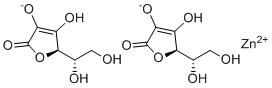 |
| Molecular Formula | C12H14O12Zn |
| Molecular Weight | 415.61 |
| CAS Registry Number | 331242-75-2 |
| EC Number | 696-358-6 |
| SMILES | C([C@@H]([C@@H]1C(=C(C(=O)O1)[O-])O)O)O.C([C@@H]([C@@H]1C(=C(C(=O)O1)[O-])O)O)O.[Zn+2] |
| Hazard Symbols |  GHS07 Warning Details GHS07 Warning Details |
|---|---|
| Risk Statements | H319 Details |
| Safety Statements | P264+P265-P280-P305+P351+P338-P337+P317 Details |
 chemBlink Chemical Story
|
Zinc ascorbate is a coordination complex formed between zinc and ascorbic acid (vitamin C), typically represented by the empirical formula C12H14O12Zn. It combines the nutritional properties of both zinc and vitamin C in a single compound, where zinc exists in the divalent state (Zn2+) and is chelated by the ascorbate anions. This combination was developed to improve zinc’s bioavailability and reduce the gastrointestinal irritation sometimes associated with inorganic zinc salts such as zinc sulfate. The compound began to be studied in the late 20th century as part of a broader interest in mineral–ascorbate complexes for human and veterinary nutrition. Early investigations focused on the potential synergistic effects between zinc and vitamin C, given that both are essential nutrients with complementary physiological roles. Zinc is crucial for immune function, wound healing, and enzyme activity, while vitamin C is a potent antioxidant and cofactor in collagen synthesis. The rationale for combining them in a single molecule was to facilitate absorption and to provide dual support for immune and connective tissue health. Applications of zinc ascorbate are primarily in the nutritional supplement industry. It is used in oral tablets, capsules, and fortified foods to support immune system function, reduce the duration and severity of common colds, and maintain skin and tissue health. The ascorbate ligand helps protect zinc from precipitation in the gastrointestinal tract and may improve its uptake compared with less soluble zinc salts. Veterinary formulations of zinc ascorbate are also available, particularly in feeds designed to enhance disease resistance and tissue repair in livestock and companion animals. In research, zinc ascorbate has been studied for its antimicrobial and antiviral properties. Zinc ions can interfere with viral replication, while vitamin C enhances the oxidative stress response, creating a combined effect that is of interest for respiratory and skin infections. The compound has also been examined in wound healing models, where both zinc and vitamin C contribute to collagen formation and tissue regeneration. Zinc ascorbate is generally stable in dry form but is hygroscopic and should be stored in airtight containers to prevent degradation. In aqueous solutions, it is susceptible to oxidation of the ascorbate moiety, particularly in the presence of heat, light, or oxygen. While both zinc and vitamin C are essential nutrients, excessive intake of zinc ascorbate can lead to symptoms of zinc toxicity such as nausea, abdominal pain, and interference with copper absorption, while very high vitamin C intake may cause gastrointestinal discomfort. |
| Market Analysis Reports |