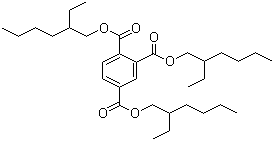
Trioctyl trimellitate is a chemical compound known for its role as a plasticizer in polymer chemistry, particularly in the formulation of flexible plastics. Its unique chemical structure and properties make it a valuable ingredient in various industrial and consumer applications.
Discovered in the mid-20th century, trioctyl trimellitate is synthesized through the esterification reaction between trimellitic anhydride and octanol. This process results in a triester with three octyl groups attached to the trimellitic acid backbone. The compound was developed to address the need for effective plasticizers that could enhance the flexibility and durability of plastic materials.
One of the primary applications of trioctyl trimellitate is as a plasticizer in the production of flexible polyvinyl chloride (PVC) and other polymeric materials. By incorporating trioctyl trimellitate into the polymer matrix, manufacturers can significantly improve the flexibility, softness, and workability of the final product. This is particularly important for applications requiring materials that maintain their performance and integrity under varying temperature and stress conditions.
Trioctyl trimellitate is also utilized in the formulation of high-performance coatings and sealants. Its presence enhances the flexibility and adhesion properties of these products, making them suitable for applications in automotive, construction, and industrial settings. The compound’s ability to improve the flow and leveling properties of coatings contributes to a smoother and more durable finish.
In addition to its role in plastics and coatings, trioctyl trimellitate finds applications in the production of rubber and elastomers. The compound’s plasticizing effect helps to achieve the desired mechanical properties and processability of rubber compounds, which are crucial for products such as tires, gaskets, and hoses.
The compound's stability and low volatility make it suitable for use in high-temperature applications. Its resistance to degradation under extreme conditions ensures that the plasticizers remain effective over time, contributing to the longevity and performance of the products in which they are used.
Research into trioctyl trimellitate continues to explore its potential in emerging applications and formulations. Its compatibility with various polymers and resins makes it a candidate for use in advanced material systems where enhanced flexibility and performance are required.
Overall, trioctyl trimellitate is a significant compound in polymer technology due to its role as a plasticizer that enhances the properties of flexible plastics, coatings, and rubbers. Its ability to improve the mechanical and performance characteristics of these materials underscores its importance in diverse industrial and consumer applications.
References
2022. Diverging trends of plasticizers (phthalates and non-phthalates) in indoor and freshwater environments-why?. Environmental Sciences Europe, 34(1).
DOI: 10.1186/s12302-022-00620-4
2018. Comprehensive monitoring of specific metabolites of tri-(2-ethylhexyl) trimellitate (TEHTM) in urine by column-switching liquid chromatography-tandem mass spectrometry. Analytical and Bioanalytical Chemistry, 410(14).
DOI: 10.1007/s00216-018-1086-7
1985. Extended storage of platelets in a new plastic container. I. Biochemical and morphologic changes. Transfusion, 25(3).
DOI: 10.1046/j.1537-2995.1985.25385219898.x
|





 GHS07;GHS08 Warning Details
 chemBlink Chemical Story