
Online Database of Chemicals from Around the World
| Biocompounds Pharmaceutical Inc. | China | |||
|---|---|---|---|---|
 | www.biocompounds.com | |||
 | +86 (21) 5768-7675 | |||
 | +86 (21) 5768-7169 | |||
 | sales@biocompounds.com info@biocompounds.com | |||
 | QQ Chat | |||
| Chemical manufacturer since 2003 | ||||
| chemBlink Standard supplier since 2007 | ||||
| Xiamen Kaijia Imp & Exp Co., Ltd. | China | |||
|---|---|---|---|---|
| www.kaijiachem.com | |||
| +86 (592) 510-1177 | |||
| +86 (592) 565-3685 | |||
| jojo@kaijiachem.com kaijiachem@163.com | |||
| Chemical distributor since 2006 | ||||
| chemBlink Standard supplier since 2008 | ||||
| Intatrade Chemicals GmbH | Germany | |||
|---|---|---|---|---|
| www.intatrade.de | |||
| +49 (3493) 605-465 | |||
| +49 (3493) 605-470 | |||
| sales@intatrade.de | |||
| Chemical distributor | ||||
| chemBlink Standard supplier since 2011 | ||||
| Shanghai 3s Technology Co., Ltd. | China | |||
|---|---|---|---|---|
| www.3s-tech.net | |||
| +86 (021) 5290-7809 | |||
| market@3s-tech.net | |||
| Chemical manufacturer since 2019 | ||||
| chemBlink Standard supplier since 2025 | ||||
| Frinton Laboratories, Inc. | USA | |||
|---|---|---|---|---|
| www.frinton.com | |||
| +1 (856) 722-7037 | |||
| +1 (856) 439-1977 | |||
| sales@frinton.com frinton@frinton.com | |||
| Chemical manufacturer since 1963 | ||||
| Shandong Xingshun New Material Co., Ltd. | China | |||
|---|---|---|---|---|
| www.sd-xingshun.com | |||
| +86 (519) 8646-1196 +86 (519) 8646-4994 +86 13809078067 | |||
| +86 (519) 8646-3703 | |||
| gxx@xingshengtech.com gxy@xingshengtech.com xp@xingshengtech.com | |||
| QQ Chat | |||
| Chemical manufacturer since 1996 | ||||
| Huaian Synniken Chemical Co., Ltd. | China | |||
|---|---|---|---|---|
| www.synniken.com | |||
| +86 (10) 8772-7796 +86 13901024257 | |||
| +86 (10) 8772-7494 | |||
| sales@synniken.com | |||
| Chemical manufacturer since 2007 | ||||
| Zhejiang Tongfeng Pharmaceutical & Chemical Co., Ltd. | China | |||
|---|---|---|---|---|
| www.tongfengchem.com | |||
| +86 (576) 8599-1251 8501-6303 | |||
| +86 (576) 8501-0026 | |||
| tongfeng@tongfengchem.com | |||
| Chemical manufacturer | ||||
| Classification | Chemical reagent >> Organic reagent >> Ester >> Methyl ester compound |
|---|---|
| Name | Methyl 6-bromo-2-naphthoate |
| Molecular Structure | 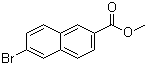 |
| Molecular Formula | C12H9BrO2 |
| Molecular Weight | 265.10 |
| CAS Registry Number | 33626-98-1 |
| EC Number | 608-896-0 |
| SMILES | COC(=O)C1=CC2=C(C=C1)C=C(C=C2)Br |
| Density | 1.5±0.1 g/cm3 Calc.* |
|---|---|
| Melting point | 121 - 123 °C (Expl.) |
| Boiling point | 357.0±15.0 °C 760 mmHg (Calc.)* |
| Flash point | 169.7±20.4 °C (Calc.)* |
| Index of refraction | 1.635 (Calc.)* |
| * | Calculated using Advanced Chemistry Development (ACD/Labs) Software. |
| Hazard Symbols |  GHS07 Warning Details GHS07 Warning Details | ||||||||
|---|---|---|---|---|---|---|---|---|---|
| Risk Statements | H315 Details | ||||||||
| Safety Statements | P264-P280-P302+P352-P321-P332+P317-P362+P364 Details | ||||||||
| Hazard Classification | |||||||||
| |||||||||
| SDS | Available | ||||||||
 chemBlink Chemical Story
|
Methyl 6-bromo-2-naphthoate is a brominated ester derivative of naphthalene that has been utilized primarily as an intermediate in organic synthesis. Its discovery traces back to systematic studies in the early to mid-20th century focusing on functionalized naphthalene compounds, which were of interest due to their aromatic stability and potential for chemical modification. Researchers sought to prepare halogenated naphthalene derivatives that could serve as versatile building blocks for the development of dyes, agrochemicals, pharmaceuticals, and advanced materials. The synthesis of methyl 6-bromo-2-naphthoate typically involves the bromination of methyl 2-naphthoate, a reaction that can be controlled to achieve regioselective substitution at the 6-position. Electrophilic bromination using reagents such as bromine or N-bromosuccinimide (NBS) under specific conditions yields the desired 6-bromo isomer. The substitution pattern is influenced by the electron density distribution across the naphthalene system, with the ester group at the 2-position directing the bromination to occur preferentially at the 6-position through an electrophilic aromatic substitution mechanism. Methyl 6-bromo-2-naphthoate has been applied extensively as a key intermediate in the preparation of more complex organic molecules. Its bromine atom serves as a reactive site for further functionalization through cross-coupling reactions such as Suzuki-Miyaura, Heck, and Sonogashira couplings. These reactions enable the formation of carbon-carbon bonds, allowing the construction of a wide variety of substituted naphthalene derivatives and extended aromatic systems. Such derivatives are of significant interest in the development of organic electronic materials, including organic light-emitting diodes (OLEDs), organic photovoltaics, and field-effect transistors. In pharmaceutical research, naphthalene-based structures have been incorporated into various bioactive compounds, and methyl 6-bromo-2-naphthoate provides a useful starting point for the synthesis of candidate molecules with potential therapeutic properties. The ester functional group can be hydrolyzed to yield the corresponding carboxylic acid, 6-bromo-2-naphthoic acid, which can then undergo amide bond formation or other derivatizations to explore biological activity. The compound’s role extends to the field of dye and pigment chemistry. Functionalized naphthalene derivatives are integral in the synthesis of vat dyes, disperse dyes, and fluorescent materials. The brominated position in methyl 6-bromo-2-naphthoate allows for the introduction of various chromophoric groups, thereby contributing to the design of compounds with tailored optical properties. Physically, methyl 6-bromo-2-naphthoate appears as a crystalline solid with relatively high melting point and good stability under ambient conditions. It is soluble in common organic solvents such as chloroform, dichloromethane, and ethyl acetate, which facilitates its handling and incorporation into synthetic protocols. Standard purification techniques, including recrystallization and column chromatography, are typically employed during its preparation and use. The importance of methyl 6-bromo-2-naphthoate as a synthetic intermediate is further highlighted by its incorporation into combinatorial chemistry and materials science. In combinatorial approaches, it serves as a modular unit for the rapid generation of libraries of structurally diverse compounds. In materials science, naphthalene cores bearing specific substituents contribute to the development of polymers and small molecules with enhanced electronic and photophysical properties. Environmental and safety data for methyl 6-bromo-2-naphthoate indicate that it should be handled with care, consistent with standard practices for brominated organic compounds. It may pose risks upon inhalation, ingestion, or skin contact, and appropriate protective equipment and containment measures are recommended during its use. The development and utilization of methyl 6-bromo-2-naphthoate exemplify the strategic value of halogenated aromatic esters in organic chemistry. Its contributions to synthetic methodologies and material innovations underscore its continuing relevance in both academic research and industrial applications. References 2022. Dearomative Functionalization of Haloarenes. Science of Synthesis. 2018. Palladium-Catalyzed Carbonylation of Aryl Bromides to Form Methyl Esters. Organic Letters, 20(17). DOI: 10.1021/acs.orglett.8b02215 2015. Synthesis of Naphthalene Derivatives via a Novel Dearomatization-Rearomatization Strategy. The Journal of Organic Chemistry, 80(20). DOI: 10.1021/acs.joc.5b01876 |
| Market Analysis Reports |