
Online Database of Chemicals from Around the World
| Sinocompound Catalysts Co., Ltd. | China | |||
|---|---|---|---|---|
 | www.sinocompound.com | |||
 | +86 (512) 6721-6630 | |||
 | +86 (512) 5631-6689 | |||
 | sales@sinocompound.com | |||
| Chemical manufacturer since 2008 | ||||
| chemBlink Standard supplier since 2010 | ||||
| BOC Sciences | USA | |||
|---|---|---|---|---|
| www.bocsci.com | |||
| +1 (631) 485-4226 | |||
| +1 (631) 614-7828 | |||
| info@bocsci.com | |||
| Chemical manufacturer | ||||
| chemBlink Standard supplier since 2010 | ||||
| Alfa Chemistry | USA | |||
|---|---|---|---|---|
| www.alfa-chemistry.com | |||
| +1 (516) 734-6573 | |||
| +1 (516) 927-0118 | |||
| support@alfa-chemistry.com | |||
| Chemical manufacturer since 2005 | ||||
| chemBlink Standard supplier since 2012 | ||||
| Zhengzhou Kingorgchem Chemical Technology Co., Ltd. | China | |||
|---|---|---|---|---|
| www.kingorgchem.com | |||
| +86 (371) 6551-1006 | |||
| +86 (371) 6575-6965 | |||
| sales@kingorgchem.com | |||
 | QQ Chat | |||
 | WeChat: 18625597674 | |||
| Chemical manufacturer since 2015 | ||||
| chemBlink Standard supplier since 2016 | ||||
| Beijing Guofang Dingsheng Technology Co., Ltd. | China | |||
|---|---|---|---|---|
| www.gfdschem.com | |||
| +86 (10) 8904-9254 5909-2859 +86 18610472091 +86 18031679351 | |||
| +86 (10) 5909-2859 | |||
| gfdskj@163.com | |||
| QQ Chat | |||
| Chemical manufacturer since 2012 | ||||
| chemBlink Standard supplier since 2016 | ||||
| Shanghai Worldyang Chemical Co., Ltd. | China | |||
|---|---|---|---|---|
| www.worldyachem.com | |||
| +86 13651600618 +86 (21) 5679-5779 | |||
| +86 (21) 5679-5266 | |||
| sales7777@worldyachem.com | |||
| QQ Chat | |||
| WeChat: 13651600618 | |||
 | WhatsApp:+86 13651600618 | |||
| Chemical manufacturer since 2012 | ||||
| Classification | Catalysts and additives >> Precious metal catalyst |
|---|---|
| Name | trans-Dichlorobis(di-tert-butylphenylphosphine)palladium(II) |
| Synonyms | ditert-butyl(phenyl)phosphane dichloropalladium |
| Molecular Structure | 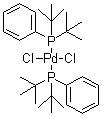 |
| Molecular Formula | C28H46Cl2P2Pd |
| Molecular Weight | 621.94 |
| CAS Registry Number | 34409-44-4 |
| EC Number | 681-978-1 |
| SMILES | CC(C)(C)P(C1=CC=CC=C1)C(C)(C)C.CC(C)(C)P(C1=CC=CC=C1)C(C)(C)C.Cl[Pd]Cl |
| Melting point | 260-264 °C (decomp.) |
|---|---|
| Hazard Symbols |  GHS07 Warning Details GHS07 Warning Details | ||||||||||||||||||||||||||||||||||||||||||||
|---|---|---|---|---|---|---|---|---|---|---|---|---|---|---|---|---|---|---|---|---|---|---|---|---|---|---|---|---|---|---|---|---|---|---|---|---|---|---|---|---|---|---|---|---|---|
| Risk Statements | H315-H319-H335 Details | ||||||||||||||||||||||||||||||||||||||||||||
| Safety Statements | P261-P264-P264+P265-P271-P280-P302+P352-P304+P340-P305+P351+P338-P319-P321-P332+P317-P337+P317-P362+P364-P403+P233-P405-P501 Details | ||||||||||||||||||||||||||||||||||||||||||||
| Hazard Classification | |||||||||||||||||||||||||||||||||||||||||||||
| |||||||||||||||||||||||||||||||||||||||||||||
| SDS | Available | ||||||||||||||||||||||||||||||||||||||||||||
 chemBlink Chemical Story
|
trans-Dichlorobis(di-tert-butylphenylphosphine)palladium(II) is an important organometallic complex, often abbreviated as trans-[PdCl2(ditbuP)2], developed in the context of expanding the utility of palladium complexes in organic synthesis. Its discovery is related to the need for more powerful and selective catalysts in cross-coupling reactions. The introduction of bulky di-tert-butylphenylphosphine ligands improves the catalytic performance of the palladium center by increasing stability and unique electronic properties. The synthesis of trans-dichlorobis(di-tert-butylphenylphosphine)palladium(II) involves the reaction of palladium(II) chloride with di-tert-butylphenylphosphine ligands in a controlled environment. The general procedure involves the synthesis or di-tert-butylphenylphosphine; the reaction of palladium(II) chloride with the ligand in a suitable solvent (usually dichloromethane or toluene); and the purification and isolation of the resulting complex as a crystalline solid. The trans configuration of the ligands around the palladium center is confirmed by spectroscopic techniques such as NMR and X-ray crystallography. The trans configuration refers to the arrangement of the ligands relative to each other in the coordination sphere of the palladium ion. This configuration contributes to the stability of the complex, making it less prone to decomposition under various reaction conditions. The bulky di-tert-butylphenylphosphine ligand forms a steric environment around the palladium center, which affects its reactivity. This steric hindrance can enhance the selectivity of the catalyst in various coupling reactions by limiting the access of the substrate to the metal center. The complex is soluble in organic solvents such as dichloromethane, chloroform, and toluene, facilitating its use in homogeneous catalytic systems. The major application of trans-dichlorobis(di-tert-butylphenylphosphine)palladium(II) is cross-coupling reactions. These reactions include Suzuki, Heck, and Stille couplings, where the complex acts as an effective catalyst for the formation of carbon-carbon bonds. The Suzuki coupling involves the coupling of aryl or vinyl boronic acids with halides or triflates. The palladium complex facilitates the transfer of an organic group from the boron reagent to the halide, thereby forming a new carbon-carbon bond. The Heck reaction couples olefins with aryl halides to form substituted olefins. The palladium catalyst activates the halide and inserts it into the olefin, which then undergoes a reductive elimination to form the product. Stille coupling involves the coupling of organotin compounds with halides. The palladium complex facilitates the transfer of the organic group from the tin reagent to the halide. The bulky di-tert-butylphenylphosphine ligand is intended to enhance the performance of the catalyst by providing electronic and steric effects that influence the reactivity and selectivity of the palladium center. This makes the complex valuable in developing new catalytic processes and optimizing existing ones. In academic and industrial research, trans-[PdCl2(ditbuP)2] is used to study the mechanisms of palladium-catalyzed reactions and develop new synthetic methods. Its stability and predictable reactivity make it a model system for understanding palladium-mediated transformations. References 2015. Ledipasvir. Pharmaceutical Substances. URL: https://pharmaceutical-substances.thieme.com/ps/search-results?docUri=KD-12-0081 |
| Market Analysis Reports |