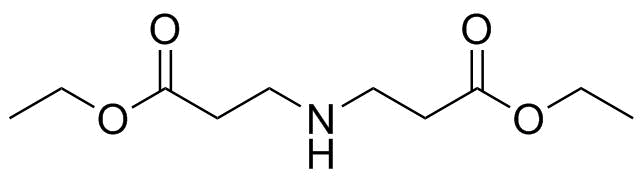
Diethyl 3,3'-iminodipropionate combines a secondary amine with two matching ester-containing arms. In the structure represented by CAS 3518-88-5, nitrogen is connected to two -CH2CH2COOCH2CH3 chains and retains one hydrogen. The molecule is therefore neither a simple diester lacking nitrogen nor an amide in which nitrogen is directly attached to a carbonyl carbon. The spacing between those groups determines which chemical relationships are actually present.
The name also needs to be distinguished from iminodiacetate chemistry. Here each nitrogen-to-carbonyl path contains two methylene groups. Removing one carbon from each arm would create a different ligand framework and a different compound. General familiarity with a similarly named chelator is not evidence that the longer ester has the same metal-binding constants or applications.
The secondary nitrogen and ester groups offer different reaction sites. Nitrogen can participate in amine chemistry, while the ethyl esters can undergo transformations characteristic of carboxylic-acid derivatives under suitable conditions. Converting an ester to an acid or an amide changes both composition and intermolecular interactions. These are structural reasons for considering the molecule as a multifunctional synthetic reagent, rather than proof of an independently verified industrial process using this exact CAS.
The manufacturer TCI lists the material as a liquid and supplies both gas-chromatographic purity and nonaqueous titration specifications. The distinction between those measurements is useful: chromatography assesses components separated by the method, while titration supplies a separate response related to basic functionality. Agreement supports a product specification, although neither measurement alone establishes every aspect of identity or possible impurity content.
Publicly verified sources reviewed here primarily document the reagent and its properties. They do not establish the specific dendrimer, radiopharmaceutical or high-performance chelator uses sometimes asserted for related structures. The scientifically supported account is thus a short one about functional-group placement and a defined research reagent. Its two ester arms create possibilities for molecular elaboration, but actual applications must be tied to the product and reaction that were tested.
References:
1. Tokyo Chemical Industry. Diethyl 3,3-prime-iminodipropionate, product D4111; CAS 3518-88-5. Identity, GC and nonaqueous-titration specifications. https://www.tcichemicals.com/OP/en/p/D4111
|




 GHS07 Warning Details
 chemBlink Chemical Story