
Online Database of Chemicals from Around the World
| Auben Chemical Co., Ltd. | China | |||
|---|---|---|---|---|
 | www.aubenchem.com | |||
 | +86 19121901603 | |||
 | sales@aubenchem.com | |||
| Chemical distributor since 2023 | ||||
| chemBlink Standard supplier since 2025 | ||||
| Classification | Organic raw materials >> Carboxylic compounds and derivatives >> Salt of carboxylic acid ester and its derivatives |
|---|---|
| Name | tert-Butyl 4-(aminomethyl)piperidine-1-carboxylate hydrochloride |
| Synonyms | 1-Boc-4-(Aminomethyl)piperidine hydrochloride |
| Molecular Structure | 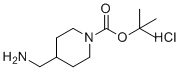 |
| Molecular Formula | C11H23ClN2O2 |
| Molecular Weight | 250.77 |
| CAS Registry Number | 359629-16-6 |
| SMILES | CC(C)(C)OC(=O)N1CCC(CC1)CN.Cl |
| Hazard Symbols |  GHS07 Warning Details GHS07 Warning Details |
|---|---|
| Risk Statements | H302 Details |
| Safety Statements | P301+P312+P330 Details |
| SDS | Available |
 chemBlink Chemical Story
|
tert‑Butyl 4‑(aminomethyl)piperidine‑1‑carboxylate hydrochloride is a protected piperidine derivative widely used in organic synthesis and medicinal chemistry. The compound is the hydrochloride salt of a Boc-protected 4-(aminomethyl)piperidine, where the nitrogen of the piperidine ring carries a tert-butyloxycarbonyl (Boc) group. This protecting group is acid-labile and was developed as a general strategy for masking amines to allow selective functionalization at other positions within a molecule. The Boc group reacts with primary and secondary amines to form stable carbamates under neutral or basic conditions and can be removed under acidic conditions, revealing the free amine for subsequent reactions. The piperidine ring is a six-membered heterocycle containing a nitrogen atom and is a common scaffold in medicinal chemistry because of its conformational flexibility and ability to engage biological targets. The 4-(aminomethyl) substitution allows selective modification at this position while preserving the integrity of the ring nitrogen when protected with Boc. The hydrochloride salt stabilizes the primary amine, increasing solubility in polar solvents and facilitating handling in laboratory procedures. The combination of Boc protection and salt formation enables sequential synthetic transformations without premature reactivity of the primary amine. tert‑Butyl 4-(aminomethyl)piperidine-1-carboxylate hydrochloride is typically synthesized starting from commercially available 4-(aminomethyl)piperidine. The nitrogen of the piperidine ring is reacted with di-tert-butyl dicarbonate in the presence of a base to form the Boc-protected carbamate. Subsequent conversion to the hydrochloride salt is achieved using hydrochloric acid in organic solvents such as dioxane. This approach ensures that the primary amine remains protonated while the piperidine nitrogen is protected, allowing for controlled reactions in downstream chemistry. In practical applications, this compound serves as a building block for the synthesis of pharmacologically active molecules. Its 4-(aminomethyl)piperidine unit is used in the preparation of ligands for G-protein-coupled receptors, including beta3 adrenoceptor agonists and other central nervous system-active compounds. The Boc-protected nitrogen provides orthogonal protection that allows chemists to functionalize other parts of the molecule selectively, an important feature in multi-step synthetic sequences. The compound is also employed in peptide synthesis, where the primary amine can be coupled to carboxylic acids or activated esters using standard coupling reagents after Boc deprotection. The structural features of the molecule, including the flexible piperidine ring, the Boc-protected nitrogen, and the primary amine at the 4-position, make it suitable for generating molecular diversity. The amine can react with aldehydes, ketones, or activated esters to produce substituted derivatives, which can then be evaluated for biological activity. This versatility has contributed to the widespread adoption of tert-butyl 4-(aminomethyl)piperidine-1-carboxylate hydrochloride as a reagent in medicinal chemistry programs aimed at exploring structure–activity relationships. In laboratory practice, the hydrochloride salt is preferred because it is solid, easy to weigh, and more stable than the free amine. It can be dissolved in polar solvents such as water, methanol, or acetonitrile, enabling its use in solution-phase synthesis. The Boc group ensures compatibility with a wide range of chemical reactions, including alkylation, acylation, and reductive amination, without undesired side reactions at the piperidine nitrogen. Overall, tert-butyl 4-(aminomethyl)piperidine-1-carboxylate hydrochloride represents a reliable and widely used building block in modern synthetic chemistry. Its design reflects long-established strategies in protecting group chemistry and heterocycle functionalization. The compound enables chemists to introduce the 4-(aminomethyl)piperidine unit selectively while maintaining orthogonal protection, facilitating the efficient synthesis of structurally complex and biologically relevant molecules. References Gomtsyan, A., Casey, M., Kauffman, G., et al. (2002) Novel substituted 4-aminomethylpiperidines as potent and selective human beta3 adrenoceptor agonists. Journal of Medicinal Chemistry 45(10) 2079–2087 PMID: 12270184 |
| Market Analysis Reports |