
Online Database of Chemicals from Around the World
| Hangzhou Verychem Science And Technology Co., Ltd. | China | |||
|---|---|---|---|---|
 | www.verychem.com | |||
 | +86 (571) 8816-2785 +86 13606544505 | |||
 | +86 (571) 8816-2787 | |||
 | lucy@verychem.com | |||
| Chemical manufacturer since 2004 | ||||
| chemBlink Massive supplier since 2021 | ||||
| Shanghai RC Chemicals Co., Ltd. | China | |||
|---|---|---|---|---|
| www.rcc.net.cn | |||
| +86 (21) 5032-2175 5866-1250 ex 603 | |||
| +86 (21) 5032-2176 / 5866-1251 | |||
| sales@rcc.net.cn chad@rcc.net.cn | |||
| Chemical manufacturer since 2006 | ||||
| chemBlink Standard supplier since 2007 | ||||
| Sinfachem Limited | China | |||
|---|---|---|---|---|
| www.sinfachem.com | |||
| +86 (25) 8468-3399 8517-8591 | |||
| +86 (25) 8468-3112 | |||
| sinfachem@foxmail.com sinfachemltd@foxmail.com info@sinfachem.com | |||
 | QQ Chat | |||
| Chemical manufacturer | ||||
| chemBlink Standard supplier since 2009 | ||||
| Rongcheng K&S Chemical Co., Ltd. | China | |||
|---|---|---|---|---|
| www.keshengchem.com | |||
| +86 (631) 733-6369 | |||
| +86 (631) 733-4322 | |||
| master@keshengchem.com | |||
| Chemical manufacturer | ||||
| chemBlink Standard supplier since 2011 | ||||
| Frontier Scientific Services, Inc. | USA | |||
|---|---|---|---|---|
| www.frontierssi.com | |||
| +1 (302) 266-6891 (888) 577-2734 | |||
| +1 (302) 266-8296 | |||
| customerservice@frontierssi.com | |||
| Chemical manufacturer | ||||
| Classification | Chemical reagent >> Organic reagent >> Aromatic alcohol |
|---|---|
| Name | 4-Biphenylmethanol |
| Synonyms | 4-Phenylbenzyl alcohol |
| Molecular Structure | 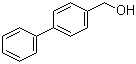 |
| Molecular Formula | C13H12O |
| Molecular Weight | 184.23 |
| CAS Registry Number | 3597-91-9 |
| EC Number | 222-745-2 |
| SMILES | C1=CC=C(C=C1)C2=CC=C(C=C2)CO |
| Density | 1.1±0.1 g/cm3 Calc.* |
|---|---|
| Melting point | 96 - 100 °C (Expl.) |
| Boiling point | 340.0±21.0 °C 760 mmHg (Calc.)*, 362.4 °C (Expl.) |
| Flash point | 154.9±17.8 °C (Calc.)* |
| Index of refraction | 1.595 (Calc.)* |
| * | Calculated using Advanced Chemistry Development (ACD/Labs) Software. |
| Hazard Symbols |   GHS07;GHS08 Warning Details GHS07;GHS08 Warning Details | ||||||||||||||||||||||||
|---|---|---|---|---|---|---|---|---|---|---|---|---|---|---|---|---|---|---|---|---|---|---|---|---|---|
| Risk Statements | H302-H315-H319-H335-H361 Details | ||||||||||||||||||||||||
| Safety Statements | P203-P261-P264-P264+P265-P270-P271-P280-P301+P317-P302+P352-P304+P340-P305+P351+P338-P318-P319-P321-P330-P332+P317-P337+P317-P362+P364-P403+P233-P405-P501 Details | ||||||||||||||||||||||||
| Hazard Classification | |||||||||||||||||||||||||
| |||||||||||||||||||||||||
| SDS | Available | ||||||||||||||||||||||||
 chemBlink Chemical Story
|
4-Biphenylmethanol, also known as (4-phenylphenyl)methanol, is an organic compound belonging to the class of benzylic alcohols. It consists of a biphenyl structure—a pair of benzene rings connected via a single bond—with a hydroxymethyl group (−CH2OH) attached at the para-position of one of the rings. The molecular formula of 4-biphenylmethanol is C13H12O, and it is typically encountered as a white crystalline solid under standard conditions. The compound is primarily synthesized by the reduction of 4-biphenylcarboxylic acid or its ester derivatives using common reducing agents such as lithium aluminum hydride (LiAlH4) or sodium borohydride (NaBH4). Alternatively, 4-biphenylmethanol can also be prepared through Grignard reaction methods by reacting phenylmagnesium bromide with benzaldehyde followed by acid work-up and subsequent modification to introduce the biphenyl moiety. 4-Biphenylmethanol has been studied and utilized in organic synthesis, particularly as an intermediate in the development of more complex chemical structures. Its hydroxyl group enables further derivatization, such as esterification, etherification, or conversion to halides, which can then undergo a variety of coupling reactions. This chemical reactivity makes it useful in the preparation of pharmaceuticals, agrochemicals, and specialty polymers where biphenyl scaffolds are involved. In medicinal chemistry, biphenyl compounds, including 4-biphenylmethanol, are recognized for their potential biological activity. While 4-biphenylmethanol itself is not an active pharmaceutical ingredient, its core structure forms a part of various bioactive molecules. The presence of the hydroxymethyl group can influence the pharmacokinetic properties of derivatives, including solubility and metabolic stability. The biphenyl moiety is often utilized in drug discovery due to its conformational rigidity and ability to interact with hydrophobic pockets in biological targets. Consequently, derivatives of 4-biphenylmethanol have been explored in the design of selective enzyme inhibitors and receptor ligands, although its primary role remains that of a synthetic intermediate rather than a therapeutic compound. In materials science, biphenyl derivatives, including 4-biphenylmethanol, are investigated for their electronic and optical properties. The conjugated aromatic system provides opportunities for the synthesis of functional organic materials. However, 4-biphenylmethanol itself is more commonly used as a precursor in the fabrication of such materials rather than as a final component. The physicochemical properties of 4-biphenylmethanol, such as moderate polarity due to the hydroxyl group and lipophilic character from the biphenyl backbone, contribute to its versatility in organic transformations. It is generally stable under ambient conditions, though it should be stored in airtight containers to avoid oxidation of the alcohol group over extended periods. Toxicologically, 4-biphenylmethanol has not been widely reported as a hazardous substance, but like many aromatic alcohols, it should be handled with care, including the use of appropriate protective equipment to avoid skin or eye contact and inhalation. Its environmental impact is considered low when used in controlled laboratory or industrial settings. Overall, 4-biphenylmethanol is a valuable intermediate in synthetic chemistry with utility in constructing more complex molecular frameworks. Its derivatization potential and structural features enable its use across various chemical disciplines, including organic synthesis, materials science, and medicinal chemistry. |
| Market Analysis Reports |