
Online Database of Chemicals from Around the World
| Hangzhou Verychem Science And Technology Co., Ltd. | China | |||
|---|---|---|---|---|
 | www.verychem.com | |||
 | +86 (571) 8816-2785 +86 13606544505 | |||
 | +86 (571) 8816-2787 | |||
 | lucy@verychem.com | |||
| Chemical manufacturer since 2004 | ||||
| chemBlink Massive supplier since 2021 | ||||
| Simagchem Corporation | China | |||
|---|---|---|---|---|
| www.simagchem.com | |||
| +86 13806087780 | |||
| +86 (592) 268-0237 | |||
| sale@simagchem.com | |||
| Chemical manufacturer since 2002 | ||||
| chemBlink Standard supplier since 2008 | ||||
| Originchem Co., Ltd. | China | |||
|---|---|---|---|---|
| www.originchem.com | |||
| +86 (523) 8620-0346 | |||
| +86 (523) 8620-0341 | |||
| originchem@gmail.com sales@originchem.com | |||
| Chemical manufacturer since 1989 | ||||
| chemBlink Standard supplier since 2009 | ||||
| Chengdu Feibo Pharm Technology Co., Ltd. | China | |||
|---|---|---|---|---|
| www.arkpharm.com | |||
| +86 (28) 8464-1798 | |||
| +86 (21) 2023-5315 | |||
| sales@arkpharm.com abby@arkpharm.com | |||
| Chemical manufacturer | ||||
| chemBlink Standard supplier since 2009 | ||||
| BOC Sciences | USA | |||
|---|---|---|---|---|
| www.bocsci.com | |||
| +1 (631) 485-4226 | |||
| +1 (631) 614-7828 | |||
| info@bocsci.com | |||
| Chemical manufacturer | ||||
| chemBlink Standard supplier since 2010 | ||||
| Hangzhou Leap Chem Co., Ltd. | China | |||
|---|---|---|---|---|
| www.leapchem.com | |||
| +86 (571) 8771-1850 | |||
| market19@leapchem.com | |||
 | QQ Chat | |||
| Chemical manufacturer since 2006 | ||||
| chemBlink Standard supplier since 2015 | ||||
| Carbone Scientific Co., Ltd. | UK | |||
|---|---|---|---|---|
| www.carbonesci.com | |||
| +44 (870) 486-8629 | |||
| +44 (870) 288-7399 | |||
| sales@carbonesci.com | |||
| Chemical distributor | ||||
| Scientific Exchange, Inc. | USA | |||
|---|---|---|---|---|
| www.htscompounds.com | |||
| +1 (603) 539-7436 | |||
| +1 (603) 539-7438 | |||
| sales@htscompounds.com | |||
| Chemical distributor | ||||
| Ambinter | France | |||
|---|---|---|---|---|
| www.ambinter.com | |||
| +33 (1) 4524-4860 | |||
| +33 (1) 4524-6241 | |||
| contact@ambinter.com | |||
| Chemical manufacturer | ||||
| BroadPharm | USA | |||
|---|---|---|---|---|
| www.broadpharm.com | |||
| +1 (858) 536-7788 | |||
| +1 (858) 536-1212 | |||
| sales@broadpharm.com | |||
| Chemical manufacturer | ||||
| Classification | Chemical reagent >> Organic reagent >> Ester >> Methyl ester compound |
|---|---|
| Name | Methyl 4-acetylbenzoate |
| Synonyms | 4-Acetobenzoic acid methyl ester |
| Molecular Structure | 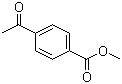 |
| Molecular Formula | C10H10O3 |
| Molecular Weight | 178.18 |
| CAS Registry Number | 3609-53-8 |
| EC Number | 807-734-8 |
| SMILES | CC(=O)C1=CC=C(C=C1)C(=O)OC |
| Density | 1.1±0.1 g/cm3 Calc.* |
|---|---|
| Melting point | 93 - 96 °C (Expl.) |
| Boiling point | 295.6±23.0 °C 760 mmHg (Calc.)* |
| Flash point | 129.3±22.7 °C (Calc.)* |
| Index of refraction | 1.517 (Calc.)* |
| * | Calculated using Advanced Chemistry Development (ACD/Labs) Software. |
| Hazard Symbols |  GHS07 Warning Details GHS07 Warning Details | ||||||||||||||||||||
|---|---|---|---|---|---|---|---|---|---|---|---|---|---|---|---|---|---|---|---|---|---|
| Risk Statements | H315-H319-H335 Details | ||||||||||||||||||||
| Safety Statements | P261-P264-P264+P265-P271-P280-P302+P352-P304+P340-P305+P351+P338-P319-P321-P332+P317-P337+P317-P362+P364-P403+P233-P405-P501 Details | ||||||||||||||||||||
| Hazard Classification | |||||||||||||||||||||
| |||||||||||||||||||||
| SDS | Available | ||||||||||||||||||||
 chemBlink Chemical Story
|
Methyl 4-acetylbenzoate is an aromatic ester compound characterized by a methyl ester group and an acetyl substituent positioned para to each other on a benzene ring. Its molecular structure is derived from benzoic acid, where the carboxylic acid is esterified with methanol and the acetyl group is introduced at the 4-position of the aromatic ring. The systematic IUPAC name is methyl 4-acetylbenzoate, and its molecular formula is C10H10O3. The compound was first synthesized as part of studies in esterification and electrophilic aromatic substitution chemistry. Its synthesis typically involves two key steps: acetylation of methyl benzoate or, alternatively, esterification of 4-acetylbenzoic acid. The Friedel–Crafts acylation reaction is commonly employed to introduce the acetyl group onto the aromatic ring, using acetyl chloride or acetic anhydride in the presence of a Lewis acid catalyst such as aluminum chloride. In another approach, 4-acetylbenzoic acid is reacted with methanol under acidic conditions to produce the methyl ester via Fischer esterification. Methyl 4-acetylbenzoate is often used in organic synthesis as an intermediate or model compound. Its dual functional groups—an ester and a ketone—make it a valuable substrate for various chemical reactions, including nucleophilic substitution, reduction, and condensation processes. For example, the ketone group can undergo reactions such as aldol condensation, while the ester moiety can participate in hydrolysis or transesterification under appropriate conditions. In materials science and pharmaceuticals, derivatives of methyl 4-acetylbenzoate have been explored for their structural compatibility with polymers and potential as precursors in drug development. Its relatively simple structure and stability under mild conditions make it a good candidate for studies in reactivity and mechanism elucidation. Spectroscopic analysis of methyl 4-acetylbenzoate typically shows characteristic signals in nuclear magnetic resonance (NMR) and infrared (IR) spectra. The ester carbonyl stretch appears near 1735 cm−1, while the ketone carbonyl group shows a strong absorption around 1680 cm−1 in the IR spectrum. In 1H NMR, the methyl group of the ester appears as a singlet around 3.9 ppm, and the methyl group of the acetyl substituent appears as a singlet near 2.6 ppm. The aromatic protons generally resonate between 7.5 and 8.2 ppm, reflecting their position in a substituted benzene ring. This compound has also found minor applications in the fragrance and flavor industries, where esters are often evaluated for their scent profiles and chemical stability. However, methyl 4-acetylbenzoate is primarily a research compound rather than a commercially significant fragrance ingredient. Because it contains both an ester and a ketone group, methyl 4-acetylbenzoate is sometimes used in educational laboratories to demonstrate functional group transformations or spectroscopic identification. In such settings, students are able to investigate chemical reactivity and confirm structural identity using standard analytical techniques. In environmental and safety contexts, methyl 4-acetylbenzoate is considered to have low toxicity, but as with most organic compounds, appropriate handling procedures are required. It should be stored in a cool, dry place and kept away from strong oxidizing agents. Personal protective equipment, including gloves and eye protection, is recommended when handling the compound in laboratory settings. Overall, methyl 4-acetylbenzoate is a useful compound in synthetic organic chemistry due to its defined reactivity, ease of preparation, and structural clarity. Its applications span academic research, method development, and material precursor studies. References 2022. Rhodium-Catalyzed Regio- and Enantioselective Direct Allylation of Methyl Ketones. Synlett, 33(15). DOI: 10.1055/a-1892-4134 2022. Enantioselective Allylation of Ketones with Allene. Science of Synthesis. URL: https://science-of-synthesis.thieme.com/app/text/?id=SD-238-00041 2017. Transition-Metal- and Halogen-Free Oxidation of Benzylic sp3 C-H Bonds to Carbonyl Groups Using Potassium Persulfate. Synthesis, 49(15). DOI: 10.1055/s-0036-1588429 |
| Market Analysis Reports |