
Online Database of Chemicals from Around the World
| MolScanner | Singapore | |||
|---|---|---|---|---|
 | www.molscanner.com | |||
 | +86 18621675448 | |||
 | marketing@molscanner.com | |||
 | WhatsApp:9896 7603 | |||
| Chemical manufacturer since 2025 | ||||
| chemBlink Standard supplier since 2025 | ||||
| Classification | Chemical reagent >> Organic reagent >> Ester >> Acid ester compound |
|---|---|
| Name | Methyl cis-4-hydroxycyclohexanecarboxylate |
| Synonyms | cis-Methyl 4-hydroxycyclohexanecarboxylate |
| Molecular Structure | 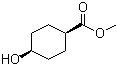 |
| Molecular Formula | C8H14O3 |
| Molecular Weight | 158.19 |
| CAS Registry Number | 3618-03-9 |
| EC Number | 965-840-0 |
| SMILES | COC(=O)C1CCC(CC1)O |
| Solubility | Soluble (41 g/L) (25 °C), Calc.* |
|---|---|
| Density | 1.121±0.06 g/cm3 (20 °C 760 Torr), Calc.* |
| Boiling point | 233.3±33.0 °C (760 Torr), Calc.* |
| Refractive index | 1.4705 (589.3 nm 21.5 °C)** |
| Flash point | 93.5±18.2 °C, Calc.* |
| * | Calculated using Advanced Chemistry Development (ACD/Labs) Software V11.02 (©1994-2013 ACD/Labs) |
| ** | Hardegger, E. |
| Hazard Symbols |  GHS07 Warning Details GHS07 Warning Details | ||||||||||||||||
|---|---|---|---|---|---|---|---|---|---|---|---|---|---|---|---|---|---|
| Risk Statements | H302-H312-H315-H319-H332-H335 Details | ||||||||||||||||
| Safety Statements | P261-P264-P264+P265-P270-P271-P280-P301+P317-P302+P352-P304+P340-P305+P351+P338-P317-P319-P321-P330-P332+P317-P337+P317-P362+P364-P403+P233-P405-P501 Details | ||||||||||||||||
| Hazard Classification | |||||||||||||||||
| |||||||||||||||||
| SDS | Available | ||||||||||||||||
 chemBlink Chemical Story
|
Methyl cis-4-hydroxycyclohexanecarboxylate is an organic compound that contains a cyclohexane ring with a hydroxyl group at the 4-position and a carboxylate ester group at the 1-position. The structure is characterized by the presence of a cis configuration, meaning that the hydroxyl group and the ester group are positioned on the same side of the cyclohexane ring. This molecular arrangement influences the compound’s physical and chemical properties, making it useful in various synthetic and industrial applications. The compound is typically synthesized through a series of chemical reactions involving the functionalization of cyclohexane derivatives. The introduction of the hydroxy group at the 4-position is usually achieved through selective hydroxylation reactions, followed by esterification to form the methyl ester group. The cis stereochemistry is important in determining the three-dimensional shape of the molecule, influencing its reactivity and interactions with other compounds. Methyl cis-4-hydroxycyclohexanecarboxylate finds application in the synthesis of various pharmaceutical intermediates. The cyclohexane ring is a key structural motif in many bioactive molecules, and the incorporation of the hydroxy and ester groups can modify the compound’s biological properties. For instance, the hydroxyl group can participate in hydrogen bonding interactions, which may enhance the solubility or stability of the compound in biological systems. The ester functionality, on the other hand, can serve as a reactive site for further chemical modifications or conjugation with other functional groups. One of the significant uses of methyl cis-4-hydroxycyclohexanecarboxylate is in the synthesis of chiral intermediates for drug development. The cis configuration of the hydroxy and ester groups may confer stereoselectivity in reactions, making it useful in the preparation of optically active compounds. The compound’s ability to undergo transformations while retaining its stereochemical integrity is valuable in the synthesis of complex molecules with high precision. In addition to its pharmaceutical applications, methyl cis-4-hydroxycyclohexanecarboxylate can be used in materials science, particularly in the synthesis of polymers and other organic materials. The functional groups present on the cyclohexane ring allow for the creation of specialized materials with tailored properties, such as enhanced flexibility, solubility, or thermal stability. The ester group can facilitate polymerization reactions, leading to the formation of copolymers or other advanced materials. Furthermore, the compound has potential applications in agrochemicals, where cyclohexane derivatives are often employed as key building blocks for the development of herbicides, insecticides, or fungicides. The functional groups on methyl cis-4-hydroxycyclohexanecarboxylate could be further modified to optimize its activity against specific pests or pathogens, making it a useful intermediate in the synthesis of agrochemical products. Methyl cis-4-hydroxycyclohexanecarboxylate also serves as a model compound for studying the stereochemistry and reactivity of cyclic esters and hydroxylated compounds. Its well-defined structure makes it a useful reference in the field of organic chemistry, particularly in research focused on the reactivity of functionalized cyclohexane derivatives. In summary, methyl cis-4-hydroxycyclohexanecarboxylate is a versatile compound with applications in drug synthesis, materials science, and agrochemicals. Its unique structure, which combines a hydroxyl group and an ester group on a cyclohexane ring, makes it valuable for the preparation of chiral intermediates and specialized materials. The compound’s ability to undergo chemical transformations while retaining its stereochemical configuration enhances its utility in organic synthesis and research. |
| Market Analysis Reports |