
Online Database of Chemicals from Around the World
| Jinan Chenghui-Shuangda Chemical Co., Ltd. | China | |||
|---|---|---|---|---|
 | www.jnchsd.com | |||
 | +86 (531) 5889-7051 +86 15053146086 | |||
 | +86 (531) 5889-7093 | |||
 | jnchsd@qq.com | |||
 | QQ Chat | |||
| Chemical manufacturer since 2002 | ||||
| chemBlink Standard supplier since 2007 | ||||
| Hefei TNJ Chemical Industry Co., Ltd. | China | |||
|---|---|---|---|---|
| www.tnjchem.com | |||
| +86 (551) 6541-8684 | |||
| +86 (551) 6541-8697 | |||
| sales@tnjchem.com | |||
| Chemical manufacturer since 2001 | ||||
| chemBlink Standard supplier since 2010 | ||||
| BOC Sciences | USA | |||
|---|---|---|---|---|
| www.bocsci.com | |||
| +1 (631) 485-4226 | |||
| +1 (631) 614-7828 | |||
| info@bocsci.com | |||
| Chemical manufacturer | ||||
| chemBlink Standard supplier since 2010 | ||||
| Hangzhou Leap Chem Co., Ltd. | China | |||
|---|---|---|---|---|
| www.leapchem.com | |||
| +86 (571) 8771-1850 | |||
| market19@leapchem.com | |||
| QQ Chat | |||
| Chemical manufacturer since 2006 | ||||
| chemBlink Standard supplier since 2015 | ||||
| Amadis Chemical Co., Ltd. | China | |||
|---|---|---|---|---|
| www.amadischem.com | |||
| +86 (571) 8992-5085 | |||
| +86 (571) 8992-5065 | |||
| sales@amadischem.com | |||
| Chemical manufacturer since 2010 | ||||
| chemBlink Standard supplier since 2015 | ||||
| Shandong Chenghui Shuangda Pharmaceutical Co., Ltd. | China | |||
|---|---|---|---|---|
| www.chsdpharma.com | |||
| +86-531-58897029 | |||
| ericqiao@jnchsd.com | |||
| QQ Chat | |||
 | WeChat: 15550412551 | |||
 | WhatsApp:15550412551 | |||
| Chemical manufacturer since 2014 | ||||
| chemBlink Standard supplier since 2025 | ||||
| Aronis | Russia | |||
|---|---|---|---|---|
| www.aronis.ru | |||
| +7 (926) 578-0336 | |||
| +7 (495) 426-5336 | |||
| rakishev@aronis.ru | |||
| Chemical manufacturer | ||||
| Kemprotec Limited | UK | |||
|---|---|---|---|---|
| www.kemprotec.com | |||
| +44 (1642) 591-764 | |||
| +44 (1845) 550-001 | |||
| sales@kemprotec.co.uk | |||
| Chemical distributor since 1998 | ||||
| Santa Cruz Biotechnology, Inc. | USA | |||
|---|---|---|---|---|
| www.scbt.com | |||
| +1 (831) 457-3800 | |||
| +1 (831) 457-3801 | |||
| scbt@scbt.com | |||
| Chemical manufacturer | ||||
| AK Scientific, Inc | USA | |||
|---|---|---|---|---|
| www.aksci.com | |||
| +1 (510) 429-8835 | |||
| +1 (510) 429-8836 | |||
| sales@aksci.com | |||
| Chemical manufacturer | ||||
| Sinbond Industrial Co., Ltd. | China | |||
|---|---|---|---|---|
| www.sinbondpharm.com | |||
| +86 (531) 8703-8285 +86 13583181986 +44 (208) 242-5518 | |||
| +86 (531) 8703-8285 | |||
| cici1124@gmail.com | |||
| QQ Chat | |||
| Chemical manufacturer since 2014 | ||||
| Classification | API >> Digestive system medication >> Gastrointestinal motility drugs |
|---|---|
| Name | Metoclopramide |
| Synonyms | 4-Amino-5-chloro-N-(2-(diethylamino)ethyl)-2-methoxybenzamide |
| Molecular Structure | 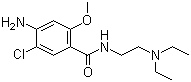 |
| Molecular Formula | C14H22ClN3O2 |
| Molecular Weight | 299.80 |
| CAS Registry Number | 364-62-5 |
| EC Number | 206-662-9 |
| SMILES | CCN(CC)CCNC(=O)C1=CC(=C(C=C1OC)N)Cl |
| Density | 1.2±0.1 g/cm3 Calc.* |
|---|---|
| Boiling point | 454.8±55.0 °C 760 mmHg (Calc.)* |
| Flash point | 228.9±31.5 °C (Calc.)* |
| Solubility | DMSO 60mg/mL, Water 60mg/mL, Ethanol <1mg/mL (Expl.) |
| Index of refraction | 1.545 (Calc.)* |
| * | Calculated using Advanced Chemistry Development (ACD/Labs) Software. |
| Hazard Symbols |   GHS07;GHS08 Danger Details GHS07;GHS08 Danger Details | ||||||||||||||||
|---|---|---|---|---|---|---|---|---|---|---|---|---|---|---|---|---|---|
| Risk Statements | H302-H362-H370 Details | ||||||||||||||||
| Safety Statements | P203-P260-P263-P264-P270-P301+P317-P308+P316-P318-P321-P330-P405-P501 Details | ||||||||||||||||
| Hazard Classification | |||||||||||||||||
| |||||||||||||||||
| SDS | Available | ||||||||||||||||
 chemBlink Chemical Story
|
Metoclopramide is a medication classified as a dopamine D2 receptor antagonist with prokinetic and antiemetic properties. It is widely used to treat gastrointestinal motility disorders and to prevent nausea and vomiting caused by various conditions, including chemotherapy, surgery, and migraine. Metoclopramide was first synthesized in the 1950s and introduced into clinical use during the 1960s. It was developed to improve gastrointestinal motility by enhancing the response of the upper gastrointestinal tract to acetylcholine, thereby accelerating gastric emptying and increasing the tone of the lower esophageal sphincter. This effect makes metoclopramide effective in conditions like gastroparesis, where delayed gastric emptying occurs. Pharmacologically, metoclopramide acts by blocking dopamine D2 receptors in the chemoreceptor trigger zone of the central nervous system, which reduces nausea and vomiting. Additionally, by antagonizing peripheral D2 receptors in the gastrointestinal tract, it increases the release of acetylcholine, promoting enhanced gastric motility and accelerated transit through the stomach and intestines. Metoclopramide is available in various formulations, including oral tablets, oral solution, and injectable forms. The onset of action varies with the route of administration, but the drug generally provides symptomatic relief within 30 to 60 minutes. The duration of effect lasts several hours, making it suitable for multiple daily dosing schedules. Clinically, metoclopramide is indicated for the treatment of diabetic gastroparesis, prevention of chemotherapy-induced nausea and vomiting, postoperative nausea and vomiting, and symptomatic treatment of gastroesophageal reflux disease when other therapies are insufficient. It is also used off-label to promote gastric emptying in other motility disorders. Pharmacokinetically, metoclopramide is well absorbed from the gastrointestinal tract, with a bioavailability of approximately 80%. It undergoes hepatic metabolism and is excreted mainly by the kidneys. The elimination half-life is approximately 5 to 6 hours in adults with normal renal function. Adverse effects of metoclopramide are primarily related to its central dopamine antagonism and include extrapyramidal symptoms such as dystonia, akathisia, and parkinsonism, especially with higher doses or prolonged use. Tardive dyskinesia is a rare but serious side effect associated with long-term use. Other common side effects include fatigue, drowsiness, and gastrointestinal disturbances. Because of the risk of neurological adverse effects, regulatory agencies recommend limiting the duration of metoclopramide use to short-term treatment, usually not exceeding 12 weeks. The drug is contraindicated in patients with pheochromocytoma, epilepsy, and gastrointestinal obstruction. In summary, metoclopramide is a dopamine D2 receptor antagonist with prokinetic and antiemetic effects used in the treatment of gastrointestinal motility disorders and prevention of nausea and vomiting. Its clinical utility is balanced by the potential for neurological side effects, necessitating cautious use and monitoring. References 1979. Striatal DOPAC elevation predicts antipsychotic efficacy of metoclopramide. Life Sciences, 24(20). DOI: 10.1016/0024-3205(79)90243-1 1990. Clinical Pharmacokinetics of Drugs Used in the Treatment of Gastrointestinal Diseases (Part I). Clinical Pharmacokinetics, 19(1). DOI: 10.2165/00003088-199019010-00002 1991. Acceleration of Luteinizing Hormone Pulse Frequency in Functional Hypothalamic Amenorrhea by Dopaminergic Blockade. The Journal of Clinical Endocrinology and Metabolism, 72(1). DOI: 10.1210/jcem-72-1-151 |
| Market Analysis Reports |