
Online Database of Chemicals from Around the World
| LOBA Feinchemie AG | Austria | |||
|---|---|---|---|---|
 | www.loba.co.at | |||
 | +43 (223) 277-391 | |||
 | +43 (223) 276-677 | |||
 | sales@loba.co.at | |||
| Chemical distributor | ||||
| chemBlink Standard supplier since 2012 | ||||
| Hangzhou Leap Chem Co., Ltd. | China | |||
|---|---|---|---|---|
| www.leapchem.com | |||
| +86 (571) 8771-1850 | |||
| market19@leapchem.com | |||
 | QQ Chat | |||
| Chemical manufacturer since 2006 | ||||
| chemBlink Standard supplier since 2015 | ||||
| Avonchem/Chromos Express Ltd. | UK | |||
|---|---|---|---|---|
| www.avonchem.co.uk | |||
| +44 (1625) 434-300 | |||
| +44 (1625) 869-777 | |||
| info@avonchem.co.uk | |||
| Chemical manufacturer | ||||
| AK Scientific, Inc | USA | |||
|---|---|---|---|---|
| www.aksci.com | |||
| +1 (510) 429-8835 | |||
| +1 (510) 429-8836 | |||
| sales@aksci.com | |||
| Chemical manufacturer | ||||
| Classification | Analytical chemistry >> Standard >> Spectrometric standard |
|---|---|
| Name | 2,4,6-Tri(2-pyridyl)-1,3,5-triazine |
| Synonyms | 2,4,6-Tripyridyl-S-triazine |
| Molecular Structure | 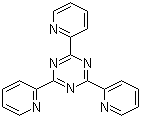 |
| Molecular Formula | C18H12N6 |
| Molecular Weight | 312.33 |
| CAS Registry Number | 3682-35-7 |
| EC Number | 222-965-9 |
| SMILES | C1=CC=NC(=C1)C2=NC(=NC(=N2)C3=CC=CC=N3)C4=CC=CC=N4 |
| Density | 1.276 |
|---|---|
| Melting point | 248-251 °C |
| Hazard Symbols |  GHS07 Warning Details GHS07 Warning Details | ||||||||||||||||||||||||||||||||
|---|---|---|---|---|---|---|---|---|---|---|---|---|---|---|---|---|---|---|---|---|---|---|---|---|---|---|---|---|---|---|---|---|---|
| Risk Statements | H315-H319-H335 Details | ||||||||||||||||||||||||||||||||
| Safety Statements | P261-P264-P264+P265-P271-P280-P302+P352-P304+P340-P305+P351+P338-P319-P321-P332+P317-P337+P317-P362+P364-P403+P233-P405-P501 Details | ||||||||||||||||||||||||||||||||
| Hazard Classification | |||||||||||||||||||||||||||||||||
| |||||||||||||||||||||||||||||||||
| SDS | Available | ||||||||||||||||||||||||||||||||
 chemBlink Chemical Story
|
2,4,6-Tris(2-pyridyl)-1,3,5-triazine, commonly known as TPTZ, is a heterocyclic compound with important applications in analytical chemistry. Its chemical formula is C18H12N6 and features a triazine ring substituted with three pyridyl groups. This unique structure imparts unique properties that make TPTZ a valuable reagent in various scientific fields, especially for iron detection and complexation studies. The discovery of TPTZ dates back to the mid-20th century, when researchers were exploring new chelating agents. The synthesis of TPTZ was part of an effort to develop reagents that could selectively bind metal ions, especially transition metals. Its ability to form highly stable complexes with iron ions quickly made it a staple in analytical chemistry. One of the main applications of TPTZ is the colorimetric determination of iron. When TPTZ forms a complex with Fe(II) ions, it produces a very intense blue color that can be quantitatively measured using spectrophotometry. This reaction is the basis of the widely used Ferric Reducing Power of Plasma (FRAP) assay. The FRAP assay measures the antioxidant capacity of plasma by assessing its ability to reduce Fe(III)-TPTZ complexes to Fe(II)-TPTZ, providing insight into the antioxidant status of biological samples. This application is particularly important in clinical biochemistry and nutrition research, where oxidative stress and antioxidant capacity are key areas of research. In addition to its use in iron detection, TPTZ is used in the synthesis and characterization of metal complexes. Its strong binding affinity for transition metals makes it an ideal ligand for studying coordination chemistry and catalysis. Researchers have used TPTZ to synthesize novel metal complexes that have potential applications in materials science, catalysis, and pharmaceuticals. These complexes often exhibit unique electronic, magnetic, and catalytic properties that aid in advances in these fields. TPTZ is also used in environmental chemistry for the analysis of water and soil samples. Its ability to detect trace amounts of iron and other transition metals aids in monitoring environmental pollution and assessing the quality of natural resources. Accurately measuring metal concentrations is critical to ensuring environmental safety and regulatory compliance. In addition to analytical applications, TPTZ is also used in organic synthesis. Its triazine ring provides a versatile scaffold for building more complex molecules, and its pyridyl group provides a reactive site for further functionalization. This versatility makes TPTZ a valuable building block for the development of new chemical entities for pharmaceuticals and agrochemicals. Handling and storage of TPTZ require standard laboratory precautions. The compound should be stored in a cool, dry place away from light and moisture to maintain its stability. When preparing solutions, appropriate safety measures such as the use of gloves, goggles, and adequate ventilation should be followed to avoid exposure and ensure safe handling. References 2017. Triazine Ligands in Coordination Chemistry. Inorganic Chemistry, 56(14). DOI: 10.1021/acs.inorgchem.7b00987 |
| Market Analysis Reports |