
Online Database of Chemicals from Around the World
| Alfa Chemistry | USA | |||
|---|---|---|---|---|
 | www.alfa-chemistry.com | |||
 | +1 (516) 734-6573 | |||
 | +1 (516) 927-0118 | |||
 | support@alfa-chemistry.com | |||
| Chemical manufacturer since 2005 | ||||
| chemBlink Standard supplier since 2012 | ||||
| Biosynth AG. | Switzerland | |||
|---|---|---|---|---|
| www.biosynth.com | |||
| +41 (71) 858-2020 | |||
| +41 (71) 858-2030 | |||
| welcome@biosynth.ch | |||
| Chemical manufacturer | ||||
| chemBlink Standard supplier since 2014 | ||||
| Shenzhen Geneseqtools Bioscience & Technology Co. Ltd. | China | |||
|---|---|---|---|---|
| geneseqtools.com | |||
| +86 (0755) 2325-1735 | |||
| sales@geneseqtools.com | |||
 | QQ Chat | |||
 | WeChat: 13302967066 | |||
| Chemical manufacturer since 2015 | ||||
| chemBlink Standard supplier since 2025 | ||||
| Classification | Biochemical >> Carbohydrate >> Monosaccharide |
|---|---|
| Name | beta-D-Glucopyranosiduronic acid 5-bromo-4-chloro-1H-indol-3-yl sodium salt hydrate |
| Synonyms | beta-D-Glucopyranosiduronic acid 5-bromo-4-chloro-1H-indol-3-yl monosodium salt trihydrate |
| Molecular Structure | 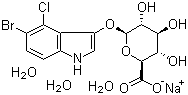 |
| Molecular Formula | C14H12BrClNO7.3(H2O).Na |
| Molecular Weight | 498.64 |
| CAS Registry Number | 370100-64-4 |
| SMILES | C1=CC(=C(C2=C1NC=C2O[C@H]3[C@@H]([C@H]([C@@H]([C@H](O3)C(=O)[O-])O)O)O)Cl)Br.O.O.O.[Na+] |
| Hazard Symbols |  GHS07 Warning Details GHS07 Warning Details |
|---|---|
| Risk Statements | H317-H319 Details |
| Safety Statements | P280-P305+351+338 Details |
| SDS | Available |
 chemBlink Chemical Story
|
beta-D-Glucopyranosiduronic acid 5-bromo-4-chloro-1H-indol-3-yl sodium salt hydrate is a synthetic chromogenic substrate designed for sensitive and specific detection of β-glucuronidase activity. It consists of a beta-D-glucuronic acid residue conjugated at the anomeric position to a substituted indoxyl group, specifically 5-bromo-4-chloro-1H-indol-3-ol. The sodium salt form enhances aqueous solubility, and the compound is typically available as a hydrate for improved stability and handling. The utility of this compound lies in its ability to release a colored or insoluble product upon enzymatic cleavage. When beta-glucuronidase catalyzes the hydrolysis of the glycosidic bond, the 5-bromo-4-chloro-indoxyl moiety is liberated. Under oxidative conditions (e.g., exposure to air), it spontaneously dimerizes and oxidizes to form an intensely colored blue precipitate, making it particularly useful in histochemical and microbiological applications. This visible color change is instrumental in qualitative and quantitative detection of beta-glucuronidase activity. A key area of application is in the identification of Escherichia coli in water quality testing, as E. coli typically expresses beta-glucuronidase, which rapidly hydrolyzes such substrates. In this context, the chromogenic response allows easy visual confirmation of bacterial contamination in environmental or clinical samples. The compound is frequently incorporated into selective media formulations to aid in the rapid screening of microbial colonies. Beyond microbiology, beta-D-glucopyranosiduronic acid derivatives are also used in enzymology to study the role of beta-glucuronidases in human physiology and disease, particularly in the context of lysosomal storage disorders, liver function, and cancer biology. The measurement of enzyme kinetics, inhibitor screening, and mechanistic studies are all facilitated by the use of this substrate due to its clear, colorimetric output and high specificity. The indoxyl-based chromophore design is particularly advantageous, as it provides a strong color signal even at low concentrations of enzyme, improving the sensitivity of detection in complex biological matrices. Furthermore, the sodium salt form improves dissolution properties, which is important for consistent performance in aqueous assay systems. In practical laboratory use, the compound is typically dissolved in buffer at a slightly alkaline pH, where beta-glucuronidase exhibits optimal activity. Upon enzymatic reaction and oxidative development of the indigo dye, absorbance is often measured spectrophotometrically, or visually assessed in solid media or plate assays. This flexibility makes it a versatile tool in both research and diagnostic settings. In summary, beta-D-glucopyranosiduronic acid 5-bromo-4-chloro-1H-indol-3-yl sodium salt hydrate is a robust, sensitive, and specific chromogenic substrate for beta-glucuronidase. Its strong visual response, coupled with ease of use in various assay formats, supports wide-ranging applications in microbiology, enzymology, and clinical diagnostics. |
| Market Analysis Reports |