
Online Database of Chemicals from Around the World
| Hangzhou Verychem Science And Technology Co., Ltd. | China | |||
|---|---|---|---|---|
 | www.verychem.com | |||
 | +86 (571) 8816-2785 +86 13606544505 | |||
 | +86 (571) 8816-2787 | |||
 | lucy@verychem.com | |||
| Chemical manufacturer since 2004 | ||||
| chemBlink Massive supplier since 2021 | ||||
| Tikslioji Sinteze | Lithuania | |||
|---|---|---|---|---|
| www.finesynthesis.lt | |||
| +370 (5) 213-5553 | |||
| ardan@micro.lt | |||
| Chemical manufacturer | ||||
| chemBlink Standard supplier since 2008 | ||||
| BOC Sciences | USA | |||
|---|---|---|---|---|
| www.bocsci.com | |||
| +1 (631) 485-4226 | |||
| +1 (631) 614-7828 | |||
| info@bocsci.com | |||
| Chemical manufacturer | ||||
| chemBlink Standard supplier since 2010 | ||||
| Hangzhou Leap Chem Co., Ltd. | China | |||
|---|---|---|---|---|
| www.leapchem.com | |||
| +86 (571) 8771-1850 | |||
| market19@leapchem.com | |||
 | QQ Chat | |||
| Chemical manufacturer since 2006 | ||||
| chemBlink Standard supplier since 2015 | ||||
| True Pharmachem Inc. | USA | |||
|---|---|---|---|---|
| www.truepharmachem.com | |||
| +1 (217) 766-6932 | |||
| +1 (973) 588-3470 | |||
| sales@truepharmachem.com | |||
| Chemical manufacturer | ||||
| Anvia Chemicals, LLC | USA | |||
|---|---|---|---|---|
| www.anviachem.com | |||
| +1 (414) 534-7845 | |||
| +1 (414) 762-5539 | |||
| sales@anviachem.com | |||
| Chemical manufacturer | ||||
| Classification | Pharmaceutical intermediate >> Heterocyclic compound intermediate >> Pyridine compound >> Pyridine derivative |
|---|---|
| Name | 2,6-Pyridinedicarboxylic acid chloride |
| Synonyms | 2,6-Pyridinedicarbonyl dichloride; Pyridine-2,6-dicarboxylic acid chloride |
| Molecular Structure | 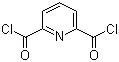 |
| Molecular Formula | C7H3Cl2NO2 |
| Molecular Weight | 204.01 |
| CAS Registry Number | 3739-94-4 |
| EC Number | 223-125-4 |
| SMILES | C1=CC(=NC(=C1)C(=O)Cl)C(=O)Cl |
| Melting point | 57-61 °C |
|---|---|
| Boiling point | 284 °C |
| Hazard Symbols |  GHS05 Danger Details GHS05 Danger Details | ||||||||
|---|---|---|---|---|---|---|---|---|---|
| Risk Statements | H314 Details | ||||||||
| Safety Statements | P260-P264-P280-P301+P330+P331-P302+P361+P354-P304+P340-P305+P354+P338-P316-P321-P363-P405-P501 Details | ||||||||
| Hazard Classification | |||||||||
| |||||||||
| Transport Information | UN 3261 | ||||||||
| SDS | Available | ||||||||
 chemBlink Chemical Story
|
2,6-Pyridinedicarbonyl chloride, also known as dipyridinyl chloride or 2,6-pyridinedicarbonyl chloride, has the chemical formula C7H3Cl2NO2 and a molecular weight of 204.01 g/mol. The pyridine ring of this compound is substituted with carbonyl chloride groups at the 2 and 6 positions to become a reactive acyl chloride derivative of pyridinedicarboxylic acid. It plays an important role in organic synthesis and materials science due to its reactivity and versatile functional groups. 2,6-Pyridinedicarbonyl chloride originated from the study of acyl chlorides and their applications in organic synthesis. The development of this compound stemmed from the need for an effective reagent to introduce acyl groups into a variety of molecules. Researchers recognized its potential in the synthesis of versatile compounds and advanced materials. The synthesis usually involves the chlorination of 2,6-pyridinedicarboxylic acid to convert it into a reactive chloride derivative. The synthesis of 2,6-pyridinedicarboxylic acid chloride involves the conversion of 2,6-pyridinedicarboxylic acid into its acid chloride form using reagents such as thionyl chloride (SOCl2) or phosphorus trichloride (PCl3). The reaction is usually carried out under controlled conditions to obtain the desired product. The compound produced by this synthesis is highly reactive and can be used in a variety of chemical transformations. In organic synthesis, 2,6-pyridinedicarboxylic acid chloride can be used as a versatile acylating agent. Its two acid chloride groups enable it to introduce acyl functionalities into different molecules, facilitating the synthesis of multifunctional compounds including esters, amides, and anhydrides. This reactivity is essential for the creation of complex organic molecules in pharmaceuticals and fine chemicals. The compound is used in polymer chemistry to synthesize polyimides and polyesters. Its ability to react with diols or diamines enables it to form polymers with a pyridine backbone, which helps improve the thermal stability and mechanical properties of the material. These polymers can be used in high-performance materials and coatings. 2,6-Pyridinedicarboxylic acid chloride is also used in coordination chemistry to synthesize metal organic frameworks (MOFs) and coordination polymers. Its bifunctional nature enables it to coordinate with metal ions to form structures with potential applications in catalysis, gas storage, and separation technologies. In research laboratories, it acts as a reagent to explore new synthetic pathways and develop novel compounds. Its reactivity with nucleophiles makes it a valuable tool for studying acylation reactions and designing new molecules with specific functionalities. References 2023. Thiocyanate-induced N-activation and nucleophilic 1,2-dearomatization of pyridinedicarbonyl dichloride: a synthetic route to a novel 1,2-dihydropyridine-based heterocyclic compound. Journal of the Iranian Chemical Society, 20(8). DOI: 10.1007/s13738-023-02863-1 2020. Synthesis of Macroheterocycles Containing Pyridine-2,6-dicarboxylic and Adipic Acid Ester and Hydrazide Fragments Starting from Tetrahydropyran. Russian Journal of Organic Chemistry, 56(12). DOI: 10.1134/s1070428020120295 2019. Synthesis and Enzyme Inhibitory Activity of Novel Pyridine-2,6-dicarboxamides Bearing Primary Sulfonamide Groups. Russian Journal of Organic Chemistry, 55(12). DOI: 10.1134/s1070428019120248 |
| Market Analysis Reports |