
Online Database of Chemicals from Around the World
| Simagchem Corporation | China | |||
|---|---|---|---|---|
 | www.simagchem.com | |||
 | +86 13806087780 | |||
 | +86 (592) 268-0237 | |||
 | sale@simagchem.com | |||
| Chemical manufacturer since 2002 | ||||
| chemBlink Standard supplier since 2008 | ||||
| Hangzhou Leap Chem Co., Ltd. | China | |||
|---|---|---|---|---|
| www.leapchem.com | |||
| +86 (571) 8771-1850 | |||
| market19@leapchem.com | |||
 | QQ Chat | |||
| Chemical manufacturer since 2006 | ||||
| chemBlink Standard supplier since 2015 | ||||
| Hangzhou Chuan Shuo Technology Co., Ltd. | China | |||
|---|---|---|---|---|
| www.transol.cn | |||
| +86 (571) 8760-9021 | |||
| qian@transol.cn | |||
| Chemical manufacturer since 2017 | ||||
| chemBlink Standard supplier since 2025 | ||||
| Ryan Scientific, Inc. | USA | |||
|---|---|---|---|---|
| www.ryansci.com | |||
| +1 (843)-884-4911 | |||
| +1 (843) 884-5568 | |||
| sales@ryansci.com | |||
| Chemical manufacturer | ||||
| Jintan Jinlv Chemical Factory | China | |||
|---|---|---|---|---|
| www.jinlvchem.com | |||
| +86 (519) 8222-9885 +86 13861079985 +86 13861118999 | |||
| +86 (519) 8231-8588 | |||
| gyq@jinlvchem.com 1685170901@qq.com | |||
| Chemical manufacturer since 1985 | ||||
| Classification | Chemical pesticide >> Herbicide >> Herbicide antidote |
|---|---|
| Name | Fenclorim |
| Synonyms | 4,6-Dichloro-2-phenylpyrimidine |
| Molecular Structure | 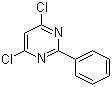 |
| Molecular Formula | C10H6Cl2N2 |
| Molecular Weight | 225.08 |
| CAS Registry Number | 3740-92-9 |
| EC Number | 609-426-7 |
| SMILES | C1=CC=C(C=C1)C2=NC(=CC(=N2)Cl)Cl |
| Density | 1.4±0.1 g/cm3 Calc.* |
|---|---|
| Boiling point | 235.5±33.0 °C 760 mmHg (Calc.)* |
| Flash point | 118.9±11.0 °C (Calc.)* |
| Index of refraction | 1.605 (Calc.)* |
| * | Calculated using Advanced Chemistry Development (ACD/Labs) Software. |
| Hazard Symbols |    GHS05;GHS07;GHS09 Danger Details GHS05;GHS07;GHS09 Danger Details | ||||||||||||||||||||||||||||||||
|---|---|---|---|---|---|---|---|---|---|---|---|---|---|---|---|---|---|---|---|---|---|---|---|---|---|---|---|---|---|---|---|---|---|
| Risk Statements | H317-H318-H332-H400-H410 Details | ||||||||||||||||||||||||||||||||
| Safety Statements | P261-P264+P265-P271-P272-P273-P280-P302+P352-P304+P340-P305+P354+P338-P317-P321-P333+P317-P362+P364-P391-P501 Details | ||||||||||||||||||||||||||||||||
| Hazard Classification | |||||||||||||||||||||||||||||||||
| |||||||||||||||||||||||||||||||||
| SDS | Available | ||||||||||||||||||||||||||||||||
 chemBlink Chemical Story
|
Fenclorim is a chemical compound belonging to the class of herbicide safeners, which are substances used in agriculture to protect crop plants from the harmful effects of herbicides without reducing the efficacy of the herbicide against weeds. Its chemical name is 2-(2-chlorophenyl)-1,3-oxazol-4-yl dimethylcarbamate, and it is characterized by a molecular structure containing an oxazole ring substituted with a chlorophenyl group and a dimethylcarbamate moiety. Fenclorim was developed and introduced in the late 20th century as part of efforts to improve herbicide selectivity and crop safety. The compound is primarily used in conjunction with herbicides such as pyrazoxyfen and other members of the pyrazole herbicide family. Its safener activity is achieved by enhancing the crop plant’s detoxification mechanisms, including the induction of enzymes such as cytochrome P450 monooxygenases and glutathione S-transferases. These enzymes metabolize and detoxify herbicides more effectively, reducing phytotoxicity to the crop. Fenclorim is especially important in rice cultivation, where it is used to protect rice plants from injury caused by herbicides targeting grass and broadleaf weeds. When applied as a seed treatment or foliar spray alongside herbicides, fenclorim reduces crop damage and improves overall yield and quality. Its use allows farmers to apply effective herbicide doses to control weeds without compromising the health of the crop. In addition to its role as a safener, fenclorim has been studied for its effects on gene expression and biochemical pathways in plants. Research has shown that fenclorim can induce expression of genes involved in oxidative stress response and xenobiotic metabolism, which contributes to the enhanced tolerance of crops to herbicides. This biochemical modulation is specific to certain crop species, and fenclorim does not confer the same protective effects to weeds, thus maintaining herbicide selectivity. Fenclorim’s chemical stability and compatibility with various herbicides make it suitable for integration into commercial agrochemical formulations. It is typically applied at low concentrations due to its high potency as a safener. The compound’s environmental profile has been evaluated to ensure that it does not persist excessively in soil or water and that its metabolites do not pose significant ecological risks when used according to recommended agricultural practices. From a safety perspective, fenclorim is handled with standard precautions common to agrochemicals. It is moderately toxic to aquatic organisms but is not classified as highly hazardous to mammals when used properly. Protective equipment such as gloves, masks, and eye protection are recommended during handling and application to minimize exposure risks. Regulatory agencies have established guidelines for its use, including maximum residue limits in food crops to ensure consumer safety. In summary, fenclorim is an important herbicide safener used to protect crops, particularly rice, from herbicide-induced injury. It enhances the crop’s ability to metabolize and detoxify herbicides through enzymatic induction, thereby improving selectivity and reducing phytotoxicity. Its development has contributed significantly to modern weed management strategies by allowing the effective use of herbicides while safeguarding crop health and productivity. References 2020. Effects of fenclorim on rice physiology, gene transcription and pretilachlor detoxification ability. BMC Plant Biology, 20(1). DOI: 10.1186/s12870-020-2304-y 2015. Crystal structure of fenclorim. Acta crystallographica. Section E, Crystallographic communications, 71(9). DOI: 10.1107/s2056989015016187 2004. Effect of pretilachlor and fenclorim on carbohydrate and protein formation in relation to their persistence in rice. Pest Management Science, 61(3). DOI: 10.1002/ps.985 |
| Market Analysis Reports |