
Online Database of Chemicals from Around the World
| Manus Aktteva | India | |||
|---|---|---|---|---|
 | www.manusaktteva.in | |||
 | +91 (79) 6512-3395 | |||
 | +91 (79) 2646-3395 | |||
 | products@manusakttevabiopharma.in | |||
| Chemical distributor | ||||
| chemBlink Standard supplier since 2008 | ||||
| BOC Sciences | USA | |||
|---|---|---|---|---|
| www.bocsci.com | |||
| +1 (631) 485-4226 | |||
| +1 (631) 614-7828 | |||
| info@bocsci.com | |||
| Chemical manufacturer | ||||
| chemBlink Standard supplier since 2010 | ||||
| Molcan Corporation | USA | |||
|---|---|---|---|---|
| www.molcan.com | |||
| +1 (905) 731-5537 | |||
| +1 (905) 248-3843 | |||
| info@molcan.com | |||
| Chemical manufacturer | ||||
| chemBlink Standard supplier since 2012 | ||||
| Hubei Teyer Pharmaceutical Co., Ltd. | China | |||
|---|---|---|---|---|
| www.hubeiteyer.com | |||
| +86 (728) 533-2622 | |||
| info@hubeiteyer.com | |||
| Chemical manufacturer since 2002 | ||||
| Pure Research Chemicals | China | |||
|---|---|---|---|---|
| www.purerechem.com | |||
| +86 (551) 6288-8437 +86 18096409024 | |||
| info@purerechem.com | |||
 | QQ Chat | |||
 | Skype Chat | |||
 | WeChat: 18856022585 | |||
| Chemical manufacturer since 2018 | ||||
| Classification | Biochemical >> Inhibitor >> Immune inhibitor |
|---|---|
| Name | Sodium mycophenolate |
| Synonyms | Mycophenolic acid monosodium salt |
| Molecular Structure | 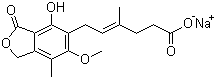 |
| Molecular Formula | C17H19O6.Na |
| Molecular Weight | 342.32 |
| CAS Registry Number | 37415-62-6 |
| EC Number | 687-703-1 |
| SMILES | CC1=C2COC(=O)C2=C(C(=C1OC)C/C=C(C)/CCC(=O)[O-])O.[Na+] |
| Hazard Symbols |    GHS07;GHS08;GHS09 Danger Details GHS07;GHS08;GHS09 Danger Details | ||||||||||||||||||||
|---|---|---|---|---|---|---|---|---|---|---|---|---|---|---|---|---|---|---|---|---|---|
| Risk Statements | H302-H341-H360-H360d-H372-H400-H410-H413 Details | ||||||||||||||||||||
| Safety Statements | P203-P260-P264-P270-P273-P280-P301+P317-P318-P319-P330-P391-P405-P501 Details | ||||||||||||||||||||
| Hazard Classification | |||||||||||||||||||||
| |||||||||||||||||||||
| SDS | Available | ||||||||||||||||||||
 chemBlink Chemical Story
|
Sodium mycophenolate is the sodium salt form of mycophenolate, a potent immunosuppressive agent primarily used to prevent organ rejection in transplant patients. It works by inhibiting the proliferation of T and B lymphocytes, which are critical components of the immune system involved in transplant rejection. Mycophenolate, in both its sodium and other forms, is a key component in the management of transplant patients and autoimmune diseases. The discovery of mycophenolate dates back to the 1980s when it was first identified as a promising immunosuppressive agent. It was initially derived from the fermentation products of a species of *Penicillium*, a genus of fungi known for producing bioactive compounds. The compound was developed to target the immune system's response to transplanted organs, helping to prevent the body from rejecting the foreign tissue. Over time, mycophenolate became widely used in clinical practice, primarily in combination with other immunosuppressive drugs to manage transplant recipients. Sodium mycophenolate is commonly used in the prevention of organ rejection in patients undergoing kidney, heart, and liver transplants. It is also used for the treatment of certain autoimmune diseases, such as lupus nephritis and rheumatoid arthritis. The drug is typically administered in combination with other immunosuppressive agents like corticosteroids and calcineurin inhibitors (such as tacrolimus or cyclosporine) to provide a more comprehensive approach to immune suppression. The mechanism of action of sodium mycophenolate involves the inhibition of inosine monophosphate dehydrogenase (IMPDH), an enzyme essential for the de novo synthesis of guanine nucleotides. These nucleotides are required for the replication of DNA in proliferating cells, including lymphocytes. By inhibiting IMPDH, sodium mycophenolate effectively prevents the proliferation of T and B cells, reducing the immune response that would otherwise lead to organ rejection. Importantly, sodium mycophenolate preferentially inhibits lymphocyte proliferation over other cells, as lymphocytes depend more heavily on de novo purine synthesis. In clinical practice, sodium mycophenolate is typically administered orally or intravenously. The oral form is available as tablets, and the intravenous form is used in more severe cases or when patients are unable to take oral medication. The dosage is adjusted based on the patient's specific needs, the type of transplant, and other factors such as the patient's renal function. While sodium mycophenolate is an effective immunosuppressant, it can have side effects. The most common adverse effects include gastrointestinal symptoms such as nausea, vomiting, diarrhea, and abdominal pain. It can also lead to a decrease in white blood cell count (leukopenia), increasing the risk of infections. Patients on sodium mycophenolate are often monitored regularly for blood cell counts, liver function, and kidney function to ensure the drug is being used safely. Other side effects may include headaches, insomnia, and increased susceptibility to viral infections, such as cytomegalovirus. In addition to its primary use in transplant medicine, sodium mycophenolate has also been used in the treatment of autoimmune diseases. In these conditions, the drug helps to modulate the overactive immune system and reduce inflammation. In autoimmune diseases like lupus nephritis, sodium mycophenolate helps prevent kidney damage caused by the body's immune response. It is also being investigated for its potential use in other autoimmune conditions, though its application remains limited to specific cases. In summary, sodium mycophenolate is a critical immunosuppressive drug widely used in the prevention of organ rejection following transplantation. Its ability to inhibit the proliferation of T and B lymphocytes makes it an effective agent in controlling the immune response. While it is associated with potential side effects, its benefits in preventing transplant rejection and managing autoimmune diseases make it a valuable component of immunosuppressive therapy. Regular monitoring of the patient's response to the drug is essential to ensure its safety and effectiveness. References 2000. Efficacy of mycophenolate mofetil in patients with diffuse proliferative lupus nephritis. The New England Journal of Medicine, 343(16). DOI: 10.1056/nejm200010193431604 1998. Synergism Between Mycophenolate Mofetil and Cyclosporine in Preventing Graft-Versus-Host Disease Among Lethally Irradiated Dogs Given DLA-Nonidentical Unrelated Marrow Grafts. Blood, 91(7). DOI: 10.1182/blood.v91.7.2581 1998. The Novel Immunosuppressive Agent Mycophenolate Mofetil Markedly Potentiates the Antiherpesvirus Activities of Acyclovir, Ganciclovir, and Penciclovir In Vitro and In Vivo. Antimicrobial Agents and Chemotherapy, 42(2). DOI: 10.1128/aac.42.2.216 |
| Market Analysis Reports |