
Online Database of Chemicals from Around the World
| Fujian South Pharmaceutical Co., Ltd. | China | |||
|---|---|---|---|---|
 | www.southpharma.com | |||
 | +86 (598) 286-0412 +86 13509335186 | |||
 | +86 (598) 286-0416 | |||
 | sales@southpharma.com | |||
 | QQ Chat | |||
| Chemical manufacturer since 2001 | ||||
| chemBlink Standard supplier since 2008 | ||||
| Simagchem Corporation | China | |||
|---|---|---|---|---|
| www.simagchem.com | |||
| +86 13806087780 | |||
| +86 (592) 268-0237 | |||
| sale@simagchem.com | |||
| Chemical manufacturer since 2002 | ||||
| chemBlink Standard supplier since 2008 | ||||
| Changzhou Hangyu Pharmaceutical Technology Co., Ltd. | China | |||
|---|---|---|---|---|
| www.czyys.com | |||
| +86 (519) 8880-2789 +86 13961196887 | |||
| +86 (519) 8880-2789 | |||
| sales@czyys.com zypharm78@hotmail.com | |||
| Chemical manufacturer since 1984 | ||||
| chemBlink Standard supplier since 2008 | ||||
| Lianyungang United Chemical Co., Ltd. | China | |||
|---|---|---|---|---|
| www.lyg-china.com | |||
| +86 (518) 8569-2709 | |||
| +86 (518) 8501-5182 | |||
| service@lyg-china.com | |||
| Chemical manufacturer since 2004 | ||||
| chemBlink Standard supplier since 2008 | ||||
| Ring Specialty Chemicals Inc. | Canada | |||
|---|---|---|---|---|
| www.ringchemicals.com | |||
| +1 (416) 493-6870 | |||
| info@ringchemicals.com | |||
| Chemical distributor | ||||
| chemBlink Standard supplier since 2010 | ||||
| BOC Sciences | USA | |||
|---|---|---|---|---|
| www.bocsci.com | |||
| +1 (631) 485-4226 | |||
| +1 (631) 614-7828 | |||
| info@bocsci.com | |||
| Chemical manufacturer | ||||
| chemBlink Standard supplier since 2010 | ||||
| Lianyungang Guike Pharmaceutical Co., ltd. | China | |||
|---|---|---|---|---|
| www.guikepharm.com | |||
| +86 (518) 8607-0808 8607-0855 | |||
| +86 (518) 8607-0852 | |||
| sale@guikepharm.com | |||
| Chemical manufacturer | ||||
| chemBlink Standard supplier since 2011 | ||||
| Shandong Boyuan Pharmaceutical Co., Ltd. | China | |||
|---|---|---|---|---|
| www.boyuanpharm.com | |||
| +86 (531) 6995-4981 8896-3280 +86 15806417970 | |||
| +86 (531) 8896-4879 | |||
| Jeffrey.Liu@boyuanpharm.com boyuanchem@126.com | |||
| QQ Chat | |||
| Chemical manufacturer since 2005 | ||||
| chemBlink Standard supplier since 2011 | ||||
| Shanghai Bioman Pharma Limited | China | |||
|---|---|---|---|---|
| www.bioman.com.cn | |||
| +86 15000110506 | |||
| +86 (21) 2302-5272 | |||
| info@bioman.com.cn zhengyunman@hotmail.com | |||
| Chemical manufacturer | ||||
| chemBlink Standard supplier since 2011 | ||||
| Selleck Chemicals LLC | USA | |||
|---|---|---|---|---|
| www.selleckchem.com | |||
| +1 (713) 535-9129 | |||
| +1 (832) 582-8590 | |||
| info@selleckchem.com | |||
| Chemical manufacturer | ||||
| chemBlink Standard supplier since 2014 | ||||
| Labseeker Inc | USA | |||
|---|---|---|---|---|
| www.labseeker.com | |||
| +1 (858) 750-1632 | |||
| +1 (858) 412-1220 | |||
| marketing@labseeker.com | |||
| Chemical manufacturer since 2002 | ||||
| chemBlink Standard supplier since 2015 | ||||
| Hangzhou Leap Chem Co., Ltd. | China | |||
|---|---|---|---|---|
| www.leapchem.com | |||
| +86 (571) 8771-1850 | |||
| market19@leapchem.com | |||
| QQ Chat | |||
| Chemical manufacturer since 2006 | ||||
| chemBlink Standard supplier since 2015 | ||||
| Tecoland Corporation | USA | |||
|---|---|---|---|---|
| www.tecoland.com | |||
| +1 (732) 603-9577 | |||
| +1 (732) 906-1522 | |||
| info@tecoland.com | |||
| Chemical distributor since 2001 | ||||
| chemBlink Standard supplier since 2019 | ||||
| Jinan Hanyu Chemical Co., Ltd. | China | |||
|---|---|---|---|---|
| www.hanyuchem.com | |||
| +86 (531) 6995-4981 | |||
| sales@hanyuchem.com | |||
| QQ Chat | |||
 | WeChat: dwyane-wang | |||
| Chemical manufacturer since 2024 | ||||
| chemBlink Standard supplier since 2025 | ||||
| Sinbond Industrial Co., Ltd. | China | |||
|---|---|---|---|---|
| www.sinbondpharm.com | |||
| +86 (531) 8703-8285 +86 13583181986 +44 (208) 242-5518 | |||
| +86 (531) 8703-8285 | |||
| cici1124@gmail.com | |||
| QQ Chat | |||
| Chemical manufacturer since 2014 | ||||
| AK Scientific, Inc | USA | |||
|---|---|---|---|---|
| www.aksci.com | |||
| +1 (510) 429-8835 | |||
| +1 (510) 429-8836 | |||
| sales@aksci.com | |||
| Chemical manufacturer | ||||
| Ganyu Unitechemical Co., Ltd. | China | |||
|---|---|---|---|---|
| www.unitechemical.com | |||
| +86 (518) 8286-9158 | |||
| +86 (518) 8519-0278 | |||
| sales@unitechemical.com | |||
| Chemical manufacturer since 2004 | ||||
| Classification | Biochemical >> Inhibitor >> Immune inhibitor |
|---|---|
| Name | Isophosphamide |
| Synonyms | 3-(2-Chloroethyl)-2-[(2-chloroethyl)amino]perhydro-2H-1,3,2-oxazaphosphorineoxide; 3-(2-Chloroethyl)-2-[(2-chloroethyl)amino]tetrahydro-2H-1,3,2-oxazaphosphorine 2-oxide; Ifosfamid |
| Molecular Structure | 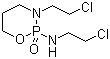 |
| Molecular Formula | C7H15Cl2N2O2P |
| Molecular Weight | 261.09 |
| CAS Registry Number | 3778-73-2 |
| EC Number | 223-237-3 |
| SMILES | C1CN(P(=O)(OC1)NCCCl)CCCl |
| Density | 1.3±0.1 g/cm3 Calc.* |
|---|---|
| Boiling point | 336.1±52.0 °C 760 mmHg (Calc.)* |
| Flash point | 157.1±30.7 °C (Calc.)* |
| Solubility | DMSO: 5mg/ml (Expl.) |
| Index of refraction | 1.506 (Calc.)* |
| * | Calculated using Advanced Chemistry Development (ACD/Labs) Software. |
| Hazard Symbols |   GHS06;GHS07 Danger Details GHS06;GHS07 Danger Details | ||||||||||||||||||||||||||||||||||||||||||||
|---|---|---|---|---|---|---|---|---|---|---|---|---|---|---|---|---|---|---|---|---|---|---|---|---|---|---|---|---|---|---|---|---|---|---|---|---|---|---|---|---|---|---|---|---|---|
| Risk Statements | H301-H319 Details | ||||||||||||||||||||||||||||||||||||||||||||
| Safety Statements | P264-P264+P265-P270-P280-P301+P316-P305+P351+P338-P321-P330-P337+P317-P405-P501 Details | ||||||||||||||||||||||||||||||||||||||||||||
| Hazard Classification | |||||||||||||||||||||||||||||||||||||||||||||
| |||||||||||||||||||||||||||||||||||||||||||||
| SDS | Available | ||||||||||||||||||||||||||||||||||||||||||||
 chemBlink Chemical Story
|
Isophosphamide is a chemotherapeutic agent used primarily in the treatment of various cancers, including certain types of sarcomas, lymphomas, and leukemias. It belongs to the class of alkylating agents, which work by damaging the DNA of cancer cells, preventing them from dividing and growing. The compound is a derivative of cyclophosphamide, a widely used alkylating agent, but with structural modifications that confer distinct pharmacological properties. The discovery of isophosphamide was based on the need to develop more effective and less toxic chemotherapeutic agents. Cyclophosphamide, which was discovered in the 1950s, has been a cornerstone in cancer therapy. However, its use is often associated with side effects such as immunosuppression, gastrointestinal distress, and risk of secondary cancers. As a result, researchers sought to modify the structure of cyclophosphamide to improve its efficacy and reduce its toxicity profile. Isophosphamide was one of the resulting compounds, designed to maintain the anti-cancer activity of cyclophosphamide while offering improvements in certain therapeutic parameters. Isophosphamide acts as an alkylating agent, meaning that it interferes with the DNA structure by adding alkyl groups to the nucleotides. This modification causes DNA cross-linking, strand breaks, and prevents the proper replication of the DNA, ultimately leading to cancer cell death. It is typically administered intravenously and is metabolized in the liver to its active form. The active metabolite is the compound that exerts the most significant anti-cancer effects. One of the main applications of isophosphamide is in the treatment of advanced or metastatic cancers, especially in cases where other therapies, such as surgery or radiation, are not effective. It has shown activity against a variety of cancers, including soft tissue sarcomas, Hodgkin’s lymphoma, and non-Hodgkin’s lymphoma. It is also occasionally used as part of combination chemotherapy regimens, where it is administered alongside other cytotoxic drugs to increase the overall efficacy of the treatment. Despite its promising anti-cancer properties, isophosphamide, like other alkylating agents, comes with a risk of side effects. Common side effects include myelosuppression (which can lead to an increased risk of infections, anemia, and bleeding), nausea, vomiting, and hair loss. More severe long-term effects can include damage to the bone marrow and an increased risk of developing secondary malignancies. As such, its use is typically carefully monitored, with dosage adjustments and supportive care to manage side effects. The clinical use of isophosphamide is often considered in patients who have not responded well to other treatment options, or in cases where cyclophosphamide is not effective or appropriate. Its effectiveness and toxicity profile continue to be the subject of ongoing research, particularly as part of combination chemotherapy regimens. Studies are also investigating the potential for isophosphamide in the treatment of cancers beyond those for which it is currently used, and its role in improving survival rates in various cancer patients. In conclusion, isophosphamide is a potent chemotherapeutic agent with established applications in treating a variety of cancers, especially in cases where other therapies have failed. Its mechanism of action as an alkylating agent involves damaging cancer cell DNA, preventing cell division, and inducing cell death. Although it is an effective treatment for certain malignancies, its use is associated with significant side effects that require careful management. As research continues, there may be opportunities to refine its use in cancer therapy and reduce its toxicity while enhancing its efficacy. References 2004. Systemically Administered Drugs. Drug Delivery Systems in Cancer Therapy. DOI: 10.1007/978-1-59259-427-6_1 2010. Association of telomerase activity with radio- and chemosensitivity of neuroblastomas. Radiation Oncology, 5(66). DOI: 10.1186/1748-717x-5-66 2012. Bortezomib in combination with rituximab, dexamethasone, ifosfamide, cisplatin and etoposide chemoimmunotherapy in patients with relapsed and primary refractory diffuse large B-cell lymphoma. Leukemia & Lymphoma, 53(7). DOI: 10.3109/10428194.2012.656629 |
| Market Analysis Reports |