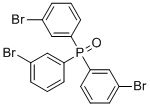
Tris(3-bromophenyl)phosphine oxide is an important organophosphorus compound, distinguished by its unique structure and versatile applications. This compound features a phosphorus atom bonded to three 3-bromophenyl groups and an oxide group, resulting in a structure that provides both electronic and steric influences important in various chemical processes.
The discovery of Tris(3-bromophenyl)phosphine oxide was driven by the need for phosphine oxide ligands that offer enhanced stability and reactivity in coordination chemistry. The 3-bromophenyl groups attached to the phosphorus atom are electron-withdrawing due to the bromine substituent, which modifies the electronic environment around the phosphorus. This effect influences the ligand’s interaction with metal centers and enhances the performance of metal complexes in various catalytic processes.
One of the primary applications of Tris(3-bromophenyl)phosphine oxide is in catalysis. As a ligand, it coordinates with metal centers to form stable complexes that are used in a range of chemical transformations. Its presence in metal-catalyzed reactions, such as cross-coupling and hydrogenation, can significantly impact the reactivity and selectivity of the catalytic processes. The electron-withdrawing bromine groups contribute to the stabilization of certain metal-ligand interactions, making the compound valuable in fine-tuning catalytic activity.
In addition to its role in catalysis, Tris(3-bromophenyl)phosphine oxide is utilized in the development of new materials. The electronic properties imparted by the bromine atoms can affect the properties of materials, making this compound useful in designing advanced materials with specific characteristics.
The compound also serves as a valuable tool in research and development within organometallic chemistry. By exploring how different substituents influence the behavior of phosphine oxide ligands, researchers can gain insights into the factors that control metal-ligand interactions and optimize various chemical processes.
In summary, Tris(3-bromophenyl)phosphine oxide is a significant organophosphorus compound with valuable applications in catalysis and materials science. Its unique structure, featuring electron-withdrawing bromine substituents, enhances its role in stabilizing metal complexes and influencing catalytic and material properties.
|




 GHS07 Warning Details
 chemBlink Chemical Story