
Online Database of Chemicals from Around the World
| Zhejiang Synose Tech Co., Ltd. | China | |||
|---|---|---|---|---|
 | www.synose.com | |||
 | +86(579)8227-5537 8917-2081 | |||
 | +86 (579) 8227-7133 | |||
 | expo@synose.com | |||
| Chemical manufacturer since 1996 | ||||
| chemBlink Standard supplier since 2011 | ||||
| Chem Service, Inc. | USA | |||
|---|---|---|---|---|
| www.chemservice.com | |||
| +1 (610) 692-3026 | |||
| +1 (610) 692-8729 | |||
| info@chemservice.com | |||
| Chemical manufacturer since 1962 | ||||
| Classification | Biochemical >> Carbohydrate >> Monosaccharide |
|---|---|
| Name | alpha-D-Glucose pentaacetate |
| Synonyms | D-Glucose 2,3,4,5,6-pentaacetate |
| Molecular Structure | 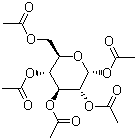 |
| Molecular Formula | C16H22O11 |
| Molecular Weight | 390.34 |
| CAS Registry Number | 3891-59-6 |
| EC Number | 223-439-1 |
| SMILES | CC(=O)OC[C@H]([C@H]([C@@H]([C@H](C=O)OC(=O)C)OC(=O)C)OC(=O)C)OC(=O)C |
| Density | 1.3±0.1 g/cm3 Calc.* |
|---|---|
| Boiling point | 472.0±45.0 °C 760 mmHg (Calc.)* |
| Flash point | 205.2±28.8 °C (Calc.)* |
| Index of refraction | 1.463 (Calc.)* |
| * | Calculated using Advanced Chemistry Development (ACD/Labs) Software. |
| Hazard Symbols |  GHS07 Warning Details GHS07 Warning Details |
|---|---|
| Risk Statements | H315-H319-H335 Details |
| Safety Statements | P261-P305+P351+P338 Details |
| SDS | Available |
 chemBlink Chemical Story
|
Alpha-D-Glucose pentaacetate is the fully acetylated derivative of alpha-D-glucopyranose in which the five hydroxyl groups of the monosaccharide are converted into acetate esters. D-glucose was identified and characterized in the nineteenth century as a fundamental carbohydrate present in fruits, honey, and as a product of starch hydrolysis. Its structural elucidation, including the recognition of its cyclic pyranose form and stereochemical configuration, was a major achievement of classical carbohydrate chemistry. The distinction between alpha and beta anomers at the anomeric carbon was established through studies of mutarotation and derivative formation, providing key evidence for the hemiacetal ring structure of glucose. The preparation of alpha-D-glucose pentaacetate arose from systematic investigations into sugar derivatization. Acetylation of D-glucose with acetic anhydride, typically in the presence of catalysts such as pyridine or sodium acetate, converts the hydroxyl groups at positions 1, 2, 3, 4, and 6 into acetate esters. Under appropriate conditions, crystalline alpha-D-glucose pentaacetate can be isolated as a distinct anomer. The formation and separation of alpha and beta pentaacetates were important experimental steps in confirming the configurational assignment at the anomeric center. Measurements of melting points, optical rotation, and interconversion between anomers provided evidence supporting the cyclic structure and stereochemistry of glucose. In the historical context of carbohydrate chemistry, peracetylated sugars served as essential tools for structure determination before the development of modern spectroscopic methods. By converting highly polar, hygroscopic sugars into less polar and more crystalline derivatives, chemists were able to obtain pure compounds suitable for careful physical characterization. Alpha-D-glucose pentaacetate exhibited defined physical properties that could be compared across laboratories, contributing to the consolidation of structural theories for monosaccharides. Beyond its role in structural studies, alpha-D-glucose pentaacetate has been widely used as an intermediate in synthetic carbohydrate chemistry. The acetyl groups act as protecting groups, masking the reactivity of hydroxyl functions and reducing extensive hydrogen bonding. This modification enhances solubility in organic solvents such as chloroform and dichloromethane and permits reactions that would be impractical with unprotected glucose. In particular, activation of the anomeric acetate under suitable conditions allows the compound to participate in glycosylation reactions, functioning as a glycosyl donor in the preparation of glycosides. Experimental investigations into glycosylation mechanisms have frequently employed peracetylated glucose derivatives. The presence of an acetyl group at the C-2 position can influence stereochemical outcomes through neighboring group participation, a phenomenon that has been studied extensively in carbohydrate reaction chemistry. Observations derived from reactions of alpha-D-glucose pentaacetate and related compounds have contributed to the understanding of how protecting groups affect reaction pathways and anomeric selectivity. Acetylated glucose derivatives have also served as starting materials in the synthesis of oligosaccharides, glycoconjugates, and other biologically relevant molecules. Controlled deacetylation under acidic or basic conditions regenerates hydroxyl groups at defined stages of multistep synthesis. This predictable behavior has made peracetylated sugars reliable building blocks in glycochemistry. Although alpha-D-glucose pentaacetate itself is primarily an intermediate rather than a final consumer product, its preparation and applications are firmly established in the literature. Its discovery and use illustrate how derivative formation advanced both the structural understanding of carbohydrates and the development of practical synthetic strategies. Through its documented role in structural elucidation and synthetic methodology, alpha-D-glucose pentaacetate remains a representative example of the importance of protected sugar derivatives in chemical research. References 2024. Development of ketalized unsaturated saccharides as multifunctional cysteine-targeting covalent warheads. Communications Chemistry. DOI: 10.1038/s42004-024-01279-z 2024. Biochemical characterization of an esterase from Thermobifida fusca YX with acetyl xylan esterase activity. Molecular Biology Reports. DOI: 10.1007/s11033-024-09601-7 |
| Market Analysis Reports |