
Online Database of Chemicals from Around the World
| Typu Group | China | |||
|---|---|---|---|---|
 | www.typugroup.com | |||
 | +86 85220966 | |||
 | order@typugroup.com | |||
| Chemical distributor since 2008 | ||||
| chemBlink Standard supplier since 2021 | ||||
| Classification | API >> Nervous system medication >> Anxiolytic |
|---|---|
| Name | Pyrazolam |
| Synonyms | 8-bromo-1-methyl-6-pyridin-2-yl-4H-[1,2,4]triazolo[4,3-a][1,4]benzodiazepine |
| Molecular Structure | 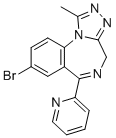 |
| Molecular Formula | C16H12BrN5 |
| Molecular Weight | 354.20 |
| CAS Registry Number | 39243-02-2 |
| SMILES | CC1=NN=C2N1C3=C(C=C(C=C3)Br)C(=NC2)C4=CC=CC=N4 |
| Density | 1.6±0.1 g/cm3, Calc.* |
|---|---|
| Index of Refraction | 1.762, Calc.* |
| Boiling Point | 544.4±60.0 °C (760 mmHg), Calc.* |
| Flash Point | 283.0±32.9 °C, Calc.* |
| * | Calculated using Advanced Chemistry Development (ACD/Labs) Software. |
| Hazard Symbols |   GHS02;GHS07 Danger Details GHS02;GHS07 Danger Details |
|---|---|
| Risk Statements | H225-H302+H312+H332-H319 Details |
| Safety Statements | P210-P280-P301+P312-P303+P361+P353-P304+P340+P312-P305+P351+P338 Details |
| SDS | Available |
 chemBlink Chemical Story
|
Pyrazolam is a benzodiazepine derivative known for its anxiolytic and sedative properties. It belongs to a class of psychoactive substances that modulate the GABA-A receptor, enhancing the effects of the neurotransmitter gamma-aminobutyric acid (GABA). This action results in a calming effect on the central nervous system, making pyrazolam useful in treating anxiety and related conditions. Its molecular formula is C₁₆H₁₂BrN₅, and it possesses a pyrazole ring fused to a benzodiazepine core, distinguishing it from other benzodiazepine derivatives. Pyrazolam was first synthesized in the 1970s by a team of researchers exploring new anxiolytic compounds. Though it was never approved for medical use, it has become known in recent years through online markets where novel benzodiazepines are sold. Early studies on the compound highlighted its ability to provide anti-anxiety effects without the same level of sedation or muscle relaxation associated with more common benzodiazepines like diazepam or alprazolam. This profile made pyrazolam of interest to researchers investigating compounds that could alleviate anxiety while minimizing the risk of drowsiness or impaired motor functions. One of the unique aspects of pyrazolam is its relatively high binding affinity to the alpha-2 and alpha-3 subunits of the GABA-A receptor, which are associated with anxiolytic effects. Unlike some benzodiazepines that also affect the alpha-1 subunit, contributing more strongly to sedation and hypnosis, pyrazolam’s receptor selectivity leads to a more targeted reduction in anxiety. This receptor profile, combined with its long half-life, makes pyrazolam suitable for controlling anxiety symptoms over extended periods without the frequent dosing required by shorter-acting benzodiazepines. In practice, pyrazolam has found limited application due to its lack of formal approval as a pharmaceutical. However, it has been researched in clinical settings to understand its pharmacological properties better and to assess its potential as a future therapeutic. Because pyrazolam is more potent than many over-the-counter anxiolytics, even in low doses, it has attracted attention from individuals seeking alternatives to prescription benzodiazepines. As with all benzodiazepines, pyrazolam carries a risk of dependence and withdrawal symptoms with prolonged use. It shares common benzodiazepine side effects, including dizziness, cognitive impairment, and tolerance development, although its selective action on specific GABA-A receptor subtypes may offer a more favorable safety profile for certain patients. Despite these potential benefits, the lack of regulatory approval and limited clinical data on pyrazolam means it remains a substance of interest primarily in research contexts rather than in mainstream medicine. In recent years, pyrazolam has been classified as a novel psychoactive substance (NPS), primarily due to its availability on online platforms. This has raised concerns about its safety, as its unregulated use could lead to misuse or accidental overdose. Public health agencies have expressed caution regarding the use of pyrazolam outside a controlled medical environment, highlighting the need for further studies to evaluate its long-term effects and potential risks. In summary, pyrazolam represents a compound of significant interest in the field of anxiolytic research due to its selective receptor activity and potential for treating anxiety with fewer sedative effects. While it has not been widely adopted in clinical practice, ongoing research may provide insights into its utility as a therapeutic agent in the future. References 2019. Organ distribution of diclazepam, pyrazolam and 3-fluorophenmetrazine. Forensic Science International, 303. DOI: 10.1016/j.forsciint.2019.109959 2018. Designer Benzodiazepines: Another Class of New Psychoactive Substances. Handbook of Experimental Pharmacology, 252. DOI: 10.1007/164_2018_154 2013. Characterization of the designer benzodiazepine pyrazolam and its detectability in human serum and urine. Forensic Toxicology, 31(2). DOI: 10.1007/s11419-013-0187-4 |
| Market Analysis Reports |