
Online Database of Chemicals from Around the World
| Shanghai Micro-Mega Industry Co., Ltd. | China | |||
|---|---|---|---|---|
 | www.micro-megaindustry.com | |||
 | +86 (21) 5715-3848 3462-8682 | |||
 | +86 (21) 5715-3848 | |||
 | weij@micro-megaindustry.com lewisliu2010@hotmail.com | |||
| Chemical manufacturer | ||||
| chemBlink Standard supplier since 2010 | ||||
| SRC Laboratories Pvt Ltd | India | |||
|---|---|---|---|---|
| www.srclaboratories.com | |||
| +91 (40) 2307-7999 | |||
| +91 (40) 2307-7999 | |||
| info@srclaboratories.com | |||
| Chemical manufacturer since 2009 | ||||
| chemBlink Standard supplier since 2011 | ||||
| Hangzhou Leap Chem Co., Ltd. | China | |||
|---|---|---|---|---|
| www.leapchem.com | |||
| +86 (571) 8771-1850 | |||
| market19@leapchem.com | |||
 | QQ Chat | |||
| Chemical manufacturer since 2006 | ||||
| chemBlink Standard supplier since 2015 | ||||
| Carbosynth China Ltd. | China | |||
|---|---|---|---|---|
| www.carbosynth.cn | |||
| +86 (512) 6260-5585 | |||
| +86 (512) 6260-5576 | |||
| sales@carbosynth.com | |||
| QQ Chat | |||
| Chemical manufacturer since 2006 | ||||
| chemBlink Standard supplier since 2016 | ||||
| Shanghai 3s Technology Co., Ltd. | China | |||
|---|---|---|---|---|
| www.3s-tech.net | |||
| +86 (021) 5290-7809 | |||
| market@3s-tech.net | |||
| Chemical manufacturer since 2019 | ||||
| chemBlink Standard supplier since 2025 | ||||
| DeLong Chemicals America | USA | |||
|---|---|---|---|---|
| www.delongchemicals.com | |||
| +1 (203) 271-9017 | |||
| sales@delongchemicals.com | |||
| Chemical manufacturer | ||||
| Classification | Chemical reagent >> Organic reagent >> Aromatic hydrocarbon reagent |
|---|---|
| Name | 3-Nitrobenzyl bromide |
| Synonyms | alpha-Bromo-m-nitrotoluene |
| Molecular Structure | 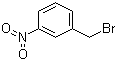 |
| Molecular Formula | C7H6BrNO2 |
| Molecular Weight | 216.03 |
| CAS Registry Number | 3958-57-4 |
| EC Number | 223-557-3 |
| SMILES | C1=CC(=CC(=C1)[N+](=O)[O-])CBr |
| Density | 1.7±0.1 g/cm3 Calc.* |
|---|---|
| Melting point | 56 - 59 °C (Expl.) |
| Boiling point | 300.9±17.0 °C 760 mmHg (Calc.)*, 337.7 - 339.1 °C (Expl.) |
| Flash point | 135.8±20.9 °C (Calc.)* |
| Index of refraction | 1.612 (Calc.)* |
| * | Calculated using Advanced Chemistry Development (ACD/Labs) Software. |
| Hazard Symbols |   GHS05;GHS07 Danger Details GHS05;GHS07 Danger Details | ||||||||||||||||||||||||||||
|---|---|---|---|---|---|---|---|---|---|---|---|---|---|---|---|---|---|---|---|---|---|---|---|---|---|---|---|---|---|
| Risk Statements | H314-H335 Details | ||||||||||||||||||||||||||||
| Safety Statements | P260-P261-P264-P271-P280-P301+P330+P331-P302+P361+P354-P304+P340-P305+P354+P338-P316-P319-P321-P363-P403+P233-P405-P501 Details | ||||||||||||||||||||||||||||
| Hazard Classification | |||||||||||||||||||||||||||||
| |||||||||||||||||||||||||||||
| Transport Information | UN 3261 | ||||||||||||||||||||||||||||
| SDS | Available | ||||||||||||||||||||||||||||
 chemBlink Chemical Story
|
3-Nitrobenzyl bromide is a halogenated aromatic compound that has been well established as a valuable intermediate in organic synthesis. Its discovery is linked to early investigations into benzyl bromides and their functional derivatives during the late 19th and early 20th centuries, when chemists systematically explored the reactivity and applications of substituted aromatic compounds. The presence of both a nitro group and a bromomethyl group on the benzene ring endows 3-nitrobenzyl bromide with unique chemical properties that have been exploited in a variety of fields, including pharmaceuticals, agrochemicals, and material science. The synthesis of 3-nitrobenzyl bromide typically proceeds from 3-nitrotoluene, which is subjected to bromination at the benzylic position. This reaction is often achieved using brominating agents such as N-bromosuccinimide (NBS) in the presence of a radical initiator like benzoyl peroxide under mild conditions. The resulting compound contains a bromine atom attached to the benzylic carbon, while the nitro group remains at the meta position relative to the bromomethyl group. The electron-withdrawing nature of the nitro group influences the reactivity of the molecule, particularly in nucleophilic substitution reactions. Applications of 3-nitrobenzyl bromide are broad and well documented. It serves as an important alkylating agent for introducing the 3-nitrobenzyl moiety into various nucleophilic substrates, including amines, alcohols, thiols, and carboxylic acids. Such functionalization is critical in the design and synthesis of complex molecules where the nitrobenzyl group acts as a protecting group, a structural component, or a linker. In the pharmaceutical industry, derivatives of 3-nitrobenzyl bromide have been investigated for their biological activities. The nitro group can be subsequently reduced to an amino group, providing a versatile synthetic handle for further transformations. Aminobenzyl derivatives derived from 3-nitrobenzyl bromide are used in the preparation of compounds with potential antibacterial, antifungal, and anticancer properties. Another significant application of 3-nitrobenzyl bromide lies in the area of photoresponsive materials. Nitrobenzyl groups are well known as photolabile protecting groups, meaning that they can be cleaved upon exposure to light of specific wavelengths. 3-Nitrobenzyl-protected derivatives are used in the controlled release of active molecules in photochemistry and photopharmacology. Upon irradiation, the nitrobenzyl group undergoes a photochemical reaction, leading to the liberation of the desired functional group, such as a carboxyl or hydroxyl group. This feature has been employed in the design of light-sensitive drug delivery systems, molecular switches, and photopatterning materials. In polymer chemistry, 3-nitrobenzyl bromide has been utilized in the functionalization of polymer backbones to introduce photodegradable linkages. This approach allows the development of polymers with tunable degradation profiles, which are useful in biomedical applications such as tissue engineering and controlled drug release. The physical properties of 3-nitrobenzyl bromide include a solid crystalline form with moderate melting point. It is typically soluble in organic solvents like dichloromethane, chloroform, and acetone, and it exhibits a characteristic yellow color due to the presence of the nitro group. The compound is sensitive to moisture and should be stored under dry conditions to prevent hydrolysis of the bromomethyl group. Safety considerations for 3-nitrobenzyl bromide are important due to its reactivity and potential toxicity. It can cause skin, eye, and respiratory irritation, and appropriate personal protective equipment should be used when handling the compound. Proper ventilation and containment measures are recommended during its storage and use to minimize exposure risks. The role of 3-nitrobenzyl bromide as a versatile synthetic intermediate continues to be significant in modern organic synthesis. Its ability to introduce functionalized benzyl groups and participate in a range of chemical transformations makes it an indispensable tool in the development of new molecules for scientific and industrial applications. References 2001. Correlation Analysis of the Kinetic Parameters of the Reactions of Benzyl Bromides with Aroylhydrazines in Nitrobenzene. Theoretical and Experimental Chemistry, 37(1). DOI: 10.1023/a:1010461722467 2016. Carbene-catalysed reductive coupling of nitrobenzyl bromides and activated ketones or imines via single-electron-transfer process. Nature Communications, 7. DOI: 10.1038/ncomms12933 2020. Can we trust the experiment? Anisotropic displacement parameters in 1-(halomethyl)-3-nitrobenzene (halogen = Cl or Br). Acta Crystallographica Section C: Structural Chemistry, 76(6). DOI: 10.1107/s2053229620006221 |
| Market Analysis Reports |