
Online Database of Chemicals from Around the World
| CAS: 39742-60-4 Product: 1-Phenethyl-4-piperidone No suppliers available. |
| Classification | Chemical reagent >> Organic reagent >> Fatty ketone (including enol) |
|---|---|
| Name | 1-Phenethyl-4-piperidone |
| Synonyms | 1-(2-Phenylethyl)-4-piperidone; 1-(beta-Phenethyl)-4-piperidone |
| Molecular Structure | 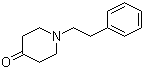 |
| Molecular Formula | C13H17NO |
| Molecular Weight | 203.28 |
| CAS Registry Number | 39742-60-4 |
| EC Number | 254-613-5 |
| SMILES | C1CN(CCC1=O)CCC2=CC=CC=C2 |
| Melting point | 57-61 °C |
|---|---|
| Hazard Symbols |  GHS07 Warning Details GHS07 Warning Details | ||||||||||||||||
|---|---|---|---|---|---|---|---|---|---|---|---|---|---|---|---|---|---|
| Risk Statements | H302 Details | ||||||||||||||||
| Safety Statements | P264-P270-P301+P317-P330-P501 Details | ||||||||||||||||
| Hazard Classification | |||||||||||||||||
| |||||||||||||||||
| SDS | Available | ||||||||||||||||
 chemBlink Chemical Story
|
1-Phenethyl-4-piperidinone (C13H17NO), commonly abbreviated as NPP, was first synthesized in the mid-20th century during the study of piperidine derivatives for pharmaceutical use. The compound features a piperidinone ring attached to a phenethyl group, forming a structure that is flexible for further chemical modification. The key functional group is the ketone at the 4-position of the piperidine ring, which provides a reactive site for the introduction of a variety of substituents, making NPP a versatile intermediate in organic synthesis. The primary use of NPP is as a precursor for the manufacture of opioids and other analgesics. Its keto group is easily converted to more complex structures, making it invaluable in the production of the following drugs:Fentanyl is a potent synthetic opioid used to treat severe pain. The synthesis of fentanyl requires NPP as an intermediate, which highlights its role in making analgesics more effective than traditional morphine-like compounds. Various other synthetic opioids and related analgesics use NPP in their production due to its structural compatibility with the pharmacophore required for analgesia. The structure of NPP allows it to undergo various chemical transformations, such as reductive amination, to introduce different functional groups, thus tailoring the pharmacological properties of the final product. In addition to drug synthesis, NPP can be used as a research tool in medicinal chemistry to develop new compounds with potential therapeutic benefits. It is used to study structure-activity relationships (SAR) to understand how different modifications of its structure affect biological activity, which can help in the design of new drugs. NPP also has applications in organic synthesis beyond pharmaceuticals. Its piperidone structure can be used to synthesize other complex organic molecules as a basis for chemical research. 1-Phenethyl-4-piperidone is strictly regulated because it is used in the synthesis of controlled substances such as fentanyl. In many countries, it is listed as a controlled chemical precursor, which means that its production, sale, and distribution are closely monitored to prevent illegal drug manufacturing. References 1998. Total synthesis of fentanyl. Archives of Pharmacal Research, 21(1). DOI: 10.1007/bf03216756 1994. Investigation of the stereodirection of the Ritter reaction. Crystalline and molecular structure of N-(2-phenethyl)-4-methylpiperid-4-ol and N-(2-phenethyl)-4-methyl-4-acetamido-piperidine. Chemistry of Heterocyclic Compounds, 30(10). DOI: 10.1007/bf01184886 1964. Ketal formation in 4-piperidones. Cellular and Molecular Life Sciences, 20(8). DOI: 10.1007/bf02152135 |
| Market Analysis Reports |