
Online Database of Chemicals from Around the World
| CAS: 40064-34-4 Product: 4,4-Piperidinediol hydrochloride No suppliers available. |
| Classification | Organic raw materials >> Amino compound >> Acyclic monoamines, polyamines and their derivatives and salts |
|---|---|
| Name | 4,4-Piperidinediol hydrochloride |
| Synonyms | 4,4-Dihydroxypiperidine hydrochloride; 4-Piperidone monohydrate hydrochloride |
| Molecular Structure | 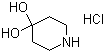 |
| Molecular Formula | C5H11NO2.HCl |
| Molecular Weight | 153.61 |
| CAS Registry Number | 40064-34-4 |
| EC Number | 254-779-9 |
| SMILES | C1CNCCC1(O)O.Cl |
| Melting point | 89-99 °C |
|---|---|
| Hazard Symbols |  GHS07 Warning Details GHS07 Warning Details | ||||||||||||||||
|---|---|---|---|---|---|---|---|---|---|---|---|---|---|---|---|---|---|
| Risk Statements | H315-H319 Details | ||||||||||||||||
| Safety Statements | P264-P280-P302+P352-P305+P351+P338-P332+P313-P337+P313 Details | ||||||||||||||||
| Hazard Classification | |||||||||||||||||
| |||||||||||||||||
| SDS | Available | ||||||||||||||||
 chemBlink Chemical Story
|
4,4-Piperidinediol hydrochloride, also known as 4,4-DMAR, is a chemical compound that was first synthesized and identified in the early 2010s. It belongs to the class of piperidinediol derivatives and is structurally related to other psychoactive substances. The discovery of 4,4-Piperidinediol hydrochloride likely stemmed from research into novel psychoactive compounds and their effects on the central nervous system. Its synthesis may have been initially pursued for scientific exploration or experimental purposes, leading to its identification and characterization as a distinct chemical entity. 4,4-Piperidinediol hydrochloride has garnered interest in pharmacological research due to its potential psychoactive properties. Scientists study its pharmacokinetics and pharmacodynamics to understand how it interacts with neurotransmitter systems in the brain. Research may focus on elucidating its mechanism of action, assessing its efficacy in preclinical models, and exploring potential therapeutic applications. Understanding the pharmacological profile of 4,4-Piperidinediol hydrochloride contributes to the broader field of psychopharmacology and may lead to the development of new medications for various neurological and psychiatric disorders. In forensic science, 4,4-Piperidinediol hydrochloride may be encountered in cases involving illicit drug use or overdose. Analytical laboratories develop methods for detecting and quantifying this compound in biological samples, such as blood or urine. Its presence in forensic samples can provide valuable information for investigations related to drug-related incidents, including criminal cases and post-mortem examinations. Forensic analysis of 4,4-Piperidinediol hydrochloride contributes to efforts aimed at understanding drug trends, preventing substance abuse, and ensuring public safety. Due to its psychoactive effects and potential for abuse, 4,4-Piperidinediol hydrochloride may be subject to regulatory control in various jurisdictions. Regulatory agencies monitor its distribution, use, and availability to prevent misuse and protect public health. Control measures may include scheduling the compound as a controlled substance, imposing restrictions on its manufacture and distribution, and implementing public health initiatives to raise awareness about its risks. Regulatory control of 4,4-Piperidinediol hydrochloride aims to mitigate potential harms associated with its use and prevent its diversion for illicit purposes. 4,4-Piperidinediol hydrochloride also serves as a subject of research and development in pharmaceutical and chemical industries. Scientists explore its chemical properties, synthesis routes, and potential applications in drug discovery. By modifying its structure and studying its biological activities, researchers aim to develop new compounds with improved pharmacological profiles and therapeutic potential. Research and development efforts may lead to the creation of novel medications for treating substance use disorders, mental health conditions, and other medical ailments. |
| Market Analysis Reports |