
Online Database of Chemicals from Around the World
| Valiant Co., Ltd. | China | |||
|---|---|---|---|---|
 | www.valiant-cn.com | |||
 | +86 (535) 610-1878 | |||
 | +86 (535) 638-6989 | |||
 | jiangyanan@valiant-cn.com chenxiaowei@valiant-cn.com | |||
| Chemical manufacturer since 1992 | ||||
| chemBlink Standard supplier since 2012 | ||||
| Hebei Winjoy United Technology Co., Ltd. | China | |||
|---|---|---|---|---|
| www.winjoy-uni.com | |||
| +86 17734561860 | |||
| winjoy@winjoy-uni.com | |||
 | QQ Chat | |||
 | WeChat: 17734561860 | |||
| Chemical manufacturer since 2020 | ||||
| chemBlink Standard supplier since 2025 | ||||
| Classification | Flavors and spices >> Synthetic spice >> Ketone fragrance >> Alicyclic ketone |
|---|---|
| Name | 4-(3-Fluorophenyl)cyclohexanone |
| Molecular Structure | 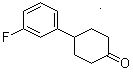 |
| Molecular Formula | C12H13FO |
| Molecular Weight | 192.23 |
| CAS Registry Number | 40503-87-5 |
| SMILES | C1CC(=O)CCC1C2=CC(=CC=C2)F |
| Density | 1.121±0.1 g/cm3, Calc.* |
|---|---|
| Index of Refraction | 1.522, Calc.* |
| Boiling Point | 289.1±40.0 °C (760 mmHg), Calc.* |
| Flash Point | 126.3±17.6 °C, Calc.* |
| * | Calculated using Advanced Chemistry Development (ACD/Labs) Software. |
| Hazard Symbols |  GHS07 Warning Details GHS07 Warning Details |
|---|---|
| Risk Statements | H315-H319-H335 Details |
| Safety Statements | P261-P305+P351+P338 Details |
| SDS | Available |
 chemBlink Chemical Story
|
4-(3-Fluorophenyl)cyclohexanone is an organic compound featuring a cyclohexanone ring substituted with a 3-fluorophenyl group at the fourth position. This compound belongs to the class of ketones, characterized by the presence of a carbonyl group (C=O) attached to a carbon atom that is also bonded to two other groups. The presence of a fluorine atom on the aromatic ring introduces specific electronic and steric effects, making 4-(3-fluorophenyl)cyclohexanone an important intermediate for the synthesis of various bioactive molecules and materials. The discovery of 4-(3-fluorophenyl)cyclohexanone is part of ongoing research into the design and synthesis of fluorine-containing compounds due to the unique properties that the fluorine atom imparts to the molecules. Fluorine substitution on aromatic rings is known to influence the electronic properties of the compound, often enhancing its lipophilicity and altering its interaction with biological targets. These characteristics make fluorinated cyclohexanones attractive for the development of pharmaceuticals and other chemical products. The synthesis of 4-(3-fluorophenyl)cyclohexanone generally involves the Friedel–Crafts acylation reaction, where cyclohexanone undergoes electrophilic substitution with 3-fluorobenzoyl chloride in the presence of a Lewis acid catalyst such as aluminum chloride (AlCl3). This method allows for the selective introduction of the 3-fluorophenyl group onto the cyclohexanone ring. The reaction conditions are mild, making this process efficient for the preparation of the compound on both a laboratory and industrial scale. 4-(3-Fluorophenyl)cyclohexanone has found applications in various fields, most notably in the pharmaceutical industry. Its structural resemblance to certain bioactive molecules makes it a valuable intermediate for the synthesis of potential therapeutic agents. For example, the compound has been explored in the design of analogs of cyclohexanone-based drugs, particularly in the development of compounds with enhanced central nervous system (CNS) activity. The fluorine substitution on the aromatic ring can modify the pharmacokinetic properties of the molecules, including their absorption, distribution, and metabolism, making them more effective as drug candidates. The compound has also been studied for its potential use as a building block in the synthesis of agrochemicals. Fluorinated aromatic compounds are widely used in the development of herbicides, fungicides, and insecticides due to their enhanced stability and bioactivity. In this context, 4-(3-fluorophenyl)cyclohexanone serves as an intermediate for the creation of more complex molecules with specific pesticidal properties. Furthermore, 4-(3-fluorophenyl)cyclohexanone has been investigated for its role in the synthesis of advanced materials. Fluorine-containing compounds often exhibit unique electronic and thermal properties, which make them useful in the creation of high-performance polymers and coatings. The compound’s ability to modify the properties of materials by influencing their structure and reactivity makes it a valuable component in the development of specialty chemicals and coatings used in electronics, automotive, and aerospace industries. Research into the diverse applications of 4-(3-fluorophenyl)cyclohexanone continues to expand as its potential in drug development, agriculture, and materials science is explored further. The compound’s unique combination of fluorine substitution and cyclohexanone structure positions it as a versatile building block for the synthesis of innovative products. |
| Market Analysis Reports |