
Online Database of Chemicals from Around the World
| Simagchem Corporation | China | |||
|---|---|---|---|---|
 | www.simagchem.com | |||
 | +86 13806087780 | |||
 | +86 (592) 268-0237 | |||
 | sale@simagchem.com | |||
| Chemical manufacturer since 2002 | ||||
| chemBlink Standard supplier since 2008 | ||||
| Hefei TNJ Chemical Industry Co., Ltd. | China | |||
|---|---|---|---|---|
| www.tnjchem.com | |||
| +86 (551) 6541-8684 | |||
| +86 (551) 6541-8697 | |||
| sales@tnjchem.com | |||
| Chemical manufacturer since 2001 | ||||
| chemBlink Standard supplier since 2010 | ||||
| BOC Sciences | USA | |||
|---|---|---|---|---|
| www.bocsci.com | |||
| +1 (631) 485-4226 | |||
| +1 (631) 614-7828 | |||
| info@bocsci.com | |||
| Chemical manufacturer | ||||
| chemBlink Standard supplier since 2010 | ||||
| Alfa Chemistry | USA | |||
|---|---|---|---|---|
| www.alfa-chemistry.com | |||
| +1 (516) 734-6573 | |||
| +1 (516) 927-0118 | |||
| support@alfa-chemistry.com | |||
| Chemical manufacturer since 2005 | ||||
| chemBlink Standard supplier since 2012 | ||||
| Shaanxi Xiyue Pharmaceutical Co., Ltd. | China | |||
|---|---|---|---|---|
| xiyuepharma.com | |||
| +86 (029) 8823-0456 | |||
| market@xiyuezy.com | |||
| Chemical manufacturer since 1998 | ||||
| chemBlink Standard supplier since 2025 | ||||
| Achemica | Switzerland | |||
|---|---|---|---|---|
| www.achemica.com | |||
| +41 (24) 466-2929 | |||
| +41 (24) 466-2800 | |||
| contact@achemica.com | |||
| Chemical manufacturer since 2010 | ||||
| Classification | API >> Digestive system medication >> Acid and gastric mucosal protective drugs |
|---|---|
| Name | Aluminium glycinate |
| Synonyms | Dihydroxyaluminum aminoacetate |
| Molecular Structure | 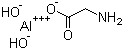 |
| Molecular Formula | C2H6AlNO4 |
| Molecular Weight | 135.05 |
| CAS Registry Number | 41354-48-7 |
| EC Number | 691-995-6 |
| SMILES | C(C(=O)O[Al])N.O.O |
 chemBlink Chemical Story
|
Aluminium glycinate is a coordination compound formed by the complexation of aluminium ions (Al3+) with glycine, the simplest amino acid (NH2CH2COOH). In this compound, aluminium typically forms chelate bonds with the carboxylate and amine functional groups of glycine, resulting in a stable, water-insoluble or slightly soluble complex depending on the stoichiometry and pH of the environment. Aluminium glycinate appears as a white to off-white powder and has been used primarily for its antacid and antiulcer properties. The compound was developed in the mid-20th century as part of efforts to create aluminium-based antacids with reduced gastrointestinal side effects and improved mucosal protection. Aluminium salts such as aluminium hydroxide and aluminium phosphate have long been employed to neutralize gastric acid. However, they are associated with side effects like constipation and phosphate binding. The incorporation of glycine into aluminium complexes was aimed at mitigating these effects by improving gastrointestinal tolerance and potentially providing cytoprotective activity. Aluminium glycinate functions as an antacid by neutralizing excess stomach acid through a chemical reaction that consumes hydrochloric acid (HCl) in the gastric lumen. Additionally, the glycine ligand may contribute to mucosal protection by promoting bicarbonate secretion or enhancing mucus production. The buffering capacity of aluminium glycinate is generally milder than that of strong bases, making it suitable for sustained or preventative use in acid-related disorders such as gastritis, gastric ulcers, and duodenal ulcers. In certain formulations, aluminium glycinate has been combined with other therapeutic agents such as magnesium hydroxide, ranitidine, or sucralfate to provide a multi-modal approach to gastrointestinal therapy. These combinations aim to reduce gastric acidity while also addressing mucosal healing and motility. The compound has also been studied in animal models for its gastroprotective effects against various ulcerogenic agents, including nonsteroidal anti-inflammatory drugs (NSAIDs) and alcohol. Aluminium glycinate is typically administered orally in tablet, capsule, or suspension form. Upon ingestion, it reacts with gastric acid, releasing aluminium ions and forming insoluble or weakly soluble salts that are eventually excreted in feces. Systemic absorption of aluminium is generally low in individuals with normal renal function. However, in patients with impaired kidney function, accumulation of aluminium can occur, necessitating caution in long-term or high-dose use. The safety profile of aluminium glycinate is comparable to that of other aluminium-based antacids. It is generally well tolerated, though prolonged use may lead to disturbances in phosphate metabolism, particularly in individuals with poor dietary phosphate intake or compromised renal function. Chronic exposure to high doses of aluminium compounds has been associated with osteomalacia and encephalopathy in patients with renal failure, but these outcomes are uncommon at standard therapeutic doses. In summary, aluminium glycinate is a chelated complex of aluminium and glycine used for its antacid and gastroprotective effects. It neutralizes gastric acid and may contribute to mucosal healing, making it a useful agent in the treatment of peptic ulcers and related gastrointestinal conditions. Its favorable tolerability and reduced side effect profile compared to older aluminium salts support its continued use in specific therapeutic contexts. References 1956. DAA: Its antacid effect and use in peptic ulcer. The American Journal of Digestive Diseases, 1(7). DOI: 10.1007/bf02298946 1954. The Efficiency of Dihydroxy Aluminum Aminoacetate in Phosphate Insolubilization. Journal of the American Pharmaceutical Association. American Pharmaceutical Association, 43(5). DOI: 10.1002/jps.3030430514 1952. In Vitro Differences Between Dihydroxy Aluminum Aminoacetate and Dried Aluminum Hydroxide Gel. Journal of the American Pharmaceutical Association. American Pharmaceutical Association, 41(7). DOI: 10.1002/jps.3030410708 |
| Market Analysis Reports |