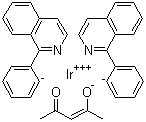
Bis(1-phenylisoquinoline)(acetylacetonato)iridium(III) is a coordination complex that features iridium as the central metal atom, coordinated by two 1-phenylisoquinoline ligands and one acetylacetonato ligand. This compound belongs to a class of iridium-based complexes that have been widely studied for their unique optical and electronic properties. The structure of this compound, with its rigid and aromatic ligands, plays a significant role in determining its photophysical behavior, which makes it suitable for use in various advanced applications.
The discovery of bis(1-phenylisoquinoline)(acetylacetonato)iridium(III) can be traced back to the broader research into metal-organic complexes, particularly those involving iridium, which is known for its ability to exhibit strong luminescent properties. These properties arise from the metal’s d-orbitals and its ability to undergo metal-to-ligand charge transfer (MLCT) and ligand-to-metal charge transfer (LMCT) processes. Iridium complexes, particularly those involving phosphorescent materials, have attracted significant attention for their potential in optoelectronic devices. Bis(1-phenylisoquinoline)(acetylacetonato)iridium(III) is particularly noted for its high quantum efficiency and long-lived excited states, which make it an ideal candidate for use in light-emitting applications.
One of the most prominent applications of bis(1-phenylisoquinoline)(acetylacetonato)iridium(III) is in organic light-emitting diodes (OLEDs). Iridium-based complexes are favored in OLED technology due to their ability to emit light efficiently and with high color purity. The strong phosphorescent emission of bis(1-phenylisoquinoline)(acetylacetonato)iridium(III) contributes to the production of bright, high-quality light, making it valuable in display technologies and lighting applications. The compound’s luminescence arises from its ability to transition between singlet and triplet excited states, a feature that enhances the efficiency of light production in OLEDs.
In addition to OLEDs, bis(1-phenylisoquinoline)(acetylacetonato)iridium(III) has been explored for use in organic solar cells (OSCs). The compound’s strong absorption properties, coupled with its ability to participate in charge transfer processes, make it a promising candidate for enhancing the efficiency of OSCs. In these devices, iridium complexes can act as light-harvesting materials, absorbing sunlight and converting it into electrical energy. The stability and efficient charge transport properties of bis(1-phenylisoquinoline)(acetylacetonato)iridium(III) contribute to its potential as a key component in the development of next-generation solar energy technologies.
Furthermore, bis(1-phenylisoquinoline)(acetylacetonato)iridium(III) has also been studied for its potential role in bioimaging and photodynamic therapy. Due to its luminescent properties, the compound can be used in the detection of biological markers or in the treatment of certain cancers through photodynamic therapy. When irradiated with light, the compound generates reactive oxygen species (ROS), which can be used to target and destroy cancerous cells. This application highlights the versatility of iridium-based complexes in both materials science and biomedicine.
In summary, bis(1-phenylisoquinoline)(acetylacetonato)iridium(III) is an important iridium-based coordination complex with a variety of applications in optoelectronics, energy conversion, and biomedicine. Its unique photophysical properties, including strong phosphorescence and efficient charge transfer characteristics, make it an ideal candidate for use in OLEDs, organic solar cells, and bioimaging technologies. As research into iridium complexes continues, compounds like bis(1-phenylisoquinoline)(acetylacetonato)iridium(III) are likely to play an increasingly prominent role in the development of advanced materials and devices.
|




 GHS07 Warning Details
 chemBlink Chemical Story