
Online Database of Chemicals from Around the World
| Hangzhou Verychem Science And Technology Co., Ltd. | China | |||
|---|---|---|---|---|
 | www.verychem.com | |||
 | +86 (571) 8816-2785 +86 13606544505 | |||
 | +86 (571) 8816-2787 | |||
 | lucy@verychem.com | |||
| Chemical manufacturer since 2004 | ||||
| chemBlink Massive supplier since 2021 | ||||
| Classification | Chemical reagent >> Organic reagent >> Cyanate ester / isocyanate |
|---|---|
| Name | 1,4-Diisocyanatobutane |
| Molecular Structure | 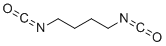 |
| Molecular Formula | C6H8N2O2 |
| Molecular Weight | 140.14 |
| CAS Registry Number | 4538-37-8 |
| EC Number | 610-246-6 |
| SMILES | C(CCN=C=O)CN=C=O |
| Density | 1.1±0.1 g/cm3, Calc.* |
|---|---|
| Index of Refraction | 1.484, Calc.* |
| Boiling Point | 220.5 °C (760 mmHg), Calc.* |
| Flash Point | 106.7 °C, Calc.* |
| * | Calculated using Advanced Chemistry Development (ACD/Labs) Software. |
| Hazard Symbols |    GHS06;GHS07;GHS08 Danger Details GHS06;GHS07;GHS08 Danger Details | ||||||||||||||||||||||||||||||||||||||||
|---|---|---|---|---|---|---|---|---|---|---|---|---|---|---|---|---|---|---|---|---|---|---|---|---|---|---|---|---|---|---|---|---|---|---|---|---|---|---|---|---|---|
| Risk Statements | H302-H312-H315-H317-H319-H330-H332-H334-H335 Details | ||||||||||||||||||||||||||||||||||||||||
| Safety Statements | P233-P260-P261-P264-P264+P265-P270-P271-P272-P280-P284-P301+P317-P302+P352-P304+P340-P305+P351+P338-P316-P317-P319-P320-P321-P330-P332+P317-P333+P317-P337+P317-P342+P316-P362+P364-P403-P403+P233-P405-P501 Details | ||||||||||||||||||||||||||||||||||||||||
| Hazard Classification | |||||||||||||||||||||||||||||||||||||||||
| |||||||||||||||||||||||||||||||||||||||||
| SDS | Available | ||||||||||||||||||||||||||||||||||||||||
 chemBlink Chemical Story
|
1,4-Diisocyanatobutane is an organic compound with the molecular formula C6H8N2O2. It belongs to the class of aliphatic diisocyanates, characterized by the presence of two isocyanate (-N=C=O) functional groups attached to a four-carbon linear alkane chain. This compound is used primarily in polymer chemistry, particularly in the production of polyurethanes. The discovery and development of diisocyanates, including 1,4-diisocyanatobutane, can be traced back to early research on isocyanate chemistry in the mid-20th century. The synthesis of this compound typically involves the phosgenation of the corresponding diamine, 1,4-diaminobutane, under controlled conditions. This process is similar to the industrial synthesis of other diisocyanates, where phosgene reacts with amine groups to form the isocyanate functionalities. One of the main applications of 1,4-diisocyanatobutane is in the production of polyurethanes. When reacted with diols or polyols, it forms polyurethane materials with specific mechanical and chemical properties. Aliphatic diisocyanates such as 1,4-diisocyanatobutane are particularly valued for their role in producing light-stable and flexible polyurethane products, including coatings, adhesives, sealants, and elastomers. Compared to aromatic diisocyanates, aliphatic variants provide superior resistance to UV degradation, making them suitable for outdoor applications. Additionally, 1,4-diisocyanatobutane is used in specialty polymer synthesis, including the development of materials with high elasticity and durability. The compound’s relatively short aliphatic chain contributes to the flexibility of the resulting polymer networks, which can be beneficial in applications requiring resilience and mechanical strength. Due to its reactive isocyanate groups, appropriate handling and safety precautions are necessary when working with 1,4-diisocyanatobutane. Like other diisocyanates, it can pose risks of respiratory sensitization and skin irritation, necessitating proper ventilation and protective measures during industrial use. The industrial significance of 1,4-diisocyanatobutane lies in its ability to contribute to the tailored properties of polymeric materials, especially in applications demanding UV resistance and mechanical flexibility. Its role in polyurethane chemistry remains a key area of utilization, aligning with the broader use of aliphatic diisocyanates in high-performance materials. References 2024. Advances in medical polyesters for vascular tissue engineering. Discover Nano, 19(1). DOI: 10.1186/s11671-024-04073-x 1998. A new biomedical polyurethane with a high modulus based on 1,4-butanediisocyanate and epsilon-caprolactone. Journal of Materials Science: Materials in Medicine, 9(12). DOI: 10.1023/a:1008922128455 1998. High molecular weight polyurethanes and a polyurethane urea based on 1,4-butanediisocyanate. Polymer Bulletin, 41(3). DOI: 10.1007/s002890050343 |
| Market Analysis Reports |