Online Database of Chemicals from Around the World

Taxifolin
[CAS# 480-18-2]

List of Suppliers
Simagchem Corporation China Inquire
www.simagchem.com
+86 13806087780
+86 (592) 268-0237
sale@simagchem.com
Chemical manufacturer since 2002
chemBlink Standard supplier since 2008
Hefei TNJ Chemical Industry Co., Ltd. China Inquire
www.tnjchem.com
+86 (551) 6541-8684
+86 (551) 6541-8697
sales@tnjchem.com
Chemical manufacturer since 2001
chemBlink Standard supplier since 2010
Wilshire Technologies, Inc. USA Inquire
www.wilshiretechnologies.com
+1 (609) 683-1117
+1 (732) 274-0049
Wilshire-info@evonik.com
Chemical manufacturer since 1997
chemBlink Standard supplier since 2010
Shaanxi Green Bio-Engineering Co., Ltd. China Inquire
www.sxgreenfine.com
+86 (29) 8621-5910
8621-5920
8621-5930
+86 (29) 8621-5580
sxgreenfine@gmail.com
rql1107@hotmail.com
Chemical manufacturer
chemBlink Standard supplier since 2010
BOC Sciences USA Inquire
www.bocsci.com
+1 (631) 485-4226
+1 (631) 614-7828
info@bocsci.com
Chemical manufacturer
chemBlink Standard supplier since 2010
Beckmann-Kenko GmbH Germany Inquire
www.beckmann-kenko.com
+49 (4241) 930-888
+49 (4241) 930-889
info@beckmann-kenko.com
Chemical distributor
chemBlink Standard supplier since 2011
Aktin Chemicals Inc China Inquire
www.aktinchem.com
+86 400-028-7725
+86 (28) 8515-2372
info@aktinchem.com
QQ Chat
Chemical manufacturer
chemBlink Standard supplier since 2011
Hangzhou Leap Chem Co., Ltd. China Inquire
www.leapchem.com
+86 (571) 8771-1850
market19@leapchem.com
QQ Chat
Chemical manufacturer since 2006
chemBlink Standard supplier since 2015
Hangzhou Hairui Chemical Co., Ltd. China Inquire
www.hairuichem.com
+86 (571) 8669-1155
+86 (571) 8669-1154
sales@hairuichem.com
Chemical distributor since 2005
chemBlink Standard supplier since 2017
Chengdu Biopurify Phytochemicals Ltd. China Inquire
www.phytopurify.com
+86 (28) 8263-3860
8263-3987
+86 (28) 8263-3165
sales@biopurify.com
biopurify@gmail.com
QQ Chat
Skype Chat
Chemical manufacturer
chemBlink Standard supplier since 2017
Nanjing Dasf Biotechnology Co., Ltd. China Inquire
www.dasfbio.com
+86 (25) 8556-2066
+86 (25) 8556-2066
linwei@dasfbio.com
Chemical manufacturer since 2011
chemBlink Standard supplier since 2018
Neostar United (Changzhou) Industrial Co., Ltd. China Inquire
www.neostarunited.com
+86 (519) 8555-7386
+86 18015025600
+86 (519) 8555-7389
marketing1@neostarunited.com
Chemical distributor since 2014
chemBlink Standard supplier since 2020
Cfm Oskar Tropitzsch GmbH Germany Inquire
www.cfmot.de
+49 (9231) 9619-0
+49 (9231) 9619-60
info@cfmot.de
Chemical distributor since 1985
chemBlink Standard supplier since 2022
Cheng Du Chenlv Herb Co., Ltd. China Inquire
www.chenlvherbs.com
+86 18981728582
chenlvherb@126.com
WeChat: Cheng Du Chenlv Herb Co., Ltd.
Chemical manufacturer since 2012
chemBlink Standard supplier since 2025
Chemos GmbH & Co. KG Germany Inquire
www.chemos.de
+49 871-966346-0
+49 871-966346-13
chemos@chemos.de
Chemical distributor
Kemprotec Limited UK Inquire
www.kemprotec.com
+44 (1642) 591-764
+44 (1845) 550-001
sales@kemprotec.co.uk
Chemical distributor since 1998
Indofine Chemical Company, Inc. USA Inquire
www.indofinechemical.com
+1 (888) 463-6346
+1 (908) 359-1179
info@indofinechemical.com
Chemical manufacturer since 1981

Identification
ClassificationBiochemical >> Natural biochemical product
NameTaxifolin
Synonyms(2R,3R)-3,3',4',5,7-Pentahydroxyflavanone; (2R,3R)-Dihydroquercetin
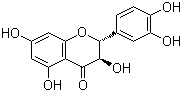
Molecular StructureCAS # 480-18-2, Taxifolin
Molecular FormulaC15H12O7
Molecular Weight304.25
CAS Registry Number480-18-2 (98006-93-0)
EC Number207-543-4
SMILESC1=CC(=C(C=C1[C@@H]2[C@H](C(=O)C3=C(C=C(C=C3O2)O)O)O)O)O
Properties
Density1.7±0.1 g/cm3 Calc.*
Boiling point687.6±55.0 °C 760 mmHg (Calc.)*
Flash point264.2±25.0 °C (Calc.)*
Index of refraction1.763 (Calc.)*
*Calculated using Advanced Chemistry Development (ACD/Labs) Software.
Safety Data
Hazard Symbolssymbol   GHS07 Warning  Details
Risk StatementsH302  Details
Safety StatementsP264-P270-P301+P317-P330-P501  Details
Hazard Classification
up    Details
HazardClassCategory CodeHazard Statement
Acute toxicityAcute Tox.4H302
SDSAvailable
up Discovery and Applications
Taxifolin, also known as dihydroquercetin, is a naturally occurring flavanonol widely distributed in plants such as Silybum marianum, Larix species, and various fruits including onions and grapes. Chemically, it is a flavonoid characterized by a 3-hydroxyflavanone backbone with multiple hydroxyl groups on the aromatic rings, which confer potent antioxidant properties. Taxifolin has attracted attention due to its diverse pharmacological activities, including antioxidant, anti-inflammatory, cardioprotective, neuroprotective, and anticancer effects.

The discovery of taxifolin dates back to studies of plant polyphenols in the early 20th century, when researchers were investigating the bioactive constituents responsible for the health benefits of fruits, vegetables, and medicinal plants. Isolation and structural elucidation were accomplished using chromatographic separation and spectroscopic methods, enabling further investigation into its biological activities and therapeutic potential.

Pharmacologically, taxifolin exhibits strong antioxidant activity. Its multiple hydroxyl groups allow it to scavenge reactive oxygen species (ROS), chelate metal ions, and inhibit lipid peroxidation, protecting cellular components from oxidative damage. These properties contribute to its potential in preventing oxidative stress–related diseases, such as cardiovascular and neurodegenerative disorders.

Taxifolin also demonstrates anti-inflammatory effects. It can suppress the production of pro-inflammatory cytokines and inhibit key enzymes such as cyclooxygenase-2 (COX-2) and inducible nitric oxide synthase (iNOS), thereby modulating inflammatory pathways like NF-κB and MAPK. These mechanisms underlie its therapeutic potential in conditions associated with chronic inflammation, including arthritis, metabolic disorders, and neuroinflammation.

In addition, taxifolin exhibits cardioprotective activity. It can improve endothelial function, reduce oxidative stress in cardiac tissues, and inhibit platelet aggregation, which supports its role in preventing atherosclerosis and other cardiovascular diseases. Its neuroprotective effects are also significant, as it reduces oxidative damage and inflammation in neuronal cells, mitigates apoptosis, and modulates signaling pathways involved in neurodegenerative diseases such as Alzheimer’s and Parkinson’s.

Taxifolin has shown anticancer activity in vitro and in vivo. It can induce apoptosis, inhibit cell proliferation, and interfere with cell cycle progression in various cancer cell lines. These effects are mediated through modulation of signaling pathways including PI3K/Akt, p53, and MAPK, suggesting potential applications as a chemopreventive or adjuvant therapeutic agent.

Despite its promising pharmacological profile, taxifolin has limited water solubility, which may restrict its bioavailability. Researchers are investigating formulation strategies, such as nanoparticle encapsulation, liposomal delivery, and complexation with cyclodextrins, to enhance solubility, absorption, and systemic distribution, thereby improving its therapeutic efficacy.

Overall, taxifolin is a bioactive flavanonol with a wide range of pharmacological activities, including antioxidant, anti-inflammatory, cardioprotective, neuroprotective, and anticancer effects. Its historical use in medicinal plants, combined with modern studies on its molecular mechanisms and potential applications, underscores its value as a therapeutic compound.

References

2021. Taxifolin, a novel food, attenuates acute alcohol-induced liver injury in mice through regulating the NF-κB-mediated inflammation and PI3K/Akt signalling pathways. Pharmaceutical Biology, 59(1).
DOI: 10.1080/13880209.2021.1942504

2018. Taxifolin, a natural flavonoid interacts with cell cycle regulators causes cell cycle arrest and causes tumor regression by activating Wnt/β-catenin signaling pathway. BMC Cancer, 18(1).
DOI: 10.1186/s12885-018-4959-4

2019. In Vitro and in Vivo Anti-Hyperglycemic Activities of Taxifolin and Its Derivatives Isolated from Pigmented Rice (Oryzae sativa L. cv. Superhongmi). Journal of Agricultural and Food Chemistry, 68(3).
DOI: 10.1021/acs.jafc.9b04962
Market Analysis Reports
List of Reports Available for Taxifolin
Related Products
Tautomycin  Taxachitriene B  Taxacin  Taxagifine  Taxamairin-A  Taxane  Taxanine M  Taxayunnansin A  Taxcultine  (-)-Taxifolin  Taxifolin 3'-gl...  Taxifolin 3-O-b...  Taxin B  Taxine  Taxinine  Taxinine B  Taxinine E  Taxinin J  Taxiphyllin  Taxiresinol