
Online Database of Chemicals from Around the World
| Nanjing Odyssey Chemical Industry Co., Ltd. | China | |||
|---|---|---|---|---|
 | www.odysseychem.net | |||
 | +86 (25) 8531-2873 8532-1503 | |||
 | +86 (25) 8532-8962 / 8531-8902 | |||
 | nods@163.net | |||
| Chemical manufacturer since 1994 | ||||
| chemBlink Standard supplier since 2005 | ||||
| Simagchem Corporation | China | |||
|---|---|---|---|---|
| www.simagchem.com | |||
| +86 13806087780 | |||
| +86 (592) 268-0237 | |||
| sale@simagchem.com | |||
| Chemical manufacturer since 2002 | ||||
| chemBlink Standard supplier since 2008 | ||||
| Sinocompound Catalysts Co., Ltd. | China | |||
|---|---|---|---|---|
| www.sinocompound.com | |||
| +86 (512) 6721-6630 | |||
| +86 (512) 5631-6689 | |||
| sales@sinocompound.com | |||
| Chemical manufacturer since 2008 | ||||
| chemBlink Standard supplier since 2010 | ||||
| Beijing Huanling Technology Co., Ltd. | China | |||
|---|---|---|---|---|
| www.huanlingkeji.com | |||
| +86 (10) 5263-2489 | |||
| +86 (10) 5263-2489 | |||
| sales@huanlingkeji.com donghong1223@163.com | |||
 | QQ Chat | |||
| Chemical manufacturer since 2011 | ||||
| chemBlink Standard supplier since 2011 | ||||
| Watec Laboratories, Inc. | China | |||
|---|---|---|---|---|
| www.wateclaboratories.com | |||
| +86 (519) 8692-1516 +86 18602586511 | |||
| +86 (519) 8526-7382 | |||
| info@wateclaboratories.com | |||
| QQ Chat | |||
| Chemical manufacturer since 2014 | ||||
| chemBlink Standard supplier since 2012 | ||||
| LOBA Feinchemie AG | Austria | |||
|---|---|---|---|---|
| www.loba.co.at | |||
| +43 (223) 277-391 | |||
| +43 (223) 276-677 | |||
| sales@loba.co.at | |||
| Chemical distributor | ||||
| chemBlink Standard supplier since 2012 | ||||
| Eastar Chemical Corporation | USA | |||
|---|---|---|---|---|
| www.eastarchem.com | |||
| +1 800-898-2436 | |||
| +1 (877) 898-2436 | |||
| info@eastarchem.com | |||
| Chemical manufacturer since 1989 | ||||
| chemBlink Standard supplier since 2014 | ||||
| Hangzhou Leap Chem Co., Ltd. | China | |||
|---|---|---|---|---|
| www.leapchem.com | |||
| +86 (571) 8771-1850 | |||
| market19@leapchem.com | |||
| QQ Chat | |||
| Chemical manufacturer since 2006 | ||||
| chemBlink Standard supplier since 2015 | ||||
| Wako Pure Chemical Industries, Ltd. | Japan | |||
|---|---|---|---|---|
| www.wako-chem.co.jp | |||
| +81 (6) 6203-3741 | |||
| +81 (6) 6201-5964 | |||
| wkhk.info@fujifilm.com | |||
| Chemical manufacturer since 1922 | ||||
| Classification | Analytical chemistry >> Standard >> Pharmacopoeia standards and magazine standards |
|---|---|
| Name | Neocuproine |
| Synonyms | 2,9-Dimethyl-1,10-phenanthroline |
| Molecular Structure | 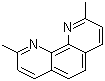 |
| Molecular Formula | C14H12N2 |
| Molecular Weight | 208.26 |
| CAS Registry Number | 484-11-7 |
| EC Number | 207-601-9 |
| SMILES | CC1=NC2=C(C=C1)C=CC3=C2N=C(C=C3)C |
| Melting point | 158-163 °C |
|---|---|
| Water solubility | slightly soluble |
| Hazard Symbols |  GHS07 Warning Details GHS07 Warning Details | ||||||||||||||||||||||||||||||||
|---|---|---|---|---|---|---|---|---|---|---|---|---|---|---|---|---|---|---|---|---|---|---|---|---|---|---|---|---|---|---|---|---|---|
| Risk Statements | H315-H319-H335 Details | ||||||||||||||||||||||||||||||||
| Safety Statements | P261-P264-P264+P265-P271-P280-P302+P352-P304+P340-P305+P351+P338-P319-P321-P332+P317-P337+P317-P362+P364-P403+P233-P405-P501 Details | ||||||||||||||||||||||||||||||||
| Hazard Classification | |||||||||||||||||||||||||||||||||
| |||||||||||||||||||||||||||||||||
| SDS | Available | ||||||||||||||||||||||||||||||||
 chemBlink Chemical Story
|
Neocuproine, also known as 2,9-dimethyl-1,10-phenanthroline, is an organic compound with the molecular formula C14H12N2. This chelator is known for its strong affinity for copper (I) ions, forming highly stable complexes that are valuable in a variety of analytical and biochemical applications. The discovery of Neocuproine dates back to the early 20th century, when phenanthroline derivatives were initially explored. Researchers were interested in these compounds because of their potential applications in coordination chemistry. Neocuproine was first synthesized and characterized in the 1930s, and its unique properties soon became apparent. Its ability to selectively bind to copper (I) ions distinguished it from other chelators and opened new avenues for its use in analytical chemistry. One of the main applications of Neocuproine is in the field of analytical chemistry, where it is used as a reagent for the detection and quantification of copper (I) ions. The Neocuproine-copper (I) complex exhibits a distinctive yellow color that is easily identified and measured by spectrophotometry. This property is used in a variety of assays and analytical methods to determine copper concentrations in biological samples, environmental samples, and industrial products. The high specificity and sensitivity of assays based on the new copper reagent make it the standard choice in laboratories around the world. In biochemistry, the new copper reagent is used to study and manipulate redox reactions involving copper. Its strong affinity for copper(I) allows researchers to probe the redox state of copper in proteins and enzymes, providing insights into the role of copper in biological systems. The new copper reagent has played an important role in elucidating the mechanisms of copper-dependent enzymes and studying electron transport chains in which copper ions play a key role. The new copper reagent also has applications in the field of environmental science. Its ability to selectively bind copper(I) ions makes it a powerful tool for monitoring and controlling copper pollution. In environmental testing, methods based on the new copper reagent can be used to assess copper levels in water and soil, helping to ensure that these levels remain within safe limits. This is particularly important in areas affected by industrial discharges and agricultural runoff, where copper contamination can pose serious environmental and health risks. In the field of medicine, the new copper reagent has been used for potential therapeutic applications. Its copper chelating properties suggest that it could be used to treat disorders associated with copper metabolism disorders, such as Wilson's disease, where excess copper accumulation in the body can lead to serious health problems. By binding and sequestering excess copper, neocuproine could help manage and alleviate the symptoms of such disorders. However, its clinical applications are still under investigation, and more research is needed to fully understand its therapeutic potential and safety. In addition, neocuproine is used in organic synthesis and catalysis. Its ability to form stable complexes with copper(I) can be used in a variety of catalytic reactions, including those used in the synthesis of fine chemicals and pharmaceuticals. The neocuproine-copper(I) complex can act as a catalyst to facilitate reactions that would otherwise be challenging or inefficient. Safety considerations are critical when handling neocuproine. While neocuproine is generally considered safe to use in a laboratory setting, appropriate precautions should be taken to avoid inhalation, ingestion, or skin contact. Proper storage and handling practices, including the use of personal protective equipment, ensure the safe use of neocuproine in research and industrial applications. References 2021. Determination of antioxidant activity and phenolic compounds for basic standardization of Turkish propolis. Applied Biological Chemistry, 64. DOI: 10.1186/s13765-021-00608-3 2002. Inner-Sphere Complexation of Cobalt(II) 2,9-Dimethyl-1,10-phenanthroline ([Co(neo)]2+) with Commercial and Sol-Gel Derived Silica Gel Surfaces. Inorganic Chemistry, 41. DOI: 10.1021/ic025824r 1986. Effects of o-phenanthroline, 2,2'-dipyridyl and neocuproine on the activities of bleomycin to inhibit DNA synthesis and growth of cultured cells. The Journal of Antibiotics, 39. DOI: 10.7164/antibiotics.39.1473 |
| Market Analysis Reports |