Benorylate was designed around an attractive medicinal-chemistry idea: instead of administering aspirin and paracetamol as two separate molecules, link them covalently into one ester and let the body release the familiar drugs after absorption. The result is a "mutual prodrug" or codrug, in which both parts of the molecule correspond to pharmacologically active agents.
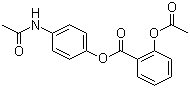
Structurally, benorylate links the phenolic oxygen of paracetamol to the carboxyl group of acetylsalicylic acid through an ester bond. That masks the free carboxylic acid of aspirin and changes the compound's physical and absorption behavior. After administration, esterases can hydrolyze the molecule, producing salicylate-related and paracetamol-related species. The design was intended to combine analgesic, antipyretic, and anti-inflammatory actions while altering gastrointestinal exposure to free aspirin.
This approach belongs to a broader period in drug design when chemists explored prodrugs not simply to rescue poorly absorbed compounds but to change where and when an active drug was generated. Linking two active drugs is especially appealing on paper: one molecular entity can carry a fixed stoichiometric relationship and may change distribution or local irritation. But a covalent combination does not guarantee clinical superiority. Hydrolysis kinetics, dose ratio, absorption, metabolism, and toxicity still matter.
Benorylate's clinical history illustrates that caution. It was used as an analgesic and anti-inflammatory drug in some countries, but it did not replace aspirin and paracetamol as universal therapy. Because its metabolism yields aspirin-related exposure, the safety issues associated with salicylates remain relevant; historical pediatric antipyretic studies and later understanding of Reye syndrome also make indiscriminate use in children inappropriate. The molecule therefore provides an instructive contrast between an elegant chemical concept and the harder question of therapeutic advantage.
The codrug strategy also changes analytical thinking. Before hydrolysis, benorylate is neither simply aspirin nor simply paracetamol, so pharmacokinetic studies must distinguish intact parent compound from released metabolites. Measuring only total salicylate or total paracetamol-related material can obscure when cleavage occurred and which species circulated. This analytical requirement is central to prodrug development: a molecule may look elegant on paper, but its value can only be understood by following the time course of parent drug, active products, and competing metabolic pathways in vivo.
Benorylate matters because it makes the prodrug idea tangible. A medicinal chemist can temporarily hide functional groups and even join two known medicines with a cleavable bond. The body then becomes part of the synthesis sequence, using enzymes to regenerate active species. Whether that strategy succeeds depends not only on clever molecular construction but on pharmacokinetics, safety, and clinical benefit. Benorylate is thus a useful historical example of how drug design moves from chemical logic to biological reality.
References:
1. PubChem. Benorylate, CAS 5003-48-5.
2. Oral antipyretic therapy: evaluation of benorylate, an ester of acetylsalicylic acid and paracetamol. European Journal of Pediatrics. 1975.
3. Bundgaard H. Design of Prodrugs. Elsevier, 1985.
4. Historical pharmaceutical literature on benorylate as a mutual prodrug of aspirin and paracetamol.
|





 GHS05;GHS07 Danger Details
 chemBlink Chemical Story