
Online Database of Chemicals from Around the World
| Mascot I.E. CO.,Ltd. | China | |||
|---|---|---|---|---|
 | www.mascotchem.com | |||
 | +86 (519) 8501-0339 +86 13584504415 | |||
 | +86 (519) 8501-0366 | |||
 | info@mascotchem.com | |||
 | QQ Chat | |||
| Chemical distributor since 2006 | ||||
| chemBlink Standard supplier since 2006 | ||||
| Tyger Scientific Inc. | USA | |||
|---|---|---|---|---|
| www.tygersci.com | |||
| +1 (609) 434-0144 | |||
| +1 (609) 434-0143 | |||
| sales@tygersci.com | |||
| Chemical manufacturer since 1992 | ||||
| chemBlink Standard supplier since 2008 | ||||
| Riverland Trading LLC. | USA | |||
|---|---|---|---|---|
| www.riverlandtrading.com | |||
| +1 (336).944-2293 | |||
| bens@riverlandtrading.com | |||
| Chemical distributor | ||||
| chemBlink Standard supplier since 2023 | ||||
| Sinocure Chemical Group | China | |||
|---|---|---|---|---|
| www.sinocurechem.com | |||
| +86 15550440621 | |||
| info@sinocurechem.com | |||
| Chemical manufacturer since 2020 | ||||
| Scientific Polymer Products, Inc. | USA | |||
|---|---|---|---|---|
| www.scientificpolymer.com | |||
| +1 (585) 265-0413 | |||
| +1 (585) 265-1390 | |||
| custserv@scipoly.com | |||
| Chemical manufacturer | ||||
| Classification | Organic raw materials >> Carboxylic compounds and derivatives >> Carboxylic esters and their derivatives |
|---|---|
| Name | Glycerine propoxylate triacrylate |
| Synonyms | Propoxylated glycerol triacrylate |
| Molecular Structure | 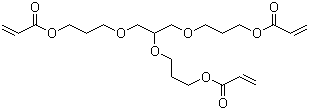 |
| Molecular Formula | C21H32O9 |
| Molecular Weight | 428.47 |
| CAS Registry Number | 52408-84-1 |
| EC Number | 500-114-5 |
| SMILES | C=CC(=O)OCCCOCC(COCCCOC(=O)C=C)OCCCOC(=O)C=C |
| Density | 1.064 g/mL (25 °C) |
|---|---|
| Index of Refraction | n20/D 1.461 |
| Hazard Symbols |  GHS07 Warning Details GHS07 Warning Details | ||||||||||||||||||||||||||||||||||||||||||||||||
|---|---|---|---|---|---|---|---|---|---|---|---|---|---|---|---|---|---|---|---|---|---|---|---|---|---|---|---|---|---|---|---|---|---|---|---|---|---|---|---|---|---|---|---|---|---|---|---|---|---|
| Risk Statements | H317-H319 Details | ||||||||||||||||||||||||||||||||||||||||||||||||
| Safety Statements | P261-P264+P265-P272-P280-P302+P352-P305+P351+P338-P321-P333+P317-P337+P317-P362+P364-P501 Details | ||||||||||||||||||||||||||||||||||||||||||||||||
| Hazard Classification | |||||||||||||||||||||||||||||||||||||||||||||||||
| |||||||||||||||||||||||||||||||||||||||||||||||||
| SDS | Available | ||||||||||||||||||||||||||||||||||||||||||||||||
 chemBlink Chemical Story
|
Glycerine propoxylate triacrylate is a compound with significant applications in the field of polymer chemistry and material science. This chemical substance features a triacrylate structure combined with a glycerine propoxylate backbone, making it a versatile monomer used in various advanced polymer formulations. The discovery of glycerine propoxylate triacrylate emerged from the need for innovative monomers that could enhance the properties of polymers, particularly in applications requiring high performance and durability. The synthesis of this compound involves the reaction of glycerine propoxylate with acrylate groups, creating a triacrylate ester. This unique chemical structure endows the substance with distinct properties that are valuable in polymer science. One of the primary applications of glycerine propoxylate triacrylate is in the creation of high-performance polymers and resins. Due to its triacrylate structure, the compound readily participates in polymerization reactions, forming cross-linked networks that contribute to the final polymer's strength and stability. Polymers derived from glycerine propoxylate triacrylate exhibit enhanced mechanical properties, chemical resistance, and thermal stability. These characteristics make them suitable for use in demanding applications such as coatings, adhesives, and composite materials. In the coatings industry, glycerine propoxylate triacrylate is valued for its ability to produce films with superior adhesion, hardness, and scratch resistance. When incorporated into coating formulations, this monomer helps create durable and long-lasting protective layers for various surfaces, including metal, wood, and plastic. The high-performance coatings resulting from the use of glycerine propoxylate triacrylate are used in automotive, aerospace, and industrial applications, where resilience and reliability are essential. Another significant application of glycerine propoxylate triacrylate is in the development of adhesives. The compound's ability to form strong cross-linked networks contributes to the adhesive's bonding strength and durability. Adhesives containing glycerine propoxylate triacrylate are used in a wide range of industries, including construction, electronics, and packaging. These adhesives are known for their excellent bonding properties, resistance to environmental factors, and compatibility with various substrates. The compound also finds utility in the field of composite materials. Glycerine propoxylate triacrylate can be used as a cross-linking agent in the production of composite resins, which are employed in the manufacturing of reinforced plastics, laminates, and other high-performance materials. The incorporation of this monomer into composite formulations enhances the mechanical properties and thermal stability of the resulting materials, making them suitable for applications in aerospace, automotive, and marine industries. In addition to its use in polymers and composites, glycerine propoxylate triacrylate is also utilized in the production of hydrogels and other specialty materials. The compound's ability to form cross-linked networks allows it to be incorporated into hydrogels with specific properties, such as responsiveness to environmental stimuli. These hydrogels have applications in drug delivery systems, tissue engineering, and environmental sensing, where they can be designed to respond to changes in pH, temperature, or other conditions. Overall, glycerine propoxylate triacrylate is a valuable chemical substance with diverse applications in polymer chemistry and material science. Its unique chemical structure and reactivity make it an essential component in the development of high-performance polymers, coatings, adhesives, and specialty materials. References 2000. Interpenetrating Networks Obtained by Crosslinking in the Vinylacetate (VAc)-Triethoxyvinylsilane (VTES)-Tetraethoxysilane (TEOS) System. Journal of Sol-Gel Science and Technology, 19(1-3). DOI: 10.1023/a:1008736906122 |
| Market Analysis Reports |