
Online Database of Chemicals from Around the World
| Simagchem Corporation | China | |||
|---|---|---|---|---|
 | www.simagchem.com | |||
 | +86 13806087780 | |||
 | +86 (592) 268-0237 | |||
 | sale@simagchem.com | |||
| Chemical manufacturer since 2002 | ||||
| chemBlink Standard supplier since 2008 | ||||
| Hefei TNJ Chemical Industry Co., Ltd. | China | |||
|---|---|---|---|---|
| www.tnjchem.com | |||
| +86 (551) 6541-8684 | |||
| +86 (551) 6541-8697 | |||
| sales@tnjchem.com | |||
| Chemical manufacturer since 2001 | ||||
| chemBlink Standard supplier since 2010 | ||||
| Wilshire Technologies, Inc. | USA | |||
|---|---|---|---|---|
| www.wilshiretechnologies.com | |||
| +1 (609) 683-1117 | |||
| +1 (732) 274-0049 | |||
| Wilshire-info@evonik.com | |||
| Chemical manufacturer since 1997 | ||||
| chemBlink Standard supplier since 2010 | ||||
| BOC Sciences | USA | |||
|---|---|---|---|---|
| www.bocsci.com | |||
| +1 (631) 485-4226 | |||
| +1 (631) 614-7828 | |||
| info@bocsci.com | |||
| Chemical manufacturer | ||||
| chemBlink Standard supplier since 2010 | ||||
| Aktin Chemicals Inc | China | |||
|---|---|---|---|---|
| www.aktinchem.com | |||
| +86 400-028-7725 | |||
| +86 (28) 8515-2372 | |||
| info@aktinchem.com | |||
 | QQ Chat | |||
| Chemical manufacturer | ||||
| chemBlink Standard supplier since 2011 | ||||
| Watec Laboratories, Inc. | China | |||
|---|---|---|---|---|
| www.wateclaboratories.com | |||
| +86 (519) 8692-1516 +86 18602586511 | |||
| +86 (519) 8526-7382 | |||
| info@wateclaboratories.com | |||
| QQ Chat | |||
| Chemical manufacturer since 2014 | ||||
| chemBlink Standard supplier since 2012 | ||||
| Shanghai Orient Chemical Co., Ltd. | China | |||
|---|---|---|---|---|
| www.greenchemintl.com | |||
| +86 (21) 5996-9669 | |||
| +86 (21) 5996-9200 | |||
| jackson@greenchemintl.com info@greenchemintl.com | |||
| Chemical manufacturer since 2002 | ||||
| chemBlink Standard supplier since 2013 | ||||
| Pure Chemistry Scientific Inc | USA | |||
|---|---|---|---|---|
| www.purechems.com | |||
| +1 (888) 588-9418 | |||
| +1 (617) 206-9595 | |||
| sales@purechems.com | |||
| Chemical manufacturer since 2004 | ||||
| chemBlink Standard supplier since 2014 | ||||
| Hangzhou Leap Chem Co., Ltd. | China | |||
|---|---|---|---|---|
| www.leapchem.com | |||
| +86 (571) 8771-1850 | |||
| market19@leapchem.com | |||
| QQ Chat | |||
| Chemical manufacturer since 2006 | ||||
| chemBlink Standard supplier since 2015 | ||||
| Carbosynth China Ltd. | China | |||
|---|---|---|---|---|
| www.carbosynth.cn | |||
| +86 (512) 6260-5585 | |||
| +86 (512) 6260-5576 | |||
| sales@carbosynth.com | |||
| QQ Chat | |||
| Chemical manufacturer since 2006 | ||||
| chemBlink Standard supplier since 2016 | ||||
| Chengdu Biopurify Phytochemicals Ltd. | China | |||
|---|---|---|---|---|
| www.phytopurify.com | |||
| +86 (28) 8263-3860 8263-3987 | |||
| +86 (28) 8263-3165 | |||
| sales@biopurify.com biopurify@gmail.com | |||
| QQ Chat | |||
 | Skype Chat | |||
| Chemical manufacturer | ||||
| chemBlink Standard supplier since 2017 | ||||
| Neostar United (Changzhou) Industrial Co., Ltd. | China | |||
|---|---|---|---|---|
| www.neostarunited.com | |||
| +86 (519) 8555-7386 +86 18015025600 | |||
| +86 (519) 8555-7389 | |||
| marketing1@neostarunited.com | |||
| Chemical distributor since 2014 | ||||
| chemBlink Standard supplier since 2020 | ||||
| Shaanxi click biotechnology co., Ltd | China | |||
|---|---|---|---|---|
| www.herbchemical.com | |||
| +86 18629008060 | |||
| anna@herbchemical.com | |||
| QQ Chat | |||
| Chemical distributor since 2019 | ||||
| chemBlink Standard supplier since 2021 | ||||
| Cfm Oskar Tropitzsch GmbH | Germany | |||
|---|---|---|---|---|
| www.cfmot.de | |||
| +49 (9231) 9619-0 | |||
| +49 (9231) 9619-60 | |||
| info@cfmot.de | |||
| Chemical distributor since 1985 | ||||
| chemBlink Standard supplier since 2022 | ||||
| Anhua Jinhou Biotechnology Co., Ltd. | China | |||
|---|---|---|---|---|
| en.jinhoubio.com | |||
| +86 18273766827 | |||
| jhswshelly@gmail.com | |||
| QQ Chat | |||
| Skype Chat | |||
 | WeChat: 18273766827 | |||
 | WhatsApp:18273766827 | |||
| Chemical manufacturer since 2016 | ||||
| chemBlink Standard supplier since 2023 | ||||
| Cheng Du Chenlv Herb Co., Ltd. | China | |||
|---|---|---|---|---|
| www.chenlvherbs.com | |||
| +86 18981728582 | |||
| chenlvherb@126.com | |||
| WeChat: Cheng Du Chenlv Herb Co., Ltd. | |||
| Chemical manufacturer since 2012 | ||||
| chemBlink Standard supplier since 2025 | ||||
| Santa Cruz Biotechnology, Inc. | USA | |||
|---|---|---|---|---|
| www.scbt.com | |||
| +1 (831) 457-3800 | |||
| +1 (831) 457-3801 | |||
| scbt@scbt.com | |||
| Chemical manufacturer | ||||
| Sinova Corporation | USA | |||
|---|---|---|---|---|
| www.sinovainc.com | |||
| +1 (301) 961-1525 | |||
| +1 (240) 235-4288 | |||
| sales@sinovainc.com | |||
| Chemical manufacturer | ||||
| Guangzhou Honsea Sunshine Bio Science & Technology Co., Ltd. | China | |||
|---|---|---|---|---|
| www.honseabio.com | |||
| +86 (20) 3206-7089 | |||
| +86 (20) 8210-6062 | |||
| info@honsea.com | |||
| Chemical manufacturer | ||||
| LKT Laboratories, Inc. | USA | |||
|---|---|---|---|---|
| www.lktlabs.com | |||
| +1 (888) 558-5227 | |||
| +1 (651) 644-8357 | |||
| peacerli@mbolin-lktlabs.com | |||
| Chemical manufacturer | ||||
| Classification | Biochemical >> Natural biochemical product |
|---|---|
| Name | Magnolol |
| Synonyms | 5,5'-Diallyl-2,2'-biphenyldiol |
| Molecular Structure | 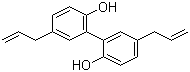 |
| Molecular Formula | C18H18O2 |
| Molecular Weight | 266.33 |
| CAS Registry Number | 528-43-8 |
| EC Number | 610-903-7 |
| SMILES | C=CCC1=CC(=C(C=C1)O)C2=C(C=CC(=C2)CC=C)O |
| Density | 1.1±0.1 g/cm3 Calc.* |
|---|---|
| Melting point | 101 - 102 °C (Expl.) |
| Boiling point | 401.0±40.0 °C 760 mmHg (Calc.)* |
| Flash point | 184.5±21.9 °C (Calc.)* |
| Solubility | DMSO: 37mg/mL (Expl.) |
| Index of refraction | 1.602 (Calc.)* |
| * | Calculated using Advanced Chemistry Development (ACD/Labs) Software. |
| Hazard Symbols |    GHS05;GHS07;GHS09 Danger Details GHS05;GHS07;GHS09 Danger Details | ||||||||||||||||||||||||
|---|---|---|---|---|---|---|---|---|---|---|---|---|---|---|---|---|---|---|---|---|---|---|---|---|---|
| Risk Statements | H315-H318-H319-H335-H411 Details | ||||||||||||||||||||||||
| Safety Statements | P261-P264-P264+P265-P271-P273-P280-P302+P352-P304+P340-P305+P351+P338-P305+P354+P338-P317-P319-P321-P332+P317-P337+P317-P362+P364-P391-P403+P233-P405-P501 Details | ||||||||||||||||||||||||
| Hazard Classification | |||||||||||||||||||||||||
| |||||||||||||||||||||||||
| Transport Information | UN 3077 | ||||||||||||||||||||||||
| SDS | Available | ||||||||||||||||||||||||
 chemBlink Chemical Story
|
Magnolol is a naturally occurring biphenolic compound primarily isolated from the bark of Magnolia officinalis and related Magnolia species. Chemically, it is a hydroxylated biphenyl with two phenolic groups at the 5 and 5′ positions, which contribute to its pharmacological activities. Magnolol has been widely studied for its diverse bioactivities, including anti-inflammatory, antioxidant, antimicrobial, and neuroprotective properties, making it a significant bioactive constituent in traditional and modern medicinal contexts. The discovery of magnolol dates back to studies of Magnolia bark in the early 20th century, when researchers isolated its active constituents responsible for the plant’s traditional use in treating digestive disorders, anxiety, and respiratory conditions. Through chromatographic separation and spectroscopic characterization, magnolol was identified and structurally elucidated, facilitating detailed investigations into its biological activities. Pharmacologically, magnolol exhibits potent anti-inflammatory effects. It can inhibit the production of pro-inflammatory cytokines, such as tumor necrosis factor-alpha (TNF-α) and interleukin-6 (IL-6), and suppress enzymes involved in inflammatory processes, including cyclooxygenase-2 (COX-2) and inducible nitric oxide synthase (iNOS). These actions contribute to its therapeutic potential in inflammatory diseases, including arthritis, colitis, and other chronic inflammatory conditions. Magnolol also demonstrates notable antioxidant activity. Its phenolic groups can scavenge reactive oxygen species (ROS), reduce oxidative stress, and protect cells from lipid peroxidation and DNA damage. This property supports its use in preventing oxidative stress–related diseases and protecting cardiovascular and neuronal tissues from damage. The compound has been investigated for its antimicrobial activity against a variety of bacteria, fungi, and viruses. Magnolol disrupts microbial cell membranes, inhibits microbial enzyme activity, and interferes with biofilm formation, highlighting its potential as a natural antimicrobial agent. In addition, magnolol has shown synergistic effects when combined with conventional antimicrobial agents, enhancing therapeutic efficacy. Neuroprotective effects of magnolol have also been reported. It can modulate neurotransmitter systems, reduce neuroinflammation, and protect neurons against apoptosis and oxidative damage. These effects indicate potential applications in neurodegenerative disorders, such as Alzheimer’s and Parkinson’s disease, and in reducing anxiety and stress-related behaviors. Despite its broad pharmacological profile, magnolol has limited water solubility, which affects its bioavailability. Researchers have explored formulation strategies, such as nanoparticle encapsulation, liposomes, and complexation with cyclodextrins, to enhance solubility, stability, and systemic absorption, thereby improving its therapeutic potential. Clinically, magnolol has been employed in traditional Chinese medicine for gastrointestinal, respiratory, and psychological conditions. Modern research continues to explore its therapeutic applications in inflammation, oxidative stress, microbial infections, and neuroprotection. Its safety profile is generally favorable, with low toxicity observed in preclinical studies. Overall, magnolol is a bioactive biphenolic compound with diverse pharmacological activities, including anti-inflammatory, antioxidant, antimicrobial, and neuroprotective effects. Its historical use in traditional medicine, combined with modern research into its mechanisms and applications, highlights its potential as a therapeutic agent in multiple disease contexts. References 2021. Magnolol attenuates inflammatory pain by inhibiting sodium currents in mouse dorsal root ganglion neurons. Inflammopharmacology, 29(5). DOI: 10.1007/s10787-021-00809-8 2021. Magnolol suppressed cell migration and invasion and induced cell apoptosis via inhibition of the NF-κB signaling pathway by upregulating microRNA-129 in multiple myeloma. Neoplasma, 68(2). DOI: 10.4149/neo_2020_200923n1010 2018. Magnolol Induces Apoptosis and Inhibits ERK-modulated Metastatic Potential in Hepatocellular Carcinoma Cells. In vivo (Athens, Greece), 32(6). DOI: 10.21873/invivo.11387 |
| Market Analysis Reports |