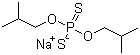
Sodium O,O-diisobutyl dithiophosphate, CAS 53378-51-1, is a sulfur-containing organophosphorus flotation reagent. It belongs to the dialkyl dithiophosphate family, whose anions contain a phosphorus center bonded to two alkoxy groups and two sulfur atoms. Such compounds are used as collectors or promoter reagents for sulfide-mineral flotation.
Dithiophosphates were developed as alternatives and complements to xanthate collectors. Their sulfur donor atoms interact with metal-containing mineral surfaces and can promote hydrophobicity, allowing selected particles to attach to air bubbles. They are particularly associated with flotation circuits for copper and other sulfide minerals, although performance depends strongly on ore mineralogy, oxidation state, pH and the other reagents present.
The two isobutoxy groups contribute hydrophobic character while the dithiophosphate head group provides the chemically active surface-binding region. Compared with xanthates, dithiophosphates can show different selectivity and frothing behavior, which is why flotation plants often use reagent combinations rather than assuming one collector is universally best.
The sodium salt form is useful for preparing water-compatible formulations. Public literature for this exact CAS number is less extensive than for the broader dithiophosphate reagent class, so it is best described through the well-established chemistry of that class rather than assigning unsupported performance claims to a specific ore.
References:
1. Bulatovic SM. Handbook of Flotation Reagents. Elsevier, 2007.
2. Fuerstenau MC, Jameson GJ, Yoon RH, eds. Froth Flotation: A Century of Innovation. SME, 2007.
3. Wills BA, Finch JA. Wills' Mineral Processing Technology. 8th ed. Elsevier, 2016.
|




 GHS05 Danger Details
 chemBlink Chemical Story