
Online Database of Chemicals from Around the World
| Zhejiang Yangfan New Materials Co., Ltd. | China | |||
|---|---|---|---|---|
 | www.shoufu.com | |||
 | +86 (571) 8890-2510 8890-2504 8890-2511 | |||
 | +86 (571) 8890-2500 | |||
 | shoufu@shoufuchem.com | |||
| Chemical manufacturer since 2002 | ||||
| chemBlink Standard supplier since 2006 | ||||
| Hangzhou TJM Chemical Co., Ltd. | China | |||
|---|---|---|---|---|
| www.tjmchem.com | |||
| +86 13388471767 | |||
| +86 (571) 8822-3279 | |||
| sales@tjmchem.com | |||
| Chemical manufacturer | ||||
| chemBlink Standard supplier since 2011 | ||||
| Hangzhou Zentra Bio-Chemical Co., Ltd. | China | |||
|---|---|---|---|---|
| www.zentrachem.com | |||
| +86 18321999949 | |||
| steven@zentrachem.com | |||
 | QQ Chat | |||
 | WeChat: Hangzhou Zentra Bio-Chemical Co., Ltd. | |||
| Chemical distributor since 2025 | ||||
| chemBlink Standard supplier since 2025 | ||||
| Kingchem Inc. | USA | |||
|---|---|---|---|---|
| www.kingchem.com | |||
| +1 (800) 211-4330 (201) 825-9988 | |||
| +1 (201) 825-9148 | |||
| customer-service@kingchem.com | |||
| Chemical manufacturer since 1994 | ||||
| Classification | Chemical reagent >> Organic reagent >> Thiol/thiophenol |
|---|---|
| Name | Bis(3-nitrophenyl) disulfide |
| Synonyms | 3-Nitrophenyl disulfide; Nitrophenide |
| Molecular Structure | 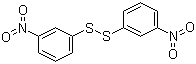 |
| Molecular Formula | C12H8N2O4S2 |
| Molecular Weight | 308.33 |
| CAS Registry Number | 537-91-7 |
| EC Number | 208-677-6 |
| SMILES | C1=CC(=CC(=C1)SSC2=CC=CC(=C2)[N+](=O)[O-])[N+](=O)[O-] |
| Density | 1.5±0.1 g/cm3 Calc.* |
|---|---|
| Melting point | 83 °C (Expl.) |
| Boiling point | 443.6±30.0 °C 760 mmHg (Calc.)* |
| Flash point | 222.1±24.6 °C (Calc.)* |
| Index of refraction | 1.718 (Calc.)* |
| * | Calculated using Advanced Chemistry Development (ACD/Labs) Software. |
| Hazard Symbols |  GHS09 Warning Details GHS09 Warning Details | ||||||||||||||||||||||||
|---|---|---|---|---|---|---|---|---|---|---|---|---|---|---|---|---|---|---|---|---|---|---|---|---|---|
| Risk Statements | H400-H410 Details | ||||||||||||||||||||||||
| Safety Statements | P273-P391-P501 Details | ||||||||||||||||||||||||
| Hazard Classification | |||||||||||||||||||||||||
| |||||||||||||||||||||||||
| Transport Information | UN 3077 | ||||||||||||||||||||||||
| SDS | Available | ||||||||||||||||||||||||
 chemBlink Chemical Story
|
Bis(3-nitrophenyl) disulfide is an organic compound consisting of two 3-nitrophenyl groups linked through a disulfide (–S–S–) bond. The molecular structure features aromatic rings each substituted with a nitro group (–NO2) at the 3-position relative to the sulfur attachment point. The disulfide linkage connects the two phenyl rings via sulfur atoms, forming a symmetrical molecule. The compound is typically synthesized through the oxidation of 3-nitrothiophenol or by coupling reactions involving 3-nitrothiol derivatives under controlled oxidative conditions. The introduction of the disulfide bond often requires mild oxidizing agents to prevent overoxidation or side reactions. Chemically, bis(3-nitrophenyl) disulfide displays characteristics typical of aromatic disulfides. The disulfide bond can undergo reversible redox reactions, including reduction to corresponding thiols or cleavage under certain conditions. The nitro substituents are strong electron-withdrawing groups, affecting the electron density of the aromatic rings and influencing reactivity such as nucleophilic aromatic substitution and reduction reactions. Applications of bis(3-nitrophenyl) disulfide include its use as an intermediate in organic synthesis, particularly in the preparation of sulfur-containing compounds, pharmaceuticals, and agrochemicals. It can serve as a precursor to 3-nitrothiophenol or related thiol derivatives upon reduction. The compound's redox-active disulfide bond is exploited in designing materials with switchable properties and in biochemical studies involving thiol–disulfide exchange. Analytical characterization involves nuclear magnetic resonance (¹H and ¹³C NMR) spectroscopy to confirm the aromatic substitution pattern and disulfide linkage. Infrared (IR) spectroscopy identifies characteristic nitro group vibrations near 1520 and 1350 cm–1 and S–S bond absorptions around 500–550 cm–1. Mass spectrometry confirms the molecular weight and fragmentation consistent with the disulfide structure. Physically, bis(3-nitrophenyl) disulfide is usually obtained as a crystalline solid with limited solubility in water but good solubility in organic solvents such as dichloromethane, chloroform, and ethanol. Its melting point and crystallinity depend on sample purity. In summary, bis(3-nitrophenyl) disulfide is a nitro-substituted aromatic disulfide with applications as a synthetic intermediate and in materials science. Its distinctive chemical features, including the disulfide bond and nitro substituents, confer unique reactivity useful in various chemical contexts. References 2023. Multimodal action of KRP203 on phosphoinositide kinases in vitro and in cells. Biochemical and Biophysical Research Communications. DOI: 10.1016/j.bbrc.2023.08.050 2022. Thioether Synthesis. Science of Synthesis. URL: https://science-of-synthesis.thieme.com/app/text/?id=SD-238-00099 2000. Bis(3-nitrophenyl) disulfide forms no C—H···O hydrogen bonds. Acta crystallographica. Section C, Crystal structure communications, 56(10). DOI: 10.1107/s010827010001012x |
| Market Analysis Reports |