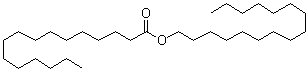
Palmityl palmitate, more commonly known as cetyl palmitate, is a wax ester formed from palmitic acid and cetyl alcohol. Palmitic acid is a saturated fatty acid that occurs widely in animal fats and vegetable oils, while cetyl alcohol is a long-chain fatty alcohol that was first isolated in the nineteenth century from spermaceti, a wax obtained from sperm whale oil. The study of naturally occurring waxes and fatty substances during the nineteenth century led to the identification of wax esters as distinct chemical entities composed of long-chain fatty acids and long-chain alcohols linked through an ester bond.
The structural characterization of wax esters such as palmityl palmitate contributed to the broader understanding of lipid chemistry. Early investigations demonstrated that natural waxes could be hydrolyzed to yield fatty acids and fatty alcohols, confirming their ester nature. The elucidation of these components helped differentiate waxes from triglycerides, which consist of glycerol esterified with three fatty acids. Palmityl palmitate became recognized as one of the principal constituents of spermaceti, and its isolation and analysis were important steps in the systematic study of marine-derived lipids.
With the development of industrial organic chemistry, palmityl palmitate was also produced synthetically by esterification of palmitic acid with cetyl alcohol under acid-catalyzed conditions. The availability of synthetic routes became particularly significant after restrictions on the use of whale-derived materials, prompting the search for alternative sources and manufacturing methods. Hydrogenation of vegetable oils provided palmitic acid and cetyl alcohol as starting materials, enabling large-scale preparation of the ester without reliance on marine resources.
The physical properties of palmityl palmitate reflect its long hydrocarbon chains. It is a waxy solid at room temperature, with a relatively high melting point compared with shorter-chain esters. Its hydrophobic character and chemical stability under neutral conditions have made it useful in a variety of applications. In cosmetics and personal care formulations, palmityl palmitate functions as an emollient and texture-modifying agent. It contributes to smoothness, spreadability, and the formation of protective films on the skin. Because it is chemically inert under typical formulation conditions, it is compatible with a wide range of ingredients.
In pharmaceutical preparations, palmityl palmitate has been used as a component of ointment bases and controlled-release matrices. Its low reactivity and hydrophobic nature allow it to serve as a structural component in semi-solid dosage forms. In addition, wax esters similar to palmityl palmitate have been studied for their role in biological systems, including their presence in certain plant and animal waxes that provide protective coatings against moisture loss.
Historically, the transition from natural spermaceti to synthetic wax esters marked an important shift in industrial practice. Palmityl palmitate became a representative example of how knowledge of lipid structure enabled the reproduction of desirable material properties through chemical synthesis. Its documented occurrence in natural waxes and its subsequent industrial production illustrate the progression from empirical observation of natural substances to controlled chemical manufacturing.
Although palmityl palmitate is not typically involved in reactive chemical processes, its significance lies in its well-established structural identity and functional performance. Through its role in the study of wax chemistry and its continued application in cosmetic and pharmaceutical formulations, it exemplifies the practical importance of long-chain fatty acid esters in both historical and modern contexts.
References
2025. A Forecasting Metric for Predictive Modeling. Linking Models and Experiments, Volume 2.
DOI: 10.1007/978-1-4419-9305-2_33
|




 GHS07 Warning Details
 chemBlink Chemical Story