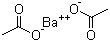
Barium acetate, a salt with the chemical formula Ba(C₂H₃O₂)₂, has been studied extensively since its initial synthesis in the 19th century. Derived from barium and acetic acid, it is commonly found as a white crystalline solid that is soluble in water. The compound was likely first produced during experiments with acetic acid derivatives and quickly became of interest due to barium’s unique chemical properties. Barium acetate continues to hold relevance in various fields, particularly in the manufacturing, chemical, and laboratory sectors.
One of the primary applications of barium acetate is in the production of pigments and specialty glass. When added to glass mixtures, barium compounds, including barium acetate, impart increased brilliance and clarity. Barium acetate in particular contributes to enhancing the refractive index of glass, a property valuable in optical applications and decorative glassware. Additionally, barium compounds are known to add durability to glass, which can make products more resistant to environmental wear. The inclusion of barium acetate in glass and pigment production therefore helps manufacturers achieve desired optical effects and enhance the material’s longevity.
Barium acetate is also used in the preparation of other barium salts, such as barium carbonate, through a simple chemical reaction with carbon dioxide. Barium carbonate is widely used in ceramics, electronics, and glass industries. As a precursor for barium carbonate, barium acetate helps meet the demand for barium-based materials in various industrial applications. Its role in producing barium carbonate indirectly supports the production of ferrites and other components used in electronics, magnetic materials, and ceramic capacitors.
In the laboratory, barium acetate serves as an analytical reagent, particularly in chemical analysis. It is useful in the detection of sulfates as barium ions form an insoluble precipitate with sulfate ions, making it an effective tool for qualitative analysis. Barium acetate also finds use in organic synthesis and as a catalyst in specific organic reactions, especially those involving acetylation or esterification. The acetate ion provides a controlled reaction environment for these transformations, making barium acetate valuable in both research and production environments.
One unique property of barium acetate is its use as a mordant in textile dyeing. Mordants are substances that help fix dyes onto fibers, making the colors more durable and less likely to fade. Barium acetate’s affinity for cellulose fibers, along with its ability to create vibrant shades when used with certain dyes, has made it useful in textile processing. Although its use as a mordant is less common today due to environmental concerns, it remains part of historical dyeing techniques and continues to have specialized applications in artistic and traditional fabric treatments.
The agricultural sector occasionally utilizes barium acetate in the form of fungicides and insecticides, as barium ions are toxic to insects and some fungi. However, due to its toxicity to humans and animals, its use in agriculture is restricted, and it is applied with caution. Barium acetate is classified as a hazardous material, and exposure can lead to severe health effects. It must be handled carefully, following strict safety guidelines to prevent ingestion, inhalation, or skin contact.
In summary, barium acetate is a versatile compound with applications in glass production, barium salt synthesis, laboratory analysis, dyeing, and limited agricultural use. Despite its toxic properties, it is highly valued for its unique characteristics when handled properly in controlled environments.
References
2016. Rapid Screening for Exposure to “Non-Target” Pharmaceuticals from Wastewater Effluents by Combining HRMS-Based Suspect Screening and Exposure Modeling. Environmental Science & Technology, 50(6).
DOI: 10.1021/acs.est.5b03332
2007. A structural insight into lead neurotoxicity and calmodulin activation by heavy metals. Acta Crystallographica Section F: Structural Biology and Crystallization Communications, 63(Pt 8).
DOI: 10.1107/s1744309107034525
2004. External Barium Affects the Gating of KCNQ1 Potassium Channels and Produces a Pore Block via Two Discrete Sites. The Journal of General Physiology, 124(1).
DOI: 10.1085/jgp.200409068
|




 GHS07 Warning Details
 chemBlink Chemical Story