
Online Database of Chemicals from Around the World
| Simagchem Corporation | China | |||
|---|---|---|---|---|
 | www.simagchem.com | |||
 | +86 13806087780 | |||
 | +86 (592) 268-0237 | |||
 | sale@simagchem.com | |||
| Chemical manufacturer since 2002 | ||||
| chemBlink Standard supplier since 2008 | ||||
| Tyger Scientific Inc. | USA | |||
|---|---|---|---|---|
| www.tygersci.com | |||
| +1 (609) 434-0144 | |||
| +1 (609) 434-0143 | |||
| sales@tygersci.com | |||
| Chemical manufacturer since 1992 | ||||
| chemBlink Standard supplier since 2008 | ||||
| Winchem Industrial Co., Ltd. | China | |||
|---|---|---|---|---|
| www.win-chemical.com | |||
| +86 (574) 8385-1061 | |||
| +86 (574) 8708-3209 | |||
| info@win-chemical.com hhp13@hotmail.com | |||
| Chemical manufacturer | ||||
| chemBlink Standard supplier since 2010 | ||||
| BOC Sciences | USA | |||
|---|---|---|---|---|
| www.bocsci.com | |||
| +1 (631) 485-4226 | |||
| +1 (631) 614-7828 | |||
| info@bocsci.com | |||
| Chemical manufacturer | ||||
| chemBlink Standard supplier since 2010 | ||||
| Hangzhou Origo Chemical Co., Ltd. | China | |||
|---|---|---|---|---|
| www.origochem.com | |||
| +86 (571) 8669-0377 +86 18657128658 | |||
| +86 (571) 8695-6257 | |||
| schiang@origochem.com sales@origochem.com | |||
 | QQ Chat | |||
 | Skype Chat | |||
| Chemical distributor since 2016 | ||||
| chemBlink Standard supplier since 2017 | ||||
| Luminescence Technology Corp. | Taiwan | |||
|---|---|---|---|---|
| www.lumtec.com.tw | |||
| +886 (2) 2697-5600 | |||
| +886 (2) 2697-5601 | |||
| sales@lumtec.com.tw | |||
| Chemical manufacturer since 1999 | ||||
| chemBlink Standard supplier since 2024 | ||||
| Nano Chemitek (Yangzhou) Corp. | China | |||
|---|---|---|---|---|
| www.solventdye.com | |||
| +86 (514) 8637-3200 | |||
| +86 (514) 8637-3703 | |||
| mail@solventdye.com | |||
| Chemical manufacturer | ||||
| Classification | Dyes and pigments >> Dyes >> Reduced dye |
|---|---|
| Name | Pigment Red 179 |
| Synonyms | 2,9-Dimethylanthra[2,1,9-def:6,5,10-d'e'f']diisoquinoline-1,3,8,10(2H,9H)-tetrone; C.I. 71130 |
| Molecular Structure | 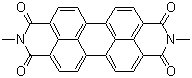 |
| Molecular Formula | C26H14N2O4 |
| Molecular Weight | 418.41 |
| CAS Registry Number | 5521-31-3 |
| EC Number | 226-866-1 |
| SMILES | CN1C(=O)C2=C3C(=CC=C4C3=C(C=C2)C5=C6C4=CC=C7C6=C(C=C5)C(=O)N(C7=O)C)C1=O |
| Density | 1.6±0.1 g/cm3, Calc.* |
|---|---|
| Melting point | 400 °C (Expl.) |
| Index of Refraction | 1.905, Calc.* |
| Boiling Point | 694.8±28.0 °C (760 mmHg), Calc.* |
| Flash Point | 341.1±16.4 °C, Calc.* |
| * | Calculated using Advanced Chemistry Development (ACD/Labs) Software. |
| Hazard Symbols |  GHS07 Warning Details GHS07 Warning Details | ||||||||||||||||||||
|---|---|---|---|---|---|---|---|---|---|---|---|---|---|---|---|---|---|---|---|---|---|
| Risk Statements | H315-H319-H335 Details | ||||||||||||||||||||
| Safety Statements | P261-P264-P264+P265-P271-P280-P302+P352-P304+P340-P305+P351+P338-P319-P321-P332+P317-P337+P317-P362+P364-P403+P233-P405-P501 Details | ||||||||||||||||||||
| Hazard Classification | |||||||||||||||||||||
| |||||||||||||||||||||
| SDS | Available | ||||||||||||||||||||
 chemBlink Chemical Story
|
Pigment Red 179, also known as CI Pigment Red 179 or Quinacridone Red, is a synthetic organic pigment used primarily in a wide range of applications such as paints, coatings, printing inks, plastics, and cosmetics. Its rich red color and excellent stability have made it a popular choice for use in various industries. The discovery of Pigment Red 179 dates back to the mid-20th century, when it was first synthesized as part of the quinacridone pigment family. Quinacridones are a class of synthetic pigments that are derived from quinacridone compounds, known for their vibrant colors and good durability. The synthesis of Pigment Red 179 was a significant development in the field of color chemistry, as it offered a more stable, vivid red color compared to earlier red pigments such as cadmium reds and lakes. Pigment Red 179 is synthesized through a chemical reaction involving quinacridone derivatives, often using a method known as the Friedel-Crafts reaction. This process typically involves the condensation of aniline with a substituted aromatic compound, followed by subsequent chemical modifications to achieve the desired structure. The resulting pigment exhibits excellent lightfastness, weatherability, and chemical resistance, which are highly valued in industrial applications. One of the primary applications of Pigment Red 179 is in the production of high-performance automotive and industrial coatings. Its exceptional durability makes it suitable for use in paints and coatings that must withstand harsh environmental conditions, such as UV radiation, heat, and moisture. The pigment’s ability to retain its color over time makes it ideal for applications where color stability is crucial, including exterior coatings for vehicles, machinery, and outdoor infrastructure. Pigment Red 179 is also widely used in printing inks, particularly in applications requiring high-quality color reproduction, such as in packaging materials and graphic design. Its strong color strength and excellent dispersion properties allow it to produce vibrant and consistent colors on paper, cardboard, and other substrates. Additionally, the pigment is utilized in plastics and rubber, where it is incorporated into polymers to provide long-lasting color without compromising the material's physical properties. In the cosmetics industry, Pigment Red 179 is used in products such as lipsticks, eye shadows, and nail polishes. Its bright red hue and stability make it an attractive option for cosmetic formulations, providing a bold and consistent color while meeting regulatory standards for safety. The pigment is often selected for its non-toxic nature, ensuring that it can be safely used in products intended for direct skin contact. Pigment Red 179 is also utilized in various art materials, including artist paints and pigments, where it contributes to the wide range of red shades available to painters. Its vibrant, transparent red tone makes it popular among artists for both mixing and glazing applications. Despite its many advantages, Pigment Red 179 has some limitations, particularly in terms of its cost and the need for precise processing to achieve the desired properties. The synthesis of this pigment requires careful control of reaction conditions, and the raw materials used in its production can be relatively expensive. As a result, Pigment Red 179 is often used in applications where its high-performance qualities justify the additional cost. In recent years, there has been growing interest in the environmental impact of synthetic pigments, and research is ongoing to develop more sustainable and eco-friendly alternatives. However, Pigment Red 179 remains a widely used and highly valued pigment due to its exceptional color quality and durability. In conclusion, Pigment Red 179 is a synthetic organic pigment that plays a significant role in industries ranging from automotive coatings to cosmetics. Its discovery and continued use have contributed to advancements in color technology, offering vibrant, stable, and durable color solutions. Its applications are diverse, and despite the challenges associated with its production, it remains a staple in color formulations across various sectors. References 2024. Dye pollution in the textile industry: challenges and solutions. Environmental Chemistry for a Sustainable World. DOI: 10.1007/978-981-97-5341-3_3 2006. Photophysics of PTCDA in thin films: influence of growth temperature. Journal of Physical Chemistry B, 110(10). DOI: 10.1021/jp056899u 2005. Laser-induced fluorescence of perylene derivatives in helium nanodroplets. Physical Chemistry Chemical Physics, 7(5). DOI: 10.1039/b418896a |
| Market Analysis Reports |