
Online Database of Chemicals from Around the World
| West Bengal Chemical Industries Limited | India | |||
|---|---|---|---|---|
 | www.wbcil.com | |||
 | 08240399360 | |||
 | wbcilpvtltd@gmail.com | |||
| Chemical manufacturer since 1970 | ||||
| chemBlink Standard supplier since 2021 | ||||
| Classification | Organic raw materials >> Organometallic compound >> Organic zinc |
|---|---|
| Name | Zinc propionate |
| Synonyms | Zinc dipropanoate |
| Molecular Structure | 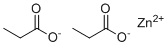 |
| Molecular Formula | C6H10O4Zn |
| Molecular Weight | 211.52 |
| CAS Registry Number | 557-28-8 |
| EC Number | 209-167-6 |
| SMILES | CCC(=O)[O-].CCC(=O)[O-].[Zn+2] |
| Boiling point | 141.7°C (760 mmHg) (Expl.) |
|---|---|
| Hazard Symbols |    GHS05;GHS07;GHS09 Danger Details GHS05;GHS07;GHS09 Danger Details | ||||||||||||||||
|---|---|---|---|---|---|---|---|---|---|---|---|---|---|---|---|---|---|
| Risk Statements | H315-H318-H319-H335-H400-H411 Details | ||||||||||||||||
| Safety Statements | P261-P264-P264+P265-P271-P273-P280-P302+P352-P304+P340-P305+P351+P338-P305+P354+P338-P317-P319-P321-P332+P317-P337+P317-P362+P364-P391-P403+P233-P405-P501 Details | ||||||||||||||||
| Hazard Classification | |||||||||||||||||
| |||||||||||||||||
| SDS | Available | ||||||||||||||||
 chemBlink Chemical Story
|
Zinc propionate is an inorganic–organic salt composed of zinc cations (Zn2+) and propionate anions (C3H5O2−), with the empirical formula Zn(C3H5O2)2. It is typically obtained through the neutralization of propionic acid with a zinc base, such as zinc oxide or zinc carbonate, followed by drying and purification. The resulting material is usually a white to slightly off-white powder, soluble in water, and characterized by the mild odor of propionic acid when exposed to moisture. The discovery and development of zinc propionate as an industrial and agricultural chemical stem from the combined functional properties of zinc and propionic acid. Propionic acid and its salts are well known for their antimicrobial activity, particularly against molds and some bacteria, and zinc compounds have additional antimicrobial and antifungal properties. By forming the zinc salt of propionic acid, it is possible to achieve a product that exhibits broad-spectrum preservation capacity with reduced volatility compared with the parent acid. Zinc propionate has been applied primarily as a preservative in animal feeds, especially in poultry, swine, and cattle rations, to inhibit mold growth and extend storage life. Its mode of action involves disruption of microbial metabolism through the propionate moiety, while zinc can interact with microbial cell membranes and enzymes to further reduce viability. This dual mechanism makes zinc propionate a useful alternative or complement to calcium and sodium propionate in environments where additional zinc supplementation is beneficial for animal health. In addition to its role as a preservative, zinc propionate serves as a source of dietary zinc in fortified feeds. Zinc is an essential trace element required for enzymatic function, growth, reproduction, and immune system performance in livestock. Using zinc propionate in feed formulations can simplify additive systems by providing both a mold inhibitor and a zinc nutrient in a single compound. Its bioavailability is considered good, although it may vary depending on diet composition and the presence of other minerals that compete for absorption. The compound has also been explored for use in certain specialized rubber and polymer applications, where metal carboxylates can act as curing agents, stabilizers, or catalysts. Zinc propionate’s solubility and compatibility with organic systems make it suitable for some niche industrial uses, though these are less common compared to its agricultural role. Zinc propionate is generally regarded as safe when used according to established guidelines, but as with other zinc salts, excessive dietary intake can result in zinc toxicity. Symptoms in animals may include gastrointestinal upset, reduced feed intake, and interference with copper metabolism. Storage in cool, dry conditions is important to maintain its stability and prevent hydrolysis or absorption of moisture from the air. References 2010. Influence of relative humidity on the interaction between different aryl propionic acid derivatives and poly(vinylpyrrolidone) K30: Evaluation of the effect on drug bioavailability. International Journal of Pharmaceutics, 398(1-2). DOI: 10.1016/j.ijpharm.2010.07.024 2003. Effects of hydrochloric, acetic, butyric, and propionic acids on pathogenesis of ulcers in the nonglandular portion of the stomach of horses. American Journal of Veterinary Research, 64(4). DOI: 10.2460/ajvr.2003.64.404 1998. A Study on the Promotion and Suppression of Demineralization of Human Dental Hard Tissues and Hydroxyapatite. Connective Tissue Research, 37(3-4). DOI: 10.3109/03008209809017028 |
| Market Analysis Reports |