
Online Database of Chemicals from Around the World
| BOC Sciences | USA | |||
|---|---|---|---|---|
 | www.bocsci.com | |||
 | +1 (631) 485-4226 | |||
 | +1 (631) 614-7828 | |||
 | info@bocsci.com | |||
| Chemical manufacturer | ||||
| chemBlink Standard supplier since 2010 | ||||
| Selleck Chemicals LLC | USA | |||
|---|---|---|---|---|
| www.selleckchem.com | |||
| +1 (713) 535-9129 | |||
| +1 (832) 582-8590 | |||
| info@selleckchem.com | |||
| Chemical manufacturer | ||||
| chemBlink Standard supplier since 2014 | ||||
| Hangzhou Leap Chem Co., Ltd. | China | |||
|---|---|---|---|---|
| www.leapchem.com | |||
| +86 (571) 8771-1850 | |||
| market19@leapchem.com | |||
 | QQ Chat | |||
| Chemical manufacturer since 2006 | ||||
| chemBlink Standard supplier since 2015 | ||||
| Amadis Chemical Co., Ltd. | China | |||
|---|---|---|---|---|
| www.amadischem.com | |||
| +86 (571) 8992-5085 | |||
| +86 (571) 8992-5065 | |||
| sales@amadischem.com | |||
| Chemical manufacturer since 2010 | ||||
| chemBlink Standard supplier since 2015 | ||||
| Targetmol Chemicals Inc. | USA | |||
|---|---|---|---|---|
| www.targetmol.com | |||
| +1 (781) 999-5354 | |||
| +1 (781) 281-9145 | |||
| sales@targetmol.com | |||
| Chemical manufacturer since 2013 | ||||
| chemBlink Standard supplier since 2025 | ||||
| Classification | Biochemical >> Inhibitor >> Metabolism >> Ferroptosis activator |
|---|---|
| Name | Erastin |
| Synonyms | 2-[1-[4-[2-(4-Chlorophenoxy)acetyl]-1-piperazinyl]ethyl]-3-(2-ethoxyphenyl)-4(3H)-quinazolinone |
| Molecular Structure | 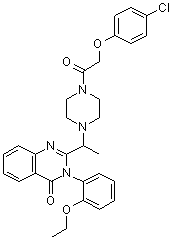 |
| Molecular Formula | C30H31ClN4O4 |
| Molecular Weight | 547.04 |
| CAS Registry Number | 571203-78-6 |
| EC Number | 637-217-0 |
| SMILES | CCOC1=CC=CC=C1N2C(=O)C3=CC=CC=C3N=C2C(C)N4CCN(CC4)C(=O)COC5=CC=C(C=C5)Cl |
| Density | 1.3±0.1 g/cm3 Calc.* |
|---|---|
| Boiling point | 721.9±70.0 °C 760 mmHg (Calc.)* |
| Flash point | 390.4±35.7 °C (Calc.)* |
| Solubility | DMSO 100 mg/mL, H2O < 1 mg/mL (insoluble) (Expl.) |
| Index of refraction | 1.634 (Calc.)* |
| * | Calculated using Advanced Chemistry Development (ACD/Labs) Software. |
| Hazard Symbols |  GHS06 Danger Details GHS06 Danger Details | ||||||||
|---|---|---|---|---|---|---|---|---|---|
| Risk Statements | H301 Details | ||||||||
| Safety Statements | P264-P270-P301+P316-P321-P330-P405-P501 Details | ||||||||
| Hazard Classification | |||||||||
| |||||||||
| SDS | Available | ||||||||
 chemBlink Chemical Story
|
Erastin is a small molecule that has been extensively studied for its ability to induce a form of cell death known as ferroptosis. This type of programmed cell death is distinct from other well-known forms like apoptosis, necrosis, and autophagy. Erastin is particularly recognized for its role in the regulation of ferroptosis, a process characterized by the accumulation of lipid peroxides to lethal levels, leading to cellular damage and death. The discovery of erastin was a significant step in the study of ferroptosis. Researchers identified erastin as one of the first compounds capable of selectively inducing ferroptosis in cancer cells, particularly in the context of oncogene-addicted cancers. Erastin acts by inhibiting the function of the system Xc-, a cystine-glutamate antiporter. System Xc- is crucial for the import of cystine into cells, which is essential for the synthesis of glutathione, a major antioxidant that protects cells from oxidative stress. By inhibiting system Xc-, erastin causes a depletion of intracellular glutathione levels, leading to the accumulation of reactive oxygen species (ROS) and lipid peroxidation, ultimately resulting in ferroptosis. The application of erastin in research has provided valuable insights into the molecular mechanisms governing ferroptosis and has highlighted the therapeutic potential of targeting this pathway. For example, cancer cells, particularly those with mutations in oncogenes like RAS, are often more sensitive to ferroptosis. This makes erastin and other ferroptosis-inducing agents potential candidates for cancer therapies, especially in cancers that are resistant to traditional forms of treatment such as chemotherapy and radiation. Beyond cancer, erastin's role in ferroptosis has prompted investigations into its potential applications in a variety of other diseases. For instance, the inhibition of ferroptosis may have therapeutic value in diseases where excessive cell death contributes to pathology, such as neurodegenerative diseases (e.g., Alzheimer's disease, Parkinson's disease) and ischemic injuries. In these contexts, controlling ferroptosis could help preserve cellular function and tissue integrity. In addition to its use in basic research, erastin has become a model compound for the development of other ferroptosis-inducing agents. Researchers have worked to synthesize derivatives of erastin with improved potency and selectivity, aiming to enhance its therapeutic applications. Despite its promising potential, the clinical use of erastin remains in the early stages, and much work is needed to optimize its efficacy, safety, and delivery methods for therapeutic use. In conclusion, erastin is a potent inducer of ferroptosis and has proven to be a valuable tool in both basic research and potential therapeutic strategies. Its role in the study of ferroptosis has opened up new avenues for cancer treatment and the management of other diseases associated with cellular death and oxidative stress. However, further studies are necessary to fully explore its therapeutic potential and to develop erastin-based therapies for clinical use. References 2003. Identification of genotype-selective antitumor agents using synthetic lethal chemical screening in engineered human tumor cells. Cancer Cell, 3(3). DOI: 10.1016/s1535-6108(03)00050-3 2008. Synthetic Lethal Screening Identifies Compounds Activating Iron-Dependent, Nonapoptotic Cell Death in Oncogenic-RAS-Harboring Cancer Cells. Chemistry & Biology, 15(3). DOI: 10.1016/j.chembiol.2008.02.010 2015. Erastin sensitizes glioblastoma cells to temozolomide by restraining xCT and cystathionine-γ-lyase function. Oncology Reports, 33(3). DOI: 10.3892/or.2015.3712 |
| Market Analysis Reports |