
Online Database of Chemicals from Around the World
| Wuhan Kemi-works Chemical Co., Ltd. | China | |||
|---|---|---|---|---|
 | www.kemiworks.net | |||
 | +86 (27) 8573-6489 | |||
 | +86 (27) 8573-6485 | |||
 | info@kemiworks.net sales@kemiworks.com | |||
| Chemical manufacturer | ||||
| chemBlink Premium supplier since 2011 | ||||
| Classification | Organic raw materials >> Carboxylic compounds and derivatives |
|---|---|
| Name | Sodium 9-oxo-10-acridineacetate |
| Synonyms | Camedon; Camedone; L 1; N-(Carboxymethyl)-9-acridone sodium salt; Neovir; Sodium 9,10-dihydro-9-oxo-10-acridineacetate |
| Molecular Structure | 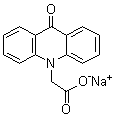 |
| Molecular Formula | C15H11NO3.Na |
| Molecular Weight | 276.24 |
| CAS Registry Number | 58880-43-6 |
| SMILES | C1=CC=C2C(=C1)C(=O)C3=CC=CC=C3N2CC(=O)[O-].[Na+] |
| Melting point | 360-370 °C* |
|---|---|
| * | Miosga, N. |
| Hazard Symbols |  GHS07 Warning Details GHS07 Warning Details |
|---|---|
| Risk Statements | H302-H315-H319-H335 Details |
| Safety Statements | P261-P280-P301+P312-P302+P352-P305+P351+P338 Details |
| SDS | Available |
 chemBlink Chemical Story
|
Sodium 9-oxo-10-acridineacetate is a chemical compound derived from acridine, a heterocyclic aromatic organic compound. It consists of an acridine ring system substituted with a carboxylate group, specifically located at the 10 position of the acridine structure. This compound is part of the broader class of acridine derivatives, which have been studied for their varied chemical reactivity and potential applications across different industries. The discovery of sodium 9-oxo-10-acridineacetate can be linked to the early studies of acridine and its derivatives, which gained attention due to their aromatic properties and ability to form stable complexes with metals. Researchers found that by introducing functional groups such as the carboxylate moiety into the acridine structure, the chemical reactivity and solubility of the compound could be significantly enhanced. This made sodium 9-oxo-10-acridineacetate particularly useful for various applications, especially in fields where acridine itself has already proven valuable. One of the key applications of sodium 9-oxo-10-acridineacetate is in the field of fluorescence and luminescence. Due to the unique electronic properties of the acridine ring system, the compound exhibits strong fluorescence, which makes it suitable for use in fluorescence-based assays and sensors. Its ability to emit light upon excitation is harnessed in various analytical techniques, where it serves as a fluorescent probe to detect and measure the presence of specific analytes. This property has made it especially useful in biochemical and environmental testing, where sensitive detection methods are required. Another important application of sodium 9-oxo-10-acridineacetate is in the pharmaceutical and medical industries. Acridine derivatives, including sodium 9-oxo-10-acridineacetate, have been investigated for their potential as anticancer agents. The compound exhibits some cytotoxic activity, which makes it an attractive candidate for the development of chemotherapeutic drugs. It is believed that the acridine ring system can intercalate into DNA, disrupting the normal function of the DNA and inhibiting cancer cell replication. Additionally, sodium 9-oxo-10-acridineacetate has shown promise in treating other diseases where DNA disruption is a therapeutic strategy. Sodium 9-oxo-10-acridineacetate also plays a role in the field of materials science, particularly in the synthesis of functional materials such as polymers and resins. Its chemical structure, with the acridine and carboxylate functionalities, allows it to participate in the formation of crosslinked networks, which are useful for creating materials with enhanced stability and durability. These materials have applications in various industrial processes, including coatings, adhesives, and sealants. In addition, sodium 9-oxo-10-acridineacetate is used in the development of advanced sensors and detection systems. The compound's fluorescence properties are particularly useful for the detection of specific ions or molecules in solution, as its emission can be easily measured and correlated with the concentration of the target analyte. This application is particularly valuable in fields such as environmental monitoring, where real-time detection of pollutants or toxins is crucial for public health and safety. In summary, sodium 9-oxo-10-acridineacetate is a versatile compound with a range of applications in various scientific fields. From its use in fluorescence-based detection and pharmaceutical development to its role in materials science, the compound continues to be a subject of research and application. Its unique properties, stemming from the combination of the acridine ring system and the carboxylate functional group, enable its use in a broad spectrum of industrial and medical applications. References 2012. Improvement in the diagnosis, therapy, and prevention of complications in patients with rectal cancer. Voprosy Onkologii. URL: https://pubmed.ncbi.nlm.nih.gov/23607204 2003. Neovir therapy in acute hepatitis C. Zhurnal Mikrobiologii, Epidemiologii i Immunobiologii. URL: https://pubmed.ncbi.nlm.nih.gov/12630357 1994. Synthesis, structure and IR characterization of disodium tetra(9,10-dihydro-9-oxo-10-acridineacetato)zincate(II) bis(ethanol) heptahydrate. Journal of Chemical Crystallography. DOI: 10.1007/bf01666961 |
| Market Analysis Reports |