
Online Database of Chemicals from Around the World
| Simagchem Corporation | China | |||
|---|---|---|---|---|
 | www.simagchem.com | |||
 | +86 13806087780 | |||
 | +86 (592) 268-0237 | |||
 | sale@simagchem.com | |||
| Chemical manufacturer since 2002 | ||||
| chemBlink Standard supplier since 2008 | ||||
| Hefei TNJ Chemical Industry Co., Ltd. | China | |||
|---|---|---|---|---|
| www.tnjchem.com | |||
| +86 (551) 6541-8684 | |||
| +86 (551) 6541-8697 | |||
| sales@tnjchem.com | |||
| Chemical manufacturer since 2001 | ||||
| chemBlink Standard supplier since 2010 | ||||
| Ningbo Sialon Chem Co., Ltd. | China | |||
|---|---|---|---|---|
| www.newsialon.com | |||
| +86 (574) 2880-9708 2880-9768 | |||
| +86 (574) 5670-8448 | |||
| sales@newsialon.com roywang0086@hotmail.com | |||
 | QQ Chat | |||
| Chemical manufacturer | ||||
| chemBlink Standard supplier since 2012 | ||||
| Hangzhou Leap Chem Co., Ltd. | China | |||
|---|---|---|---|---|
| www.leapchem.com | |||
| +86 (571) 8771-1850 | |||
| market19@leapchem.com | |||
| QQ Chat | |||
| Chemical manufacturer since 2006 | ||||
| chemBlink Standard supplier since 2015 | ||||
| Sai Chemie Inc. | India | |||
|---|---|---|---|---|
| www.saichemie.com | |||
| +91 (816) 935-6778 | |||
| saichemicalinc@gmail.com | |||
| Chemical manufacturer since 2016 | ||||
| chemBlink Standard supplier since 2020 | ||||
| Innovassynth Technologies (I) Ltd | India | |||
|---|---|---|---|---|
| www.innovassynth.com | |||
| +91 2192 - 260100 | |||
| marketing@innovassynth.com | |||
| Chemical manufacturer since 2001 | ||||
| chemBlink Standard supplier since 2021 | ||||
| Hubei Jianchu Biomedical Co., Ltd. | China | |||
|---|---|---|---|---|
| www.hbhxry.com | |||
| +86 (027) 6538-1247 +86 15671591110 | |||
| +86 (027) 6552-6669 | |||
| 2394105454@qq.com | |||
| QQ Chat | |||
| Chemical manufacturer since 2014 | ||||
| chemBlink Standard supplier since 2022 | ||||
| QV Chemicals LLC | USA | |||
|---|---|---|---|---|
| www.qvchemicals.com | |||
| +1 (636) 489-2021 | |||
| +1 (636) 284-2510 | |||
| info@qvchemicals.com | |||
| Chemical manufacturer | ||||
| Interchim | France | |||
|---|---|---|---|---|
| www.interchim.com | |||
| +33 (4) 7003-7301 | |||
| interfine@mail.interchim.fr | |||
| Chemical manufacturer | ||||
| Eburon Organics bvba | Belgium | |||
|---|---|---|---|---|
| www.eburon-organics.com | |||
| +32 (51) 335-068 | |||
| +32 (51) 335-064 | |||
| sales@eburon-organics.com | |||
| Chemical manufacturer | ||||
| Classification | Chemical reagent >> Organic reagent >> Fatty acid |
|---|---|
| Name | Allylacetic acid |
| Synonyms | 4-Pentenoic acid; Pent-4-enoic acid |
| Molecular Structure | 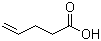 |
| Molecular Formula | C5H8O2 |
| Molecular Weight | 100.12 |
| CAS Registry Number | 591-80-0 |
| EC Number | 209-732-7 |
| FEMA | 2843 |
| SMILES | C=CCCC(=O)O |
| Density | 0.981 |
|---|---|
| Melting point | -22.5 °C |
| Boiling point | 83-84 °C (12 mmHg) |
| Refractive index | 1.4273-1.4303 |
| Flash point | 89 °C |
| Hazard Symbols |   GHS05;GHS07 Danger Details GHS05;GHS07 Danger Details | ||||||||||||||||||||||||||||
|---|---|---|---|---|---|---|---|---|---|---|---|---|---|---|---|---|---|---|---|---|---|---|---|---|---|---|---|---|---|
| Risk Statements | H302-H314-H318 Details | ||||||||||||||||||||||||||||
| Safety Statements | P260-P264-P264+P265-P270-P280-P301+P317-P301+P330+P331-P302+P361+P354-P304+P340-P305+P354+P338-P316-P317-P321-P330-P363-P405-P501 Details | ||||||||||||||||||||||||||||
| Hazard Classification | |||||||||||||||||||||||||||||
| |||||||||||||||||||||||||||||
| Transport Information | UN 2922 | ||||||||||||||||||||||||||||
| SDS | Available | ||||||||||||||||||||||||||||
 chemBlink Chemical Story
|
Allylacetic acid, a chemical compound also known as 2-propenylacetic acid, was first discovered through organic chemistry research. It is synthesized through the reaction of acetic acid with allyl chloride or allyl alcohol. The discovery of allylacetic acid can be traced back to the early 20th century, with its structure confirmed through spectroscopic analysis and chemical characterization. This compound's unique structure, containing both an allyl group and a carboxylic acid functional group, makes it valuable for various applications across different industries. Allylacetic acid serves as a precursor in organic synthesis for the production of various compounds. It participates in reactions to introduce the allyl group into organic molecules, facilitating the synthesis of pharmaceuticals, fragrances, and agrochemicals. This compound finds applications in pharmaceutical synthesis as an intermediate for producing medications targeting inflammation, pain relief, and microbial infections. It contributes to the synthesis of active pharmaceutical ingredients (APIs) with therapeutic properties. Allylacetic acid is utilized in the flavor and fragrance industry for its characteristic odor. It imparts a fruity, floral, or spicy aroma to perfumes, cosmetics, and food products, enhancing their sensory appeal. In agrochemical synthesis, allylacetic acid is used for the production of herbicides, insecticides, and plant growth regulators. It serves as a building block for active ingredients that protect crops from pests and weeds and enhance their growth. Researchers utilize allylacetic acid in chemical research for studying reaction mechanisms and developing new synthetic routes. It plays a crucial role in the discovery and synthesis of novel compounds with potential applications in various fields. References 2021. One mutation, three phenotypes: novel metabolic insights on MELAS, MIDD and myopathy caused by the m.3243A > G mutation. Metabolomics : Official journal of the Metabolomic Society. DOI: 10.1007/s11306-020-01769-w 2021. γ-Valerolactone as a Promising Solvent and Basic Chemical Product: Catalytic Synthesis from Plant Biomass Components. Catalysis in Industry, 13(3). DOI: 10.1134/s2070050421030119 2023. Alkoxycarbonylation of Unsaturated Substrates of Plant Origin in the Presence of Palladium Catalysts as a Route to Synthesize Ester Products. Catalysis in Industry, 15(4). DOI: 10.1134/s2070050423040104 |
| Market Analysis Reports |