
Online Database of Chemicals from Around the World
| wuhan chemi Pharmacy Chemical Technology Co., Ltd. | China | |||
|---|---|---|---|---|
 | www.chemipharm.com.cn | |||
 | +86 13971619949 | |||
 | gmn424@chemipharm.com.cn | |||
 | QQ Chat | |||
 | WeChat: 13971619949 | |||
| Chemical manufacturer since 2014 | ||||
| chemBlink Standard supplier since 2026 | ||||
| Classification | Dyes and pigments >> Dyes |
|---|---|
| Name | Carbocyanine |
| Synonyms | (2E)-1-ethyl-2-[(E)-3-(1-ethylquinolin-1-ium-2-yl)prop-2-enylidene]quinoline iodide |
| Molecular Structure | 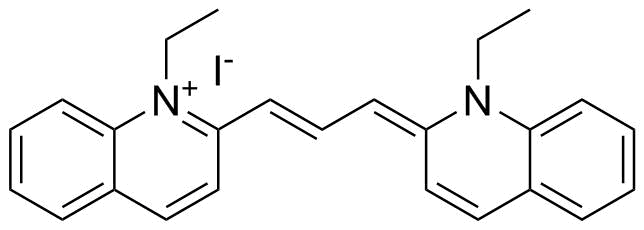 |
| Molecular Formula | C25H25IN2 |
| Molecular Weight | 480.38 |
| CAS Registry Number | 605-91-4 |
| EC Number | 210-099-4 |
| SMILES | CCN1/C(=C/C=C/C2=[N+](C3=CC=CC=C3C=C2)CC)/C=CC4=CC=CC=C41.[I-] |
| Melting point | 295 °C (Decomposes) (Expl.) |
|---|---|
| Hazard Symbols |  GHS06 Danger Details GHS06 Danger Details | ||||||||||||||||||||||||
|---|---|---|---|---|---|---|---|---|---|---|---|---|---|---|---|---|---|---|---|---|---|---|---|---|---|
| Risk Statements | H301-H311-H331 Details | ||||||||||||||||||||||||
| Safety Statements | P261-P262-P264-P270-P271-P280-P301+P316-P302+P352-P304+P340-P316-P321-P330-P361+P364-P403+P233-P405-P501 Details | ||||||||||||||||||||||||
| Hazard Classification | |||||||||||||||||||||||||
| |||||||||||||||||||||||||
| SDS | Available | ||||||||||||||||||||||||
 chemBlink Chemical Story
|
Carbocyanines are a class of synthetic organic dyes belonging to the broader family of cyanine compounds, characterized by two nitrogen-containing heterocyclic groups connected through a polymethine chain. In carbocyanines, the polymethine chain typically contains three conjugated carbon atoms, which is shorter than in higher cyanines such as dicarbocyanines or tricarbocyanines. This conjugated system is responsible for their strong light absorption and fluorescence properties. The development of cyanine dyes dates back to the nineteenth century, when early synthetic dye chemistry rapidly expanded following the discovery of aniline dyes and other coal-tar-derived colorants. Cyanine compounds were first studied for their intense coloration and unusual spectral properties. Carbocyanines emerged as a defined subclass through systematic variation of polymethine chain length and heterocyclic end groups, which allowed chemists to tune optical absorption across the visible spectrum. Carbocyanine dyes are typically composed of two heteroaromatic ring systems, such as indole, benzothiazole, or quinoline derivatives, linked by a conjugated trimethine bridge. The positive charge is delocalized across the conjugated system, giving rise to strong absorption bands and high molar absorptivity. This delocalization also contributes to fluorescence, making carbocyanines useful as fluorescent probes in a wide range of analytical and biological applications. One of the most important applications of carbocyanine dyes is in fluorescence microscopy and bioimaging. Their strong fluorescence and ability to be structurally modified allow them to function as fluorescent labels for nucleic acids, proteins, and cellular membranes. Certain carbocyanines are used as membrane potential indicators because their fluorescence properties can change in response to variations in cellular environment or membrane polarization. Carbocyanines are also widely used in molecular biology for nucleic acid staining. Some derivatives bind to DNA or RNA through intercalation or groove association, enabling visualization of genetic material under ultraviolet or visible light excitation. This property has made them valuable tools in gel electrophoresis and other analytical techniques where detection of biomolecules is required. The optical properties of carbocyanines can be finely tuned by modifying the heterocyclic end groups and the length or substitution pattern of the polymethine chain. Small structural changes can significantly shift absorption and emission wavelengths, allowing the design of dyes for specific spectral windows. This tunability is one of the reasons cyanine dyes remain important in modern photochemistry and imaging science. In addition to biological applications, carbocyanines have been investigated for use in optical recording media, solar energy conversion systems, and nonlinear optics. Their strong light absorption and efficient charge delocalization make them candidates for light-harvesting and photonic applications. However, many of these uses remain specialized and depend on specific structural modifications of the core carbocyanine scaffold. From a physicochemical perspective, carbocyanines are generally highly conjugated, planar cationic molecules. Their solubility and aggregation behavior depend strongly on substituents attached to the heterocyclic rings. In aqueous environments, some carbocyanines tend to form aggregates, which can alter their optical properties by shifting absorption bands or quenching fluorescence. This aggregation behavior is often exploited in sensing applications. The synthesis of carbocyanine dyes typically involves condensation reactions between quaternized heterocyclic compounds and polymethine precursors. These reactions allow stepwise construction of the conjugated chain and incorporation of desired substituents. The ability to systematically vary structure has contributed to the extensive library of carbocyanine derivatives available today. Overall, carbocyanines represent an important class of polymethine dyes with strong optical activity and broad utility in fluorescence-based technologies. Their significance lies in their tunable electronic structure, high absorption efficiency, and versatility as molecular probes in chemical, biological, and materials science applications. References 2025. In vivo two-photon FLIM resolves photosynthetic properties of maize bundle sheath cells. Photosynthesis Research. DOI: 10.1007/s11120-024-01135-0 2022. A quantitative high-throughput screen identifies compounds that lower expression of the SCA2-and ALS-associated gene ATXN2. The Journal of biological chemistry. URL: https://www.ncbi.nlm.nih.gov/pmc/articles/PMC9356275 |
| Market Analysis Reports |